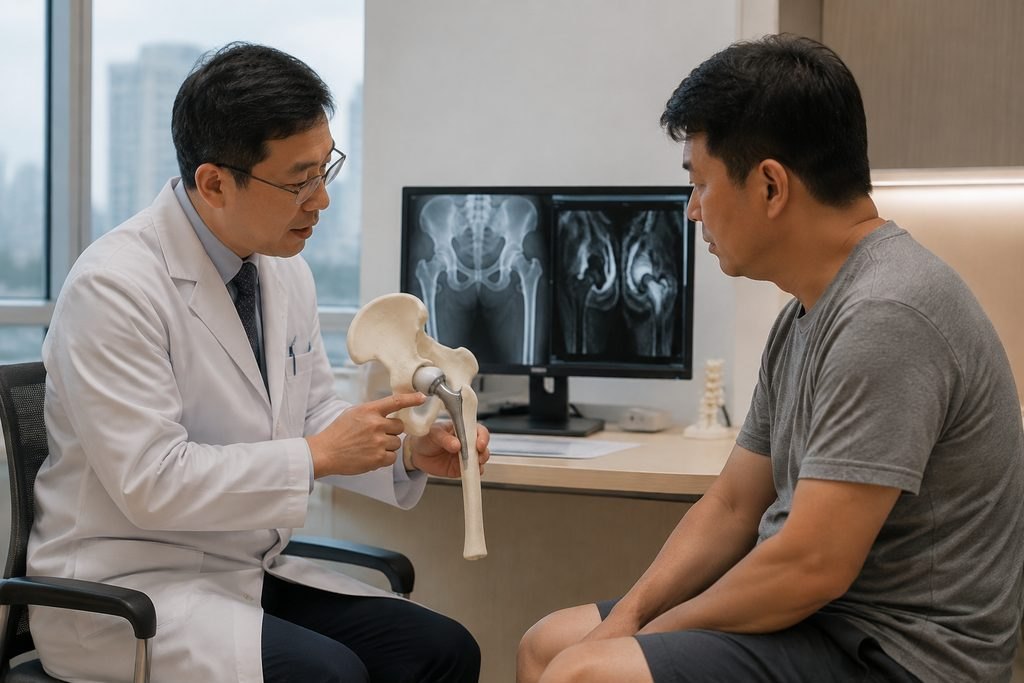
Why the preservation-versus-replacement question cannot be answered from an article
Hip avascular necrosis means bone in the femoral head has lost its blood supply. The femoral head can collapse, and the ball-and-socket joint can become damaged. How much has changed, and where, matters. A guide can explain what to ask, but it cannot decide for your hip.
Joint preservation and replacement are different kinds of decision. Preservation aims to keep your own joint, sometimes with procedures that support or reshape the femoral head. Replacement removes damaged ball-and-socket surfaces and puts in artificial components. The AAOS patient information on total hip replacement describes this replacement principle and notes that suitability is assessed individually.
That individual assessment is the point. Two people with the same diagnosis label can have different stages, different parts of the hip involved, different symptoms and different previous operations. The treating surgeon needs your actual imaging and history, not a general description.
What staging and imaging records a hip team needs to see
Staging is the language clinicians use to describe how far avascular necrosis has progressed. It usually depends on imaging, not on pain alone. If you do not know your stage, say so and send the images rather than guessing.
Ask the imaging provider for the actual image files, not only the written report. For hip avascular necrosis, that commonly means the MRI that shows the femoral head, plus any X-rays or CT scans you have had. Reports are useful, but a surgeon assessing preservation versus replacement needs to look at the images.
Also send the dates. An MRI from two years ago and one from last month may tell different stories. If your symptoms have changed since the last scan, mention when and how.
If you have had a previous hip procedure, include the operation note or discharge summary if you can obtain it. Previous surgery can change what is technically possible, and the new team should not have to infer it from a scar description.
- Diagnosis wording you were given, and whether it was confirmed on MRI.
- Stage, if a clinician has already assigned one, and the date of that assessment.
- Actual image files for hip MRI, X-ray and CT, with dates.
- Previous hip surgery or injection records, including operation notes if available.
- Current symptoms: pain location, what makes it worse, night pain, walking distance and aids used.
- Medicines and allergies, and other major health conditions.
Questions that turn a general opinion into a decision you can use
A useful consultation does not end with 'you need a replacement.' It should explain why one route is being suggested for your hip and what the alternatives would involve. Ask directly which findings on your imaging drive the recommendation.
Ask what joint preservation would mean in your case. It is not one procedure. It could involve different operations depending on the stage and the part of the bone affected. Ask what the goal would be, what recovery and follow-up would require, and what happens if it does not control the problem.
Ask what replacement would mean in your case. Total hip replacement replaces damaged ball-and-socket surfaces with artificial components, but the plan still depends on your bone quality, previous surgery and general health. Ask what type of components and approach the surgeon is considering, and why.
Ask what the team cannot yet tell from your records. If a clinician says more imaging or an in-person examination is needed before a firm plan, that is a real answer, not a delay tactic. It tells you what the next step is.
How to raise the question with a China orthopedic team
You do not need a complete medical archive to start. A short summary with your main question is enough for an initial enquiry. After first contact, you can be told how to share records securely.
When you write, lead with the decision you are trying to make. For example: 'I have hip avascular necrosis. I want to understand whether joint preservation is still possible for me, or whether replacement is more appropriate. I have MRI images from [date] and a previous hip operation in [year].' That gives the team something concrete to route.
Ask whether the first response will be a non-clinical intake review or a clinician's records-based opinion. These are different. Intake checks whether your question and records match a relevant service. A records-based opinion involves a clinician looking at your material. Neither one confirms hospital acceptance or a final surgical plan.
If you are considering a proxy consultation, treat it as optional. It can be useful when you want a records-based view before travelling, but it is not a prerequisite for every appointment. An initial enquiry does not require buying a proxy consultation.
What a reply can and cannot confirm
A records-based reply can help you understand the range of options, what records are missing and what questions to ask next. It may say that preservation looks worth assessing, that replacement seems more likely, or that the images are not sufficient to say. All three are useful outcomes.
It can also tell you which findings on your imaging the clinician is weighing, and which of your symptoms or prior procedures change the picture. That reasoning is the part worth reading closely, because it shows you what a later in-person assessment would need to confirm.
A reply cannot confirm final eligibility, hospital acceptance, a named surgeon or a clinical outcome. Suitability is assessed individually by the treating team. If you are told a plan is 'provisional pending examination,' that is the honest status.
Ask what would change the recommendation. If a surgeon says preservation is worth assessing now but replacement would become more likely if the femoral head collapses further, that tells you what the follow-up interval is for and why repeat imaging may be requested. If the reply instead says the images are not sufficient, ask which specific views or sequences are missing.
Costs are also not settled by a general reply. Hospital fees, clinician fees, imaging, implants and ward type are separate from any coordination service. Ask the named hospital or provider for a written quote that lists what is included and what is not. Do not rely on a range from a website or another patient's experience.
If you receive two different opinions, do not treat that as a reason to stop. Ask each clinician which imaging finding or clinical feature drives their view. A disagreement about timing, about whether preservation is still worth attempting, or about which procedure fits is common enough that the reasoning matters more than the label.
Keep the reply with your imaging files. If you later see a local orthopaedic surgeon, or travel to China for an in-person assessment, that written reasoning gives the next clinician a starting point rather than a blank sheet.
If a step cannot be completed, what to do next
Sometimes you cannot get the original MRI files, or the previous operation note is not available. Say that clearly instead of sending nothing. The team can tell you whether the records you have are enough for a useful discussion or whether a new scan would be needed. Do not arrange new imaging on your own before a clinician has said what is required.
If your pain is worsening, you cannot bear weight, or you have new symptoms, seek local medical assessment rather than waiting for an overseas reply. An enquiry about care in China should not delay necessary local care.
If you want help with records, interpretation or requesting a specialist appointment, ChinaSpecialistCare can coordinate those non-clinical steps. Clinical assessment, prescriptions and treatment decisions remain with the treating hospital and licensed clinicians.
The practical next step is to write a short summary: your diagnosis, stage if known, dates of imaging, previous hip procedures and the one question you most need answered. Send it through the enquiry form, email or WhatsApp. An initial enquiry is free, and it does not commit you to any treatment or purchase.
Sources & scope of this guide
References and official service information relevant to this guide.
This is general planning information and has not been individually reviewed by a doctor. Medical decisions and personal treatment advice come from your treating clinicians.