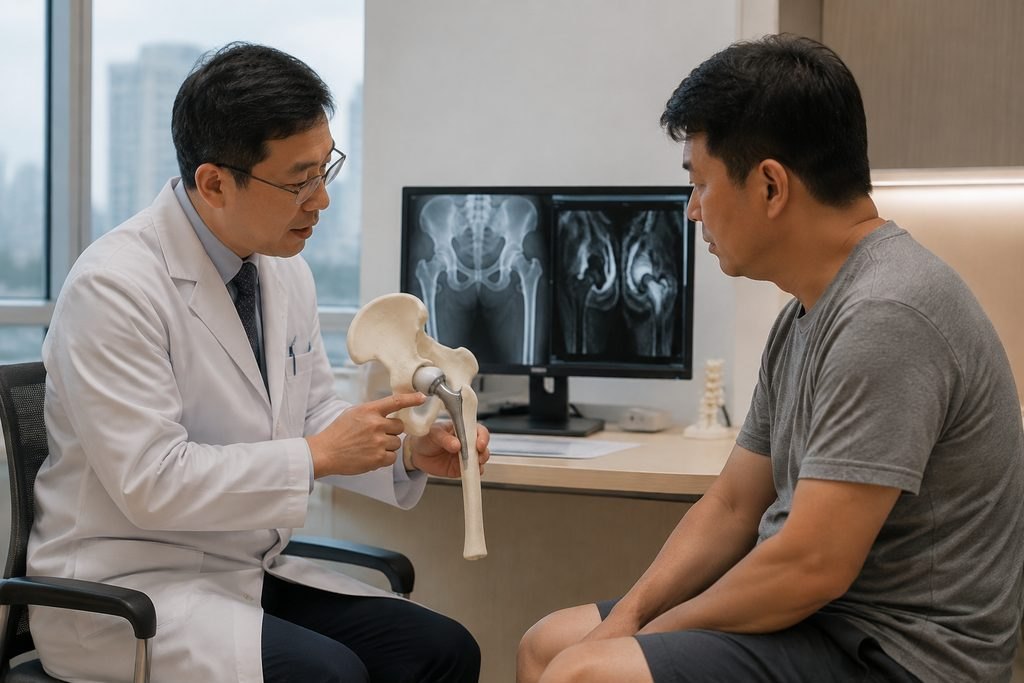
Why the stage and imaging records change the decision
Hip avascular necrosis, also called osteonecrosis of the femoral head, is a condition where bone tissue in the femoral head loses its blood supply and may collapse. The stage describes how far that process has progressed. A report that says only 'AVN of the hip' without a stage or imaging description leaves the treating clinician unable to judge whether the femoral head is still intact, partially collapsed or severely damaged.
That distinction matters because the range of options differs. Some patients with early, preserved joint surfaces may be assessed for joint-preserving procedures. Others with advanced collapse or secondary arthritis may be assessed for total hip replacement, in which damaged ball-and-socket surfaces are replaced with artificial components. Suitability for any option is assessed individually by the treating team.
For an overseas enquiry, the practical question is not 'which operation do I need?' but 'does my report give the specialist enough to understand my stage and anatomy?' If the stage is missing, the imaging description is vague, or the report does not mention the opposite hip, the first reply may be a request for more records rather than a treatment plan.
What a complete diagnosis report should contain
A report that supports a meaningful review usually includes several specific items. The affected side should be stated clearly, because AVN can affect one or both hips and the management question differs. The stage should be recorded using the system your diagnosing clinician used, with the date of that assessment. Imaging findings should describe the femoral head contour, whether there is flattening or collapse, and whether the joint space is preserved or narrowed. If a previous hip procedure has been performed, the report should describe what was done and how it may affect future surgery.
The report should also identify the imaging studies themselves: which modality was used, when it was performed, and where the images or reports can be obtained. A written report without the actual images may be enough for an initial conversation, but a surgeon assessing surgical options may need the images or a radiology review. Ask your imaging provider how to obtain a copy in a format the receiving hospital can open.
If the report mentions a cause, such as steroid use, alcohol-related factors, trauma or an underlying condition, that context belongs in the summary you send. It does not replace the stage and imaging description, but it helps the treating team understand the overall picture.
Previous hip procedures and why they matter
A history of hip surgery changes how a new specialist reads the imaging. Previous procedures may include core decompression, bone grafting, a previous joint replacement, or surgery for a fracture. Each can alter the shape of the femoral head, the condition of the bone stock, and the options that remain. A report that lists the diagnosis but omits the surgical history leaves the treating clinician to work with an incomplete picture of the hip they are being asked to assess.
If you have had a previous hip replacement, the report should state the type of components, the date of surgery, and whether there are signs of loosening, wear or infection. If you have had joint-preserving surgery, the report should describe what was done and whether the procedure has failed or is still being monitored. This is not a detail the treating team can safely assume, because a hip that has already been operated on behaves differently from an untouched one, and the range of options may narrow or shift accordingly.
When you prepare your records, include the operative notes if you can obtain them, not only the imaging reports. Operative notes describe what was actually done, which may differ from what the imaging alone suggests. If the notes are unavailable, say so clearly rather than leaving the history blank. A clear statement that the operative record is missing is more useful than silence, because the treating team can then tell you whether they need it before forming a view.
It also helps to separate what you know from what you are assuming. If you were told years ago that you had a procedure but cannot recall its name, write that down as an open question rather than guessing. The treating clinician can often infer a good deal from the imaging, but they should be told which parts of the history are uncertain so they can weigh the records accordingly.
One practical step is to request a short surgical history summary from the hospital where the previous procedure was performed, even if the full notes take longer to arrive. A dated summary naming the procedure and the side operated on gives the reviewing clinician a starting point and flags what still needs to be obtained. This is a records task, not a clinical one, and it can proceed while you wait for other documents.
Joint preservation versus replacement: what the records help clarify
The choice between joint-preserving treatment and hip replacement is a clinical decision that depends on the stage, the condition of the femoral head, the patient's symptoms and overall health, and the treating surgeon's assessment. Records help clarify which options are even worth discussing. They do not determine the answer on their own.
For early-stage disease with a preserved femoral head, a clinician may consider procedures intended to preserve the joint. For advanced collapse or significant arthritis, total hip replacement may be the more relevant discussion. The AAOS patient information on total hip replacement explains that the procedure replaces damaged ball-and-socket surfaces with artificial components and that suitability is assessed individually. That individual assessment is exactly why the stage and imaging records matter.
A useful question to ask the treating team is: 'Based on these records, which options are worth assessing further, and what additional information would you need?' This keeps the conversation focused on the decision rather than on a procedure name chosen in advance.
Preparing records for a China specialist review
For an initial enquiry, a brief summary is enough to start. You do not need to send a complete medical archive before anyone has looked at your case. A short summary should include the diagnosis, the affected hip, the stage if known, the date and type of the most recent imaging, any previous hip procedures, your main symptoms, and your main question.
After first contact, you can be guided on how to share the actual reports and images. If a records-based specialist opinion is arranged, the clinician reviews the available documents and explains what can and cannot be concluded from them. That opinion is not a final treatment plan and does not guarantee hospital acceptance. The hospital makes its own assessment after reviewing your records and, where relevant, examining you.
If your records are incomplete, that is not a reason to delay urgent local care. Worsening pain, inability to bear weight, fever or other acute symptoms need local medical assessment. An overseas enquiry can proceed in parallel, but it should not replace timely local evaluation.
Questions to ask before you commit to a plan
Before agreeing to travel or treatment, ask the treating team specific questions. What stage does the report describe, and does the team agree with that staging? What imaging would they want to see, and in what format? Based on the records, which options are being considered, and what would make one option more suitable than another? What does the written estimate include, and what remains undecided until after an in-person assessment?
Also ask how the team will communicate findings and whether an interpreter is needed for the consultation. If you are considering a records-based opinion first, ask what the clinician can and cannot assess without an examination. These questions are not a substitute for the treating team's judgement; they are how you understand the basis of that judgement.
ChinaSpecialistCare can help you organise records, clarify your main question and identify the relevant next step. An initial enquiry is free and does not require buying a proxy consultation. You can start with a short summary through the enquiry form, email or WhatsApp, and the team will explain how to share records after first contact. The hospital decides suitability, and coordination fees are separate from hospital charges.
Sources & scope of this guide
References and official service information relevant to this guide.
This is general planning information and has not been individually reviewed by a doctor. Medical decisions and personal treatment advice come from your treating clinicians.