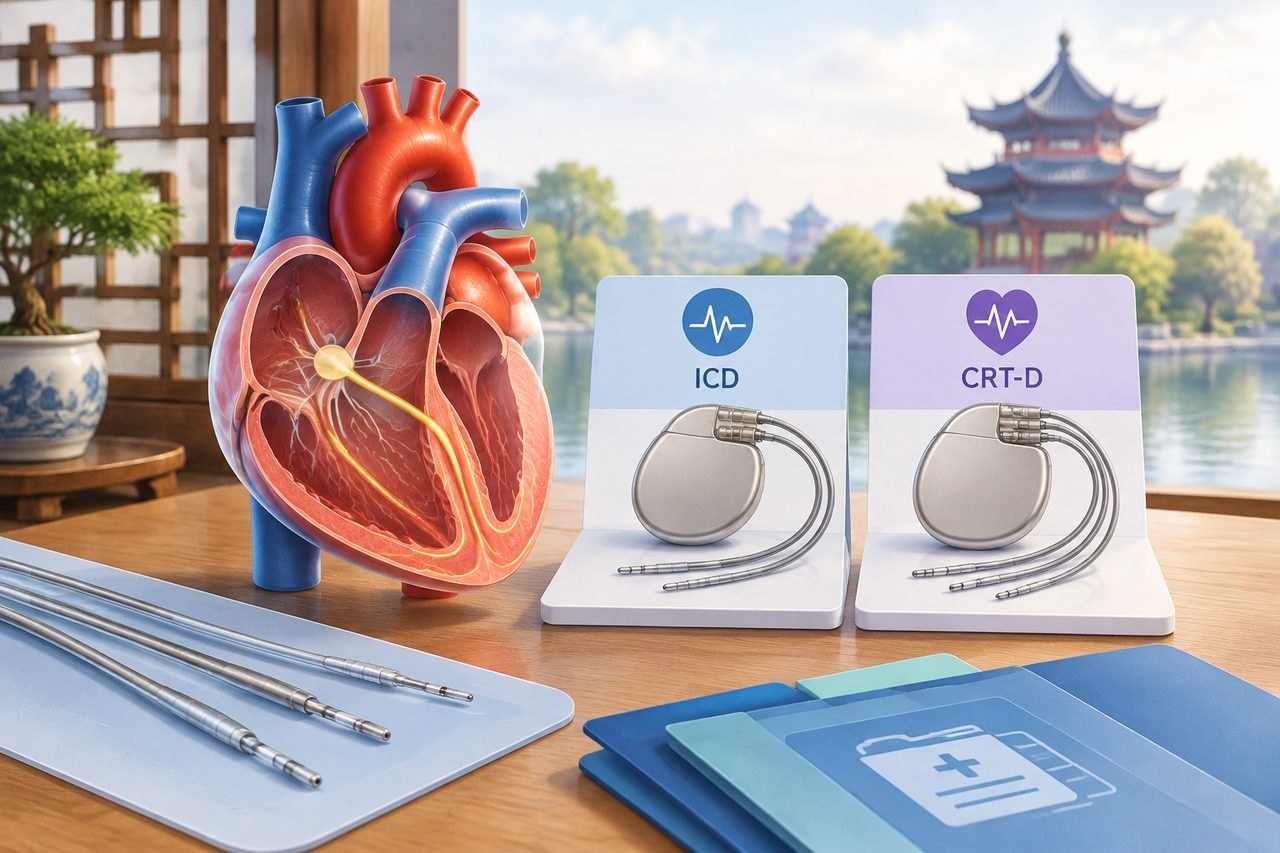
What device indication actually means
An implantable cardioverter defibrillator (ICD) treats dangerous heart rhythms. A cardiac resynchronisation therapy defibrillator (CRT-D) also supports coordinated pumping. These device labels are not interchangeable, and the clinical reasoning behind choosing one over the other is what clinicians call the indication.
Indication is not a product preference. It is a conclusion drawn from your diagnosis, your heart's pumping function, your rhythm history, your symptoms and your response to other treatments. Two patients with the same label on a discharge summary can have different indications, because the underlying problem and the treatment goal differ.
For an overseas patient, this matters because the device decision is not something you select from a catalogue. It is a clinical judgement that the receiving hospital makes after reviewing evidence. Your job before travel is to understand what that judgement depends on, so you can supply the right records and ask the right questions.
Why ICD and CRT-D are not the same decision
An ICD is indicated when the main concern is a dangerous ventricular rhythm that could cause sudden cardiac arrest. The device monitors the heart and can deliver therapy when it detects such a rhythm. The decision rests on whether your history and test results put you in a category where that protection is appropriate.
A CRT-D is indicated when there is also a problem with the heart's electrical coordination, so the chambers do not pump together efficiently. The device adds a pacing function intended to improve that coordination, alongside defibrillation capability. Not every CRT device includes a defibrillator, and not every patient who needs rhythm protection also needs resynchronisation.
This distinction changes what you should ask. For a possible ICD, the question is whether your rhythm risk justifies the device. For a possible CRT-D, there is a second question: whether your heart's electrical pattern and pumping function suggest that resynchronisation would help. The hospital must confirm both.
The records that let a hospital assess indication
A hospital cannot assess device indication from a brief description. It needs the evidence behind your diagnosis. Which records are relevant depends on your case, but the clinical team will want to see the documents that show how your heart rhythm and heart function have behaved over time. The purpose is not to build a complete file for its own sake. It is to give the reviewing clinician enough to judge whether your history fits a recognised indication, and to identify what is still unclear.
Start with the rhythm evidence. An ICD or CRT-D decision turns on whether a dangerous ventricular rhythm has been documented, and how often. Holter reports, event-monitor downloads and ECG tracings that show the actual rhythm are more useful than a summary sentence. If your records describe an arrhythmia without the underlying tracing, say so, because the hospital may want to know whether the tracing exists elsewhere.
Heart function evidence matters just as much. Echocardiogram reports with measurements, and any cardiac MRI or nuclear study, show how the heart is pumping and whether its electrical pattern is coordinated. These are the measurements that separate a possible ICD indication from a possible CRT-D indication. A report that states a diagnosis without the numbers behind it leaves the reviewing team unable to confirm the reasoning.
The underlying heart condition also needs to be visible. Coronary angiography, stress testing or structural imaging explains why the rhythm problem exists and whether another treatment should come first. Treatment history belongs in the same summary: current and previous cardiac medicines, ablation procedures, and any prior device or lead information. If you already have a device, the model and lead details are relevant to any revision discussion.
Ask your current cardiology team what they can provide in English or with translation. You do not need to assemble a complete archive before making an initial enquiry. A short summary of the diagnosis and the main question is enough to start, and the coordinator can explain what to send next. A useful first message names the diagnosis, the rhythm problem if known, the current treatment, and the specific question your cardiologist wants answered.
If some records are missing, that is a question to raise rather than a reason to delay local care. Tell the receiving team what is unavailable and ask whether they need it repeated or whether existing evidence is sufficient for a records-based view. Do not assume that a missing report blocks the enquiry, and do not assume that the hospital will arrange a replacement test without telling you. Ask which items it considers necessary and which it can proceed without.
Keep the summary short and factual. A one-page chronology of diagnoses, procedures, medicines and test dates is easier for a reviewing clinician to use than a folder of unsorted scans. If translation is needed, ask whether the hospital accepts translated summaries or requires the original documents alongside them. That is an administrative question the coordinator can help you clarify before you send anything.
- Rhythm documentation: Holter or event-monitor reports, ECG tracings, and any record of ventricular arrhythmia.
- Heart function assessment: echocardiogram reports with measurements, and any cardiac MRI or nuclear study.
- Coronary and structural evaluation: angiography, stress testing or other imaging that explains the underlying heart condition.
- Treatment history: current and previous cardiac medicines, ablation procedures, and any prior device or lead information.
- Clinical summary: your symptoms, functional capacity, and the specific question your cardiologist wants answered.
Questions that clarify the proposed system
Once a hospital has reviewed your records, the discussion moves from whether a device is indicated to which system is proposed. This is where overseas patients can lose track, because the language of device selection is technical and the assumptions are rarely explained.
Ask which device and which leads are proposed, and why that configuration fits your indication. Ask whether a defibrillator function is included, and whether resynchronisation is part of the plan. If the answer is that the decision depends on further testing, ask which test and what it would change.
Ask how the device would be programmed initially and what follow-up checks would involve. Remote monitoring is not universally compatible with every device or every location, so ask whether it is available for the proposed model and how it would work from your home country. Ask whether MRI access would be possible with the proposed device, because not every device is approved for every imaging setting.
These are not challenges to the clinician's judgement. They are the practical details that determine whether a device plan can be carried out safely across two health systems.
What indication review does and does not establish
A records-based review can clarify whether your history fits a recognised indication for an ICD or CRT-D. It can identify missing information and help you prepare focused questions. It does not establish that the hospital will accept you for implantation, that a particular device is available, or that the procedure is suitable for you.
Suitability is decided by the treating hospital after it has the records and, where needed, its own assessment. An initial enquiry is free and does not commit you to a proxy consultation or any paid service. If a proxy consultation is offered, it is optional and is not a prerequisite for an appointment.
Be cautious about any statement that a device is definitely appropriate before the hospital has reviewed your case. Indication is a clinical conclusion, and it can change when new information appears or when the treating team applies its own assessment.
Follow-up planning belongs in the same conversation
Device implantation is not a single event. After implantation, the device needs programming checks, battery monitoring and rhythm review. For an overseas patient, the practical question is how that follow-up would be shared between the hospital in China and your cardiology team at home.
Ask the hospital how it would coordinate programming, remote monitoring and later device checks. Ask what information it would send to your local team and what your local team would need to take over routine follow-up. Ask what you should do if the device delivers therapy or if you notice new symptoms after you return home.
These questions do not have a single answer that applies everywhere. They depend on the device, the hospital's follow-up arrangements and your local health system. The point is to have the conversation before the procedure, not after.
A useful next step is to send a short summary of your diagnosis and the specific question your cardiologist wants answered. The ChinaSpecialistCare team can review what you have, identify missing information and suggest the relevant next step. You can start with the enquiry form, email or WhatsApp, and you do not need to send a complete medical archive at first contact.
Sources & scope of this guide
References and official service information relevant to this guide.
This is general planning information and has not been individually reviewed by a doctor. Medical decisions and personal treatment advice come from your treating clinicians.