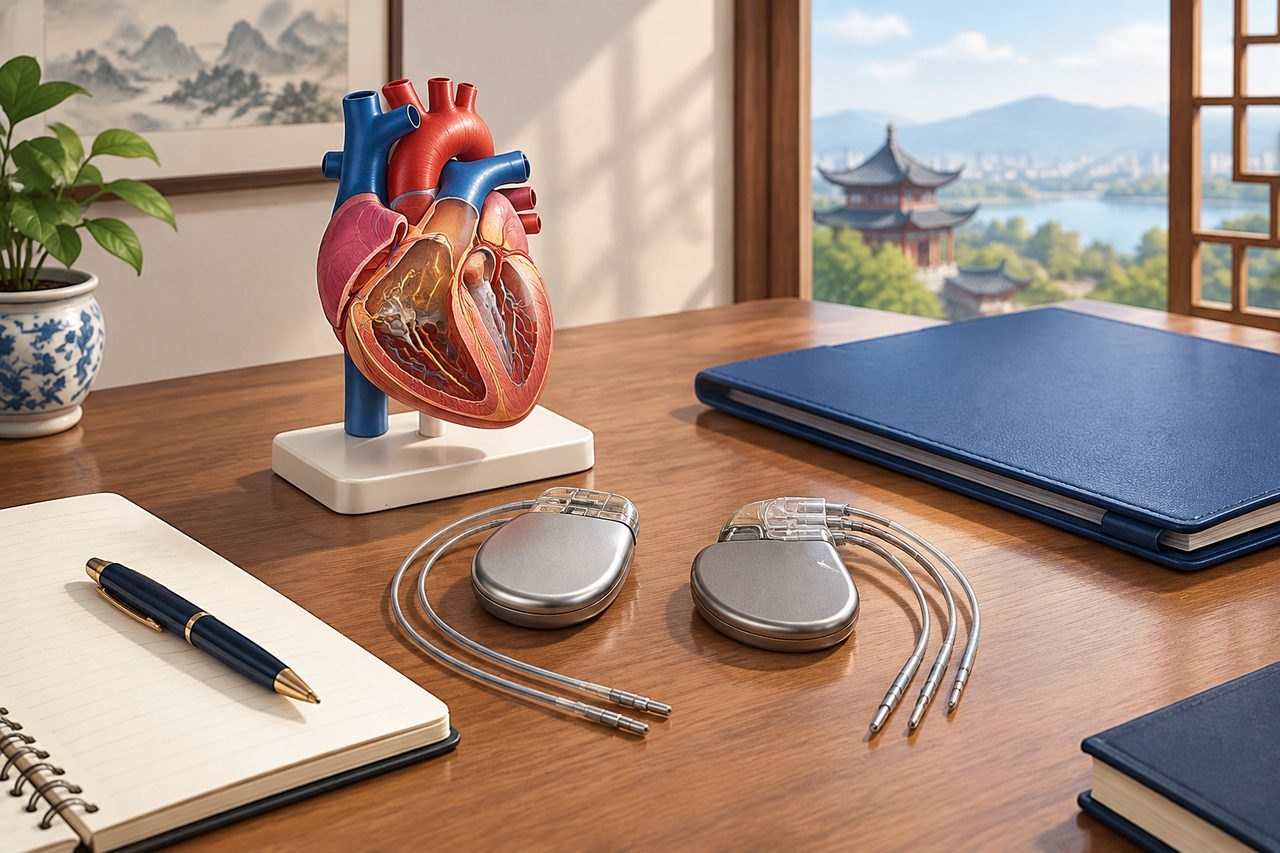
What an ICD is actually for
An implantable cardioverter defibrillator is a small device placed under the skin, with leads that connect to the heart. Its purpose is to detect and treat dangerous heart rhythms. That is a narrower job than many patients assume. It is not a treatment for blocked arteries, a faulty valve, or the underlying muscle problem that may have caused the rhythm risk in the first place. Those need their own assessment and their own decisions.
This distinction matters when you are deciding whether to travel for care. If your main question is 'will this fix my heart failure symptoms?', the honest answer is that an ICD is not designed to do that. It is designed to reduce the risk that a dangerous rhythm becomes fatal. A clinician may still recommend one alongside other treatment, but the goals are separate and should be discussed separately.
The device also does not remove the need for medication, lifestyle changes, or follow-up. It adds a layer of protection. It does not replace the rest of the plan.
What CRT adds, and why the labels are not interchangeable
Cardiac resynchronisation therapy is a different job. It uses leads to help the lower chambers of the heart contract in a more coordinated way. It is considered for selected patients with heart failure and a specific electrical pattern on ECG. The goal is to improve how the heart pumps, not to shock a dangerous rhythm.
Here is where confusion creeps in. Some devices combine both functions. A CRT-D includes defibrillation. A CRT-P does not. If someone tells you 'I have a CRT', that does not tell you whether the device can also deliver a shock. The letters after the name matter, and they change what the device can and cannot do.
So when you ask about 'a CRT device', you are asking an incomplete question. The useful question is: which specific device and which leads are proposed, and why that combination rather than another? Ask for the full device name, not a shorthand. Ask whether defibrillation is included. Ask what the alternative would be if you chose a different configuration. These are reasonable questions, and a treating team should be able to explain the reasoning in plain terms.
What neither device can solve
Neither an ICD nor a CRT device reverses the underlying heart disease. If the heart muscle is weakened, the device does not restore it. If there is a valve problem or blocked arteries, the device does not open or repair them. Those issues need their own evaluation and their own treatment decisions.
Neither device removes the need for medication. Neither device guarantees you will never have a dangerous rhythm or a worsening of symptoms. A device can fail to terminate a rhythm, can deliver therapy that is inappropriate, and can be affected by infection, lead problems, or battery depletion over time. These are real device-related risks, not just logistics. The treating team should explain them, and you should feel able to ask about them directly.
Neither device is right for everyone. Suitability depends on your diagnosis, your heart function, your ECG pattern, your other conditions, and your own goals. A device that helps one patient may offer little to another. This is why a records-based review is a starting point, not a final answer.
Why individual differences change the decision
Two patients with the same label, 'heart failure', can have very different device decisions. One may have an electrical pattern that makes CRT likely to help. Another may not. One may have a rhythm risk that makes defibrillation worth considering. Another may not. Age, other illnesses, kidney function, and prior procedures all feed into the assessment.
This is not a reason to feel that the decision is arbitrary. It is a reason to make sure the assessment is based on your actual records, not on a general description of the device. If a hospital or coordinator offers a device recommendation before seeing your ECG, echo, and history, that recommendation is provisional at best.
It also means that a second opinion is not an insult to the first team. It is a way of checking that the proposed device matches your specific situation. If you are considering care in China, the useful first step is to have your records reviewed by a clinician who can say whether a device is even the right conversation to be having.
Questions to ask before agreeing to a device
The device decision is not only about which box is implanted. It is also about how the device will be checked afterwards, how programming will be adjusted, and who will respond if something changes. These are practical questions that affect whether travelling for the procedure makes sense for you.
Ask which specific device and leads are proposed, and why. Ask whether the proposed device includes defibrillation, and what the alternative would be. Ask what the plan is for programming the device after implantation, and how that programming would be adjusted over time. Ask how remote monitoring would work, if it is proposed, and whether it is compatible with your home country. Ask how later device checks would be coordinated once you return home, and who would be responsible for them. Ask what the written plan says about follow-up intervals and what triggers an earlier review.
Ask about MRI compatibility if that matters for your future care. Not every device is MRI-conditional, and the answer depends on the specific model and leads. Ask about the risks the team considers most relevant in your case, and how they would be managed. Ask what would happen if the device delivered therapy you did not expect.
If you are comparing hospitals, ask each one the same questions and compare the answers, not just the device name. A plan that does not address follow-up is incomplete, regardless of where the procedure happens.
How to prepare records and what to confirm next
A useful review starts with your actual cardiac records. These typically include recent ECG tracings, an echocardiogram report, any Holter or event monitor results, your current medication list, and a summary of your symptoms and how they have changed. If you have had a coronary angiogram, a stress test, or a prior device, include those reports as well. A short summary of your main question helps the team focus the review.
You do not need to send a complete archive at first contact. A brief summary and the key reports are enough to start. After that, the team can tell you what else is needed. This keeps the first step manageable and avoids sending sensitive documents before there is a clear reason.
What you should not expect from an initial review is a final decision. A records-based opinion can indicate whether a device is worth discussing, what information is missing, and what questions to bring to a consultation. It cannot confirm that a procedure will go ahead, that a particular device will be used, or that you are a suitable candidate. Those decisions belong to the treating hospital and its clinicians, after they have assessed you directly.
If your symptoms are worsening, or if you have had fainting, chest pain, or sustained palpitations, seek local medical assessment first. An overseas enquiry should not delay urgent care. Once your situation is stable and you are thinking about options, you can start with a free initial review. Our team checks the available diagnosis, records, and your main question, identifies what is missing, and suggests a relevant next step. That is not a diagnosis or a promise of acceptance. You can begin with a short summary by the enquiry form, email, or WhatsApp, and share records after first contact.
For the procedure itself, the relevant reference page is ICD and CRT devices, which explains the implantation context. Use it alongside this article rather than instead of it.
Sources & scope of this guide
References and official service information relevant to this guide.
This is general planning information and has not been individually reviewed by a doctor. Medical decisions and personal treatment advice come from your treating clinicians.