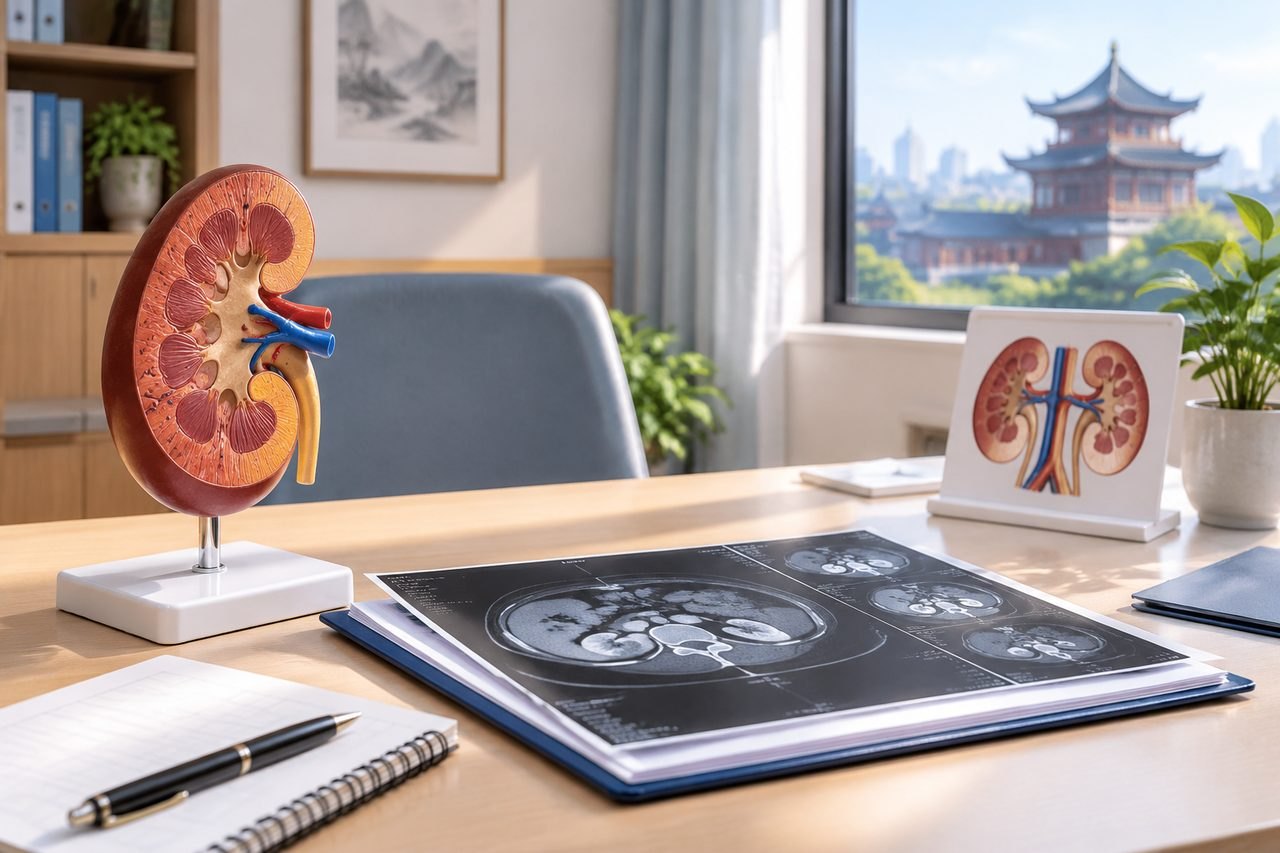
Why the partial-versus-radical question belongs to your clinical team
Partial nephrectomy removes part of a kidney. Radical nephrectomy removes the whole kidney. Both are established operations for kidney tumours, but they are not interchangeable choices that a patient can select from a description. The proposed approach depends on the lesion and on an assessment of the kidney, and that assessment is specific to your imaging, your kidney function and your overall health.
This is why the useful question is not 'which operation is better?' but 'which operation is being proposed for me, and on what evidence?' A urologist who has reviewed your scans, blood tests and history can explain the reasoning. A website, including this one, cannot. The hospital decides suitability, and the treating clinician decides what to recommend.
Your job before travelling is to make that clinical conversation possible. That means assembling the records a urology team needs, understanding what each record shows, and preparing questions that force a clear answer rather than a general one.
The records that make a partial-versus-radical discussion concrete
A urology team cannot discuss partial versus radical surgery in the abstract. The discussion becomes concrete when the team can see the tumour and the kidney. Ask your current clinicians for the actual imaging files, not only the written report. Cross-sectional imaging of the abdomen, with the images themselves, lets a surgeon assess the lesion's size, position and relationship to the collecting system and major vessels.
Kidney function records matter just as much. Serum creatinine, estimated glomerular filtration rate and any nuclear medicine split-function study tell the team how much working kidney you have and how much you would lose. If you have had previous kidney surgery, stones, obstruction or a solitary kidney, say so explicitly and provide those records. Previous procedures change the anatomy and the operative plan.
Pathology records matter if a biopsy or previous surgery has already been performed. A pathology report with the tumour type and grade, and the original slides or blocks if review is possible, gives the team information that imaging alone cannot. If no biopsy has been done, that is a question for the clinician, not a gap you need to fill yourself.
Write a one-page summary in English: your diagnosis or suspected diagnosis, the date of first detection, the imaging performed, your kidney function results, previous kidney procedures, current medicines and allergies, and your main question. This summary is not a substitute for the records, but it helps a coordinator route your case and helps the clinician see the shape of the problem quickly.
Questions that turn a general answer into a decision you can act on
Ask the urologist to state the proposed operation in plain terms: partial nephrectomy, radical nephrectomy, or a decision that will be made during surgery. Then ask what specific features of your imaging and kidney assessment support that proposal. If the answer is vague, ask what additional information would make the recommendation clearer.
Ask what the alternatives are and why they are not preferred in your case. Ask what the expected effect on kidney function is, and what the plan is if kidney function declines. Ask whether the tumour's position makes partial removal technically feasible, and what the surgeon would do if it is not. These are clinical judgements; the point of the questions is to hear the reasoning, not to override it.
Ask who will make the final decision and when. In some cases the plan is confirmed before surgery; in others the surgeon decides intraoperatively based on what is found. You are entitled to know which situation applies to you, and what that means for consent.
Ask about the recovery and follow-up plan in general terms, and ask the clinician to confirm what applies to you rather than relying on a general timeline. Do not accept a fixed number of days for hospital stay or return to activity from a non-clinical source.
What a records-based opinion can and cannot settle before you travel
A records-based opinion from a Chinese urology specialist can review your imaging, kidney function and pathology, explain how the case looks to that team, and indicate what further assessment might be needed. It can help you decide whether travelling to China for treatment is worth pursuing. It does not establish final eligibility, hospital acceptance or a guaranteed operation.
If you request a specialist appointment or a records review through a coordination service, be clear about what you are asking for. A non-clinical intake can check that your records are complete enough to route, identify missing items and suggest a next step. A clinical opinion requires a licensed specialist reviewing the actual records. These are different services with different limits.
Do not treat a preliminary reply as a surgical plan. A coordinator can confirm that a hospital has received your file and that an appointment has been requested. Only the treating hospital can confirm acceptance, scheduling and the proposed operation. If a reply says the case 'looks suitable for partial nephrectomy', ask who reviewed the images and whether that opinion is preliminary or definitive.
Practical preparation for a urology appointment in China
Once an appointment is confirmed, prepare the records in a form the hospital can use. Imaging on discs or a secure transfer link, pathology slides if requested, and translated summaries of key reports reduce the chance of a wasted visit. Ask the hospital or your coordinator what format and language they need before you travel.
Prepare your questions in writing and bring them to the appointment. Ask about the proposed operation, the evidence behind it, the alternatives, the effect on kidney function, the plan for follow-up and what you should do if symptoms worsen before surgery. Ask who to contact with questions after the appointment.
Do not delay necessary local care while pursuing an overseas enquiry. If you have blood in the urine, severe pain, fever or rapidly worsening symptoms, seek local assessment first. An overseas planning process is not an emergency route.
If you need help with records, interpretation or a specialist appointment request, a coordination service can assist with those practical steps. It does not prescribe, decide suitability or promise that a particular operation will be offered.
Next step: ask for a records-based discussion, not a decision from an article
The next step is to gather your imaging, kidney function results, pathology and a short summary of previous kidney procedures, then ask a urology team to explain which operation is proposed for you and why. If you want to explore care in China, you can start with a free initial enquiry that checks whether your records are complete enough to route to a relevant specialist. You do not need to purchase a proxy consultation to make that first enquiry.
Keep the clinical decision with the treating team. Your role is to provide accurate records, ask direct questions and understand the reasoning before you consent to any operation.
One more thing is worth doing before you send anything: write down the single question you most need answered. For most people weighing partial against radical surgery, it is some version of "why this operation for this tumour in this kidney?" A coordinator can route a file, but only the treating urologist can answer that question. If the first reply you receive does not address it directly, ask again and ask who reviewed the images.
It also helps to decide in advance what would make you travel and what would not. If a records-based discussion leaves the partial-versus-radical question open, that is not a failure of the process; it may simply mean the decision depends on findings that only surgery will show. Knowing that in advance stops a preliminary reply from being read as a final plan.
Finally, keep a copy of everything you send. Imaging discs, pathology slides and translated summaries can be requested again, but having your own set makes a second opinion or a follow-up appointment faster. Store the records together with your written questions and the names of the clinicians you have spoken to, so that any later discussion starts from the same information rather than from memory.
Sources & scope of this guide
References and official service information relevant to this guide.
This is general planning information and has not been individually reviewed by a doctor. Medical decisions and personal treatment advice come from your treating clinicians.