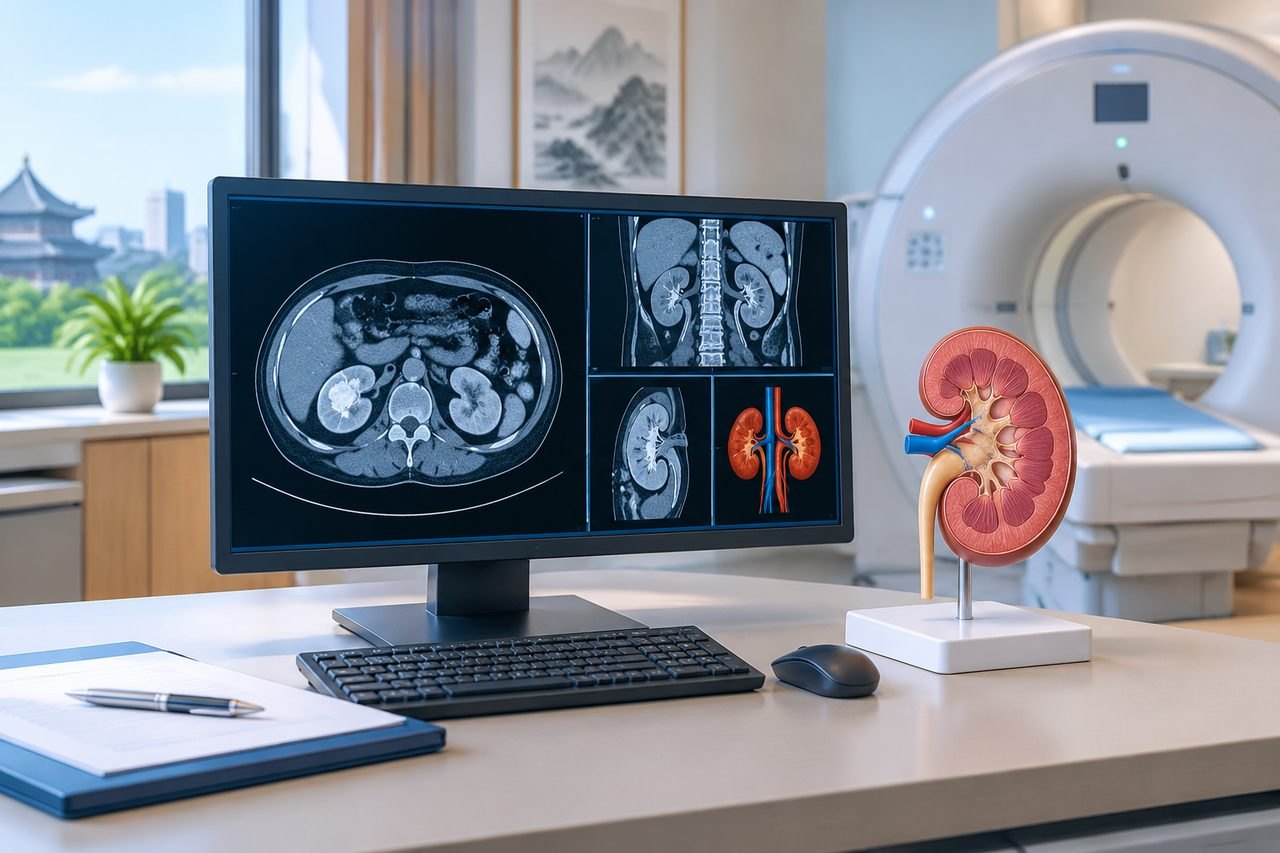
Why staging comes before a decision about kidney removal
Nephrectomy is surgery to remove a kidney. It can be performed for cancer or other serious kidney problems. When cancer is the reason, the operation is only one part of the plan. Staging answers a different question from diagnosis: not simply whether a tumour is present, but how far it has extended and whether it has reached structures or organs beyond the kidney. That distinction changes what a surgeon needs to remove, what other specialists should be involved, and what the patient should understand before agreeing to surgery.
For an overseas patient, staging is also the practical bridge between a home-country diagnosis and a decision about care in China. A hospital cannot judge whether whole-kidney removal is suitable from a brief message or a single report. It needs the imaging and pathology that establish stage, plus enough information about the other kidney and the patient's general health. Without that, any reply is provisional.
This guide does not repeat the full kidney removal procedure reference. It focuses on one decision: how staging information shapes whether radical nephrectomy is the right operation, and what a patient should prepare and ask before travelling.
What staging records actually contain
Staging is not a single number. It is a summary built from imaging, sometimes biopsy, and after surgery, the pathology report on the removed kidney. Each source contributes different information, and a receiving team will want to see the original images or reports rather than a translated summary alone.
Imaging such as CT or MRI shows the size and position of the tumour, its relationship to the kidney's blood vessels, and whether there are signs of spread to lymph nodes or distant organs. A chest scan is often part of this assessment because the lungs are a common site where kidney cancer can spread. The exact scans requested depend on the clinical question, and the treating team decides which are needed.
Pathology describes what the tumour is made of, its grade, and whether the margins and sampled lymph nodes show involvement. If a biopsy was taken before surgery, that report matters too. If no biopsy has been done, the team may still proceed on imaging alone, but they will want to know why.
Blood tests and a kidney function assessment are separate from staging but equally important. They show how well each kidney is working, which directly affects whether removing one whole kidney is safe for that patient.
A useful way to think about the file is that staging records answer 'how far has this gone', while kidney function records answer 'can this patient afford to lose one kidney'. Both are needed before a responsible surgical plan can be discussed.
How staging changes the surgical approach
Staging influences whether the plan is partial nephrectomy, removing only the tumour and sparing the rest of the kidney, or radical nephrectomy, removing the whole kidney. A small, confined tumour in a patient with two working kidneys may be suitable for partial removal. A larger tumour, one involving major blood vessels, or one in a kidney that is already not functioning may point toward whole-kidney removal.
Staging also affects whether other treatments are discussed before or after surgery. If imaging suggests spread beyond the kidney, the team may want to consider systemic therapy or other options, and surgery may not be the first step. This is not a decision a patient should make from a staging number alone. It requires a clinician who has reviewed the images and the full history.
The surgical approach itself, whether open surgery or a minimally invasive technique, depends on tumour size, position, prior surgery, and the surgeon's assessment. Staging informs that choice but does not dictate it. A patient should ask what approach is proposed for their specific tumour and why.
One common misunderstanding is that a higher stage automatically means surgery is impossible or that a lower stage automatically means surgery is straightforward. Neither is true. Stage is one input among several, including kidney function, other medical conditions, and the patient's own priorities.
The remaining kidney: what must be assessed
When one whole kidney is removed, the other kidney takes over its work. Whether that is safe depends on how well the remaining kidney functions before surgery, whether it has any disease of its own, and the patient's overall health. This is why a kidney function assessment is not optional paperwork; it is part of the decision.
Blood tests such as creatinine and estimated glomerular filtration rate give a picture of overall kidney function. Imaging shows whether the other kidney looks structurally normal. In some patients, a more detailed split-function test may be requested, but the treating team decides whether that is necessary.
Patients should ask what their current kidney function is, what it is expected to be after surgery, and what monitoring will be needed afterward. These are clinical questions for the treating team, not something to infer from a staging report.
If the remaining kidney is already impaired, the team may favour partial nephrectomy to preserve more function, or may discuss other options. This is a genuine reason why staging and kidney function must be reviewed together rather than in isolation.
Pathology after surgery and later surveillance
The staging picture is not final until the removed kidney is examined under a microscope. The pathology report confirms the tumour type, grade, size, and whether the margins and lymph nodes are clear. This final stage may differ from the pre-surgery estimate, and it guides what surveillance is recommended afterward.
Surveillance usually involves periodic imaging and blood tests to check for recurrence or new tumours. The schedule depends on the final stage, the tumour type, and the patient's overall health. There is no single schedule that fits everyone, and a patient should ask the treating team what is recommended for their case and why.
For an overseas patient, surveillance planning matters before travel. If follow-up is expected in the home country, the patient should ask for a written summary of the pathology, the stage, and the recommended follow-up interval so the local clinician can continue care. If follow-up is planned in China, the patient should confirm how appointments, imaging, and results will be arranged.
A patient should also ask who will review the pathology and whether a second review is available if the result is unclear. This is a reasonable question, not a sign of distrust.
Preparing your records and questions for a China enquiry
A useful first enquiry does not require a complete medical archive. It requires enough information for the team to understand the question. For a kidney tumour, that means the imaging reports and images if available, any biopsy or pathology report, recent blood tests including kidney function, and a short summary of the patient's main concern and current treatment.
The patient should be ready to explain why kidney removal has been proposed, what the current stage estimate is, and what the home team has already discussed. This helps the receiving hospital understand whether the question is about surgical technique, a second opinion on staging, or whether surgery is appropriate at all.
Questions worth asking the treating team include: What is the current stage estimate and what is it based on? Is partial nephrectomy an option, and if not, why? How is the remaining kidney function assessed? What surveillance is recommended after surgery, and where should it happen? What records are still missing for a full assessment?
It is also reasonable to ask how the hospital's written estimate is structured, what it includes, and what remains undecided until after clinical assessment. The answer will be specific to that hospital and that patient, so it should be requested in writing rather than assumed.
An initial enquiry through ChinaSpecialistCare is free and does not require buying a proxy consultation. The team can review the available records, identify what is missing, and suggest the relevant next step. Hospital suitability and acceptance are decided by the treating hospital, not by the enquiry itself.
If symptoms are worsening or urgent, local care should not be delayed for an overseas enquiry. Staging and surgical planning can proceed in parallel with local assessment.
Sources & scope of this guide
References and official service information relevant to this guide.
This is general planning information and has not been individually reviewed by a doctor. Medical decisions and personal treatment advice come from your treating clinicians.