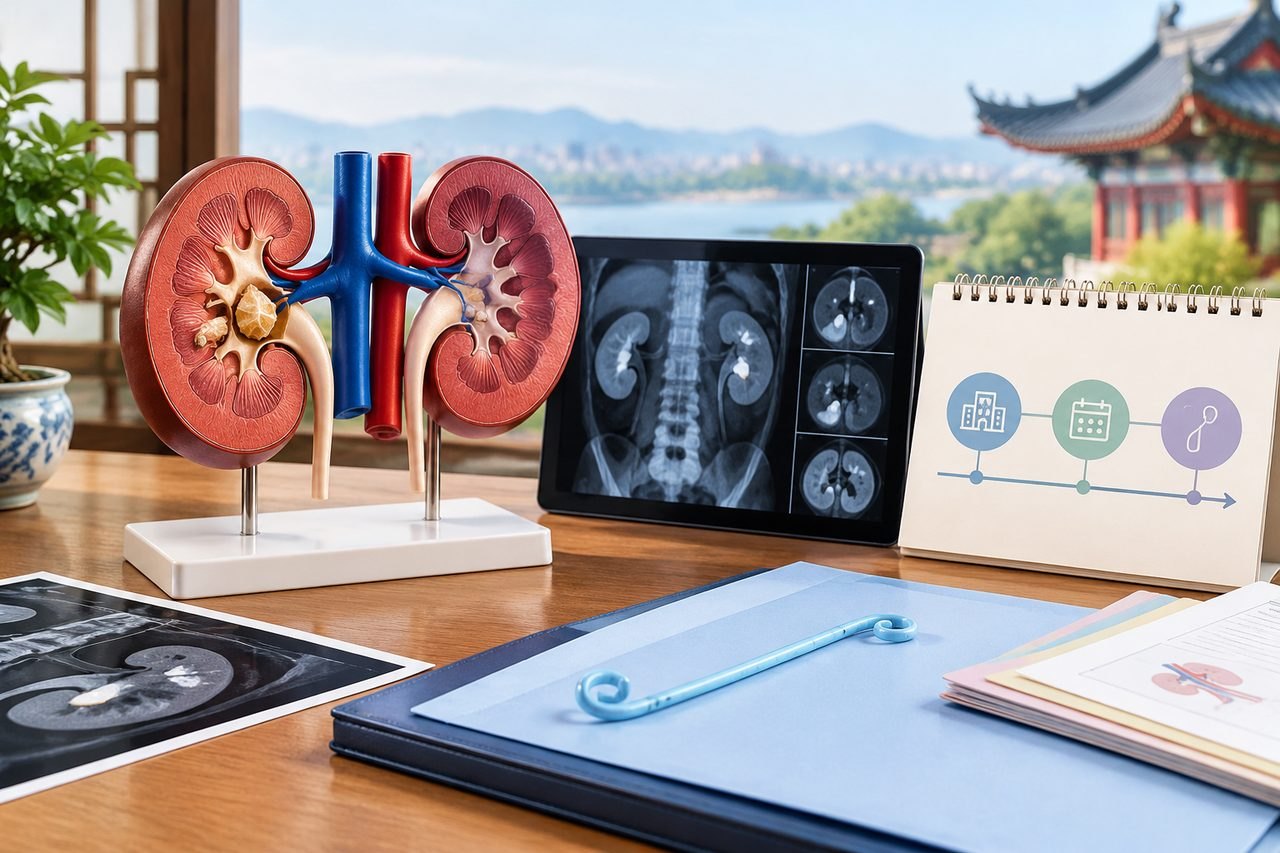
What Long-Term Follow-Up Actually Involves After Kidney Stone Treatment
Kidney stone disease is often a recurring condition, so follow-up is not simply a final check that the stone is gone. It usually includes confirming that the stone has been cleared, checking that the kidney is draining properly, reviewing whether any residual fragments remain, and looking at why stones formed in the first place. That last part may involve dietary review, fluid intake, urine testing or blood tests, depending on what your treating clinician considers relevant to your case.
For an overseas patient, the practical difficulty is that these steps are spread over time and across countries. The operation may happen in China, but the metabolic review, repeat imaging and lifestyle adjustments may need to continue where you live. This is why the follow-up conversation should begin before treatment, not after discharge. Ask the treating team which parts of follow-up must be done at their hospital and which parts can reasonably be done by your local doctor or urologist.
It also helps to separate two different questions. The first is clinical: what does this particular stone, and this particular patient, need over the next months and years? The second is logistical: how will those clinical steps actually be delivered once you are no longer in China? A plan that answers only the first question is incomplete for someone who travels for care.
Stone Location, Imaging and Previous Procedures: What the Receiving Team Needs
The location of a stone changes what treatment options are realistic. A stone in the kidney, a stone in the ureter, and multiple stones in different positions are not the same problem, and the approach to each can differ. The treating team will want to see the actual imaging, not just a written summary. If you have CT, ultrasound or X-ray images, ask how they can be shared in a format the hospital can open. A report describing a stone is useful, but the images themselves often carry more information.
Previous stone procedures matter just as much. If you have had shock wave lithotripsy, ureteroscopy, or percutaneous stone removal before, the details affect how the current stone is assessed. Which kidney was treated? Was a stent placed, and when was it removed? Were there complications? Were stone fragments analysed? These details are not administrative trivia; they change how a clinician thinks about the current problem.
If any of this information is missing, that is worth stating clearly rather than guessing. You can tell the hospital what you have, what you do not have, and ask what they would like you to obtain. Do not delay urgent local care while gathering records for an overseas enquiry. If you have fever, severe pain, vomiting or difficulty passing urine, that needs local assessment first.
Staged Treatment and Stents: Why the Timeline Matters for Follow-Up
Some kidney stone treatment is completed in one session. Other cases are staged, meaning more than one procedure or visit is planned. Staging can be recommended for several reasons, including stone size, stone position, infection risk, or the need to let the kidney recover between steps. If your treatment is staged, the follow-up plan has to cover the gap between stages, not just the period after the final procedure.
A stent is a small tube sometimes placed to help urine drain from the kidney to the bladder. If a stent is planned, ask directly: who will remove it, where, and when? This matters for patients who travel for stone surgery, because a stent left in longer than intended can cause discomfort or complications. The treating team should give you clear instructions about stent removal before you leave, and you should confirm that a local clinician at home is willing and able to remove it if that is the agreed plan.
Percutaneous nephrolithotomy (PCNL) accesses kidney stones through a small tract from the skin. Further treatment or drainage may be needed after this procedure. That possibility should be discussed with you in advance so that you understand what follow-up imaging and review will involve. No outcome is guaranteed, and the treating team must confirm what is appropriate for your individual case.
The Handover Question: Who Is Responsible After You Leave China
The most important long-term follow-up question is also the simplest: after you leave China, who is responsible for your kidney stone care? The answer is not automatic. The Chinese treating team may be willing to review imaging remotely, or they may expect your local urologist to take over. Your local urologist may be willing to continue follow-up, or may prefer the original team to make decisions about stent removal or repeat procedures. This needs to be clarified, not assumed.
A useful handover includes a written summary of what was done, what was found, what was left in place (such as a stent), what imaging was performed, and what the treating team recommends next. Ask for this in a form your local clinician can read. If language is a barrier, ask whether an English summary can be provided, and confirm what the hospital can actually supply rather than assuming it is standard.
It is also reasonable to ask what the treating team cannot do once you leave. For example, they may not be able to arrange imaging in your home country, prescribe medication through a local pharmacy, or take responsibility for urgent problems that arise after you return. Knowing these limits in advance helps you plan realistically.
Preparing Your Records and Questions Before You Travel
Before committing to treatment in China, gather the records that a urology team would need to assess your case. These typically include recent imaging (CT, ultrasound or X-ray), any previous operation notes, discharge summaries, stone analysis results if available, and current medication lists. You do not need to send a complete medical archive at the first enquiry; a brief summary is enough to start. The hospital will tell you what else it needs.
Prepare a short list of questions to ask the treating team. Useful ones include: Is my treatment likely to be completed in one session or staged? Is a stent planned, and if so, what is the plan for removal? What follow-up imaging will I need, and can it be done locally? What symptoms should prompt me to seek urgent care? What written summary will I receive before discharge? These questions are not a substitute for the clinician's judgement, but they help you understand the plan.
If you are considering percutaneous nephrolithotomy specifically, you can read more about the procedure on our PCNL reference page. That page explains the general approach; your own suitability and treatment plan must be confirmed by the treating hospital.
What to Confirm About Follow-Up Before You Return Home
Before you leave China, confirm the follow-up arrangements in writing. Ask who will review your imaging, how stent removal will be arranged if applicable, and what your local doctor needs to know. If the treating team recommends repeat imaging at a specific interval, ask what that interval is based on and whether it can be done at home. Do not assume that a follow-up appointment will be automatically scheduled; ask how it will be arranged and who will contact whom.
It is also worth asking what the treating team's written plan includes and what remains undecided. For example, if further treatment may be needed depending on follow-up imaging, ask how that decision would be made and where. If you would need to return to China for a second stage, ask what that would involve. These are practical questions that affect your planning, and the hospital is best placed to answer them for your case.
Finally, keep a copy of your discharge summary, imaging reports and contact details for the treating team. If a problem arises after you return home, your local clinician will need this information. If you have severe pain, fever, or difficulty passing urine, seek local urgent care rather than waiting for an overseas reply.
If you would like help understanding what records to prepare or how to approach a Chinese hospital about kidney stone care, you can start with a free initial enquiry. Our team can review your summary, identify missing information and suggest a relevant next step. This is not a diagnosis or a promise of acceptance, and it does not replace assessment by a licensed clinician.
Sources & scope of this guide
References and official service information relevant to this guide.
This is general planning information and has not been individually reviewed by a doctor. Medical decisions and personal treatment advice come from your treating clinicians.