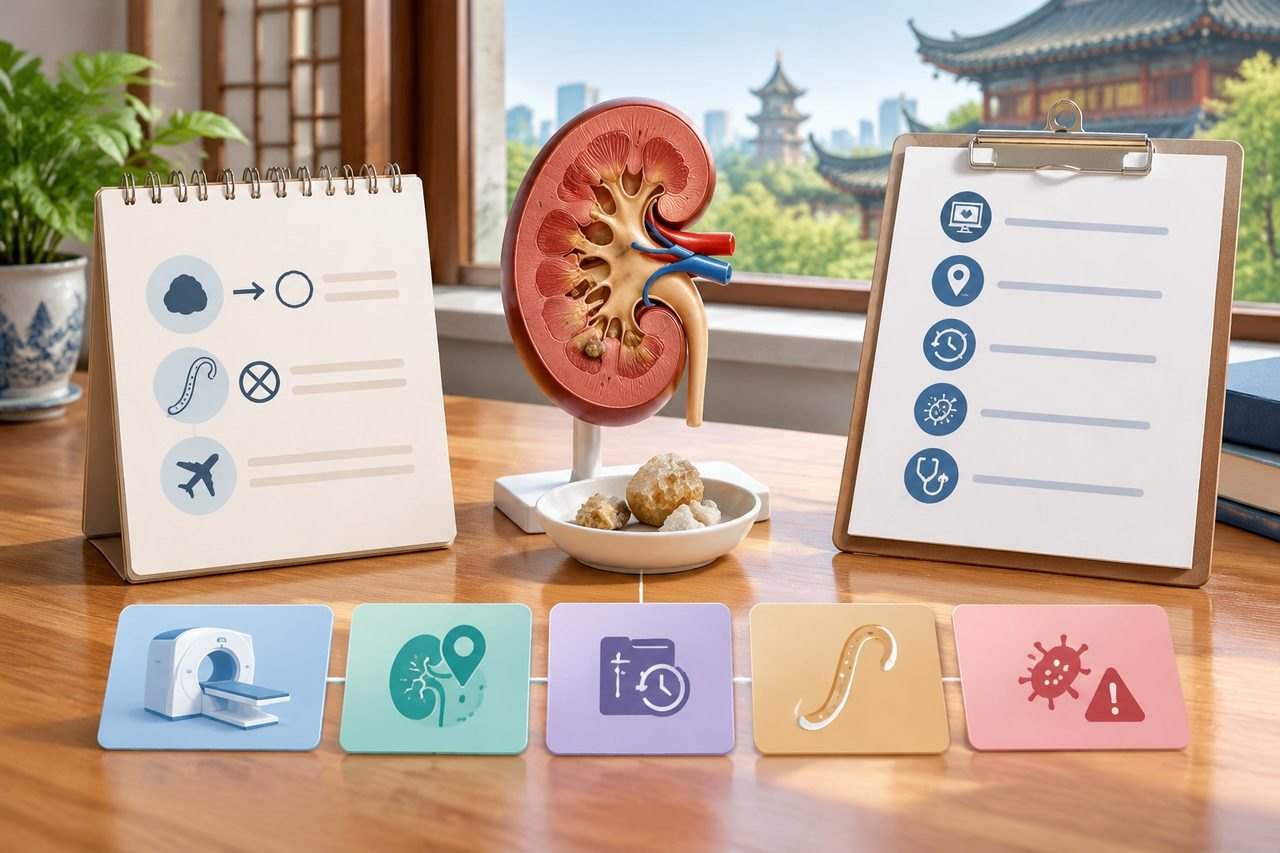
Your Goal and the Clinician's Goal Are Not the Same Question
Most patients arrive with a clear personal goal: remove the stone, avoid another procedure, travel once, or stop the pain. Those are reasonable things to want. They are not the same as the clinical question a urologist answers. A urologist assesses where the stone sits, how it affects drainage, whether infection is present, what previous stone procedures did to the kidney and ureter, and whether the planned route can reach the stone safely.
This distinction matters because a personal goal can be fully valid and still not match what is medically achievable in one plan. You might want a single definitive treatment. The clinician might see a stone that needs staging, a stent that needs to stay for a period, or further imaging before any decision. Neither side is wrong. The useful conversation is about which parts of your goal are realistic now, which need more information, and which cannot be promised by anyone.
For care in China, this means the first step is not choosing a hospital or a procedure name. It is stating your goal clearly and asking the clinical team to tell you what they can and cannot assess from your records. That answer shapes everything else.
What Imaging and Stone Location Actually Tell the Team
Stone location is not a minor detail. A stone in the kidney, a stone stuck in the ureter, and multiple stones in different places are different problems. The location affects which treatment route is technically possible, how much access the clinician needs, and whether a single session is likely to address everything.
Imaging is the foundation of that assessment. A CT scan, ultrasound, or X-ray may be used, but they do not answer the same questions. The treating urologist needs to see the actual images or a proper report, not just a summary that says 'kidney stone.' If you only have a written note, ask whether the original imaging files can be shared. Without them, the clinician may be able to discuss possibilities but not give a reliable opinion on your specific stone.
This is also where you should ask directly: does the imaging show anything that changes the plan, such as hydronephrosis, infection, or a stone that has already caused damage? You do not need to interpret the scan yourself. You need to know whether the team considers your records sufficient to assess your goal, or whether something is missing.
Previous Stone Procedures Change What Is Possible
If you have had stone treatment before, that history is not background detail. Previous ureteroscopy, shock wave lithotripsy, or percutaneous surgery can leave scar tissue, narrow the ureter, or change how easily a new procedure can reach the stone. A clinician assessing your goal needs to know what was done, when, where, and what the outcome was.
Ask yourself what you actually know about those earlier procedures. Do you have the operation notes, discharge summaries, and follow-up imaging? If not, say so. The team can still review what you have, but they should tell you what they cannot conclude without the missing records. Do not assume that a previous successful procedure means the same approach will work again, or that a previous failure means nothing can be done.
For your own planning, write a short timeline: first stone, each procedure, each stent, each infection, and any current symptoms. This is more useful to a urologist than a long narrative. It also helps you see which parts of your goal depend on history you may not have fully documented.
Staged Treatment and Stents: What You Need to Ask
Some kidney stone plans are completed in one session. Others are staged, meaning more than one procedure or a period with a stent or drainage tube. This is often where a patient's goal and the clinical plan diverge most sharply. You may want everything finished before you fly home. The clinician may see a reason to stage treatment, such as infection, stone burden, or the need to let swelling settle.
Percutaneous kidney stone removal accesses stones through a small tract from the skin. Further treatment or drainage may be needed. That is a clinical possibility, not a prediction about your case. The point for you is to ask what would trigger a second stage, how a stent would affect your daily life, and what symptoms would require urgent local care rather than waiting for a planned review.
You should also ask who removes a stent if one is placed, and where. This is a practical question with real consequences for an overseas patient. Do not assume the answer. Ask whether the plan includes stent removal, whether it can be done locally, and what the treating team recommends if you cannot return to China. The hospital decides what it can arrange; your job is to get that in writing before you commit.
Infection and Urgent Symptoms Take Priority Over Travel Plans
A kidney stone with fever, severe pain, vomiting, or difficulty passing urine is not a situation for an overseas enquiry. It needs local urgent assessment. This is not a disclaimer added to every article; it is a specific boundary for stone care. Infection behind a blocked stone can become serious quickly, and no travel plan should delay that assessment.
If you are currently stable and planning ahead, say so clearly in your enquiry. If you have had recent infections or hospital admissions, include that in your summary. The clinical team needs to know whether your situation is stable enough to plan elective care in China, or whether you should be assessed and treated closer to home first.
This boundary also affects your goal. If infection risk is part of your case, the clinician may prioritise drainage or antibiotics before any stone removal. That is not a failure to meet your goal. It is a different sequence that may be necessary to make treatment safe. Ask the team to explain the sequence in plain terms and what would change it.
How to Prepare Your Records and Questions for a China Enquiry
A useful first enquiry is short. You do not need to send a complete medical archive before anyone has looked at your case. Start with a one-page summary: your main goal, current symptoms, stone location if known, date and type of imaging, previous stone procedures, and any current infection or stent. Then ask what else the team needs.
Your questions should be specific to your goal. For example: Is my imaging sufficient to assess my stone? Does my history of previous procedures change the options? Is a single treatment realistic for my case, or should I expect staging? If a stent is placed, what is the plan for removal? What would make you recommend I seek care locally instead of travelling? These are questions a urologist can answer within the limits of your records.
You should also ask about the practical scope of any written estimate. Ask what the quote includes, what it excludes, and what remains undecided until after an in-person assessment. Do not assume that a consultation fee, hospital fee, or coordination fee works a certain way in China. Ask the named provider to put its own scope in writing. For confirmed services, ChinaSpecialistCare can help with specialist matching and appointment coordination, but the hospital decides suitability and treatment.
A free initial case review is a reasonable starting point. It checks whether your records and question are clear enough to suggest a next step. It is not a diagnosis, and it does not promise hospital acceptance. You can also ask whether a records-based opinion from a relevant specialist is available, but that is optional and not required before every appointment. The goal of the first contact is to clarify what can be assessed and what still needs confirmation.
- One-page summary: main goal, current symptoms, stone location, imaging date and type, previous procedures, current stent or infection.
- Ask whether your imaging files, not just reports, can be reviewed.
- Ask what would make the team recommend local urgent care instead of travel.
- Ask for the provider's written scope of any estimate before you commit.
Sources & scope of this guide
References and official service information relevant to this guide.
This is general planning information and has not been individually reviewed by a doctor. Medical decisions and personal treatment advice come from your treating clinicians.