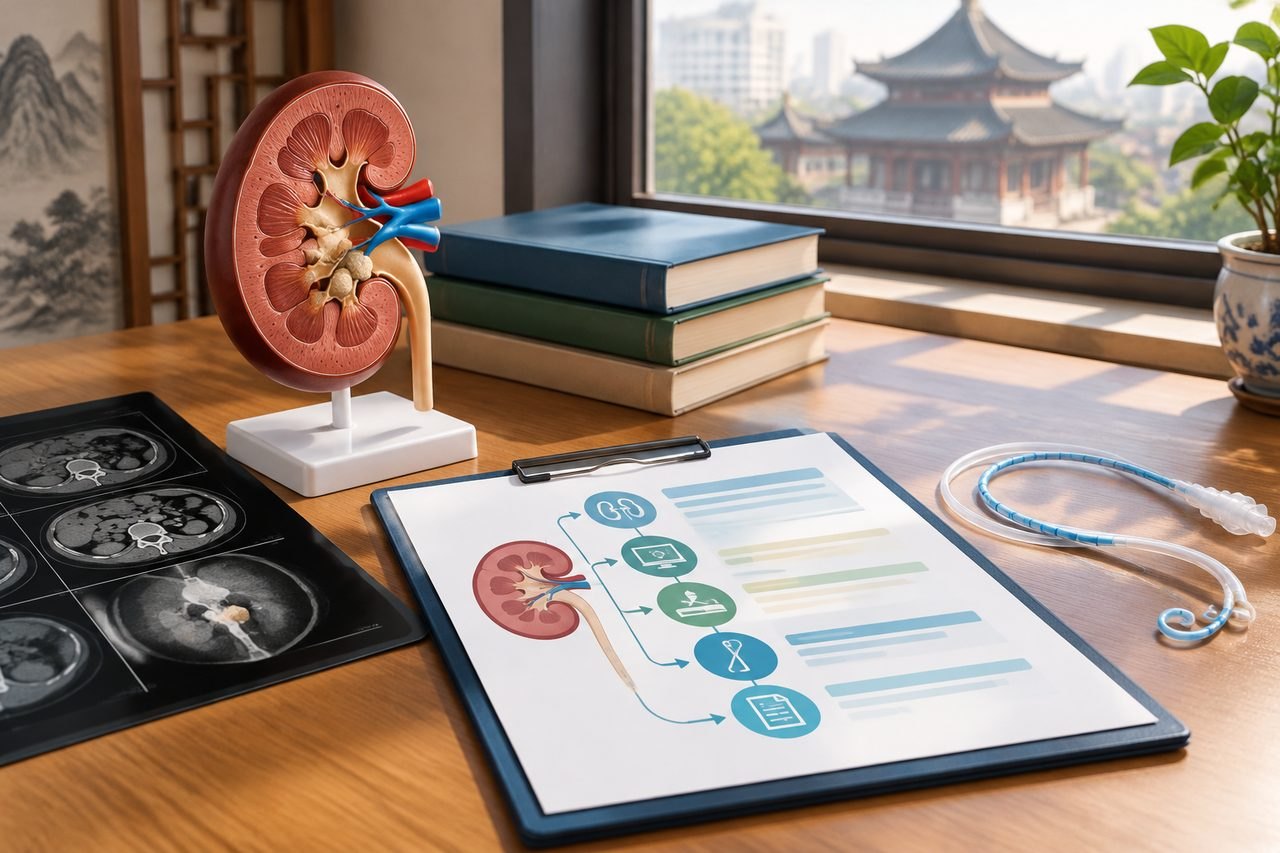
What staged treatment means for kidney stones
Staged treatment means the urology team plans more than one procedure or step rather than a single session. For kidney stones, staging can be discussed when a stone is large, when several stones are present, when there is infection or obstruction, or when the team judges that one session would carry too much risk. The stages may include drainage first, stone removal later, or a planned second look after an initial procedure.
This is a clinical judgement, not a menu choice. The treating urologist decides whether staging is appropriate after reviewing your imaging, kidney function, urine tests, infection status and general health. Your role is to make sure you understand why staging is proposed, what the alternative single-stage approach would involve, and what would change the plan.
For percutaneous nephrolithotomy (PCNL), the kidney stones are reached through a small tract from the skin. The same source notes that further treatment or drainage may be needed. PCNL is therefore one route for selected kidney stones, and it can sit inside a staged plan rather than being a guaranteed one-step solution.
Questions that clarify your stone location and imaging
Stone location matters because a stone in the kidney, a stone in the ureter and a stone at the kidney outlet are not managed identically. Before any discussion of staging, ask the urologist to point to your stone or stones on the imaging and explain the exact position. Ask whether the stone is causing obstruction, whether the kidney is draining, and whether there is any sign of infection.
Bring the actual imaging files, not only the written report. A CT scan, ultrasound or X-ray report can summarise findings, but the urologist may need the images to judge stone size, density, position and surrounding anatomy. If you had imaging in your home country, ask how to share the original files in a format the Chinese hospital can open.
Ask which imaging the Chinese team wants repeated. Some tests may need to be current, and the receiving hospital decides what it will accept. Do not assume that older imaging is sufficient or that a new scan is automatically required. The practical question is: what does this hospital require before it can confirm a treatment plan?
- Ask the urologist to show you the stone on the image and name its position.
- Ask whether there is obstruction, infection or reduced kidney drainage.
- Ask which imaging files the hospital needs and in what format.
- Ask whether any imaging must be repeated in China and why.
Previous stone procedures change the conversation
A history of stone procedures is not just background. Previous ureteroscopy, shock wave lithotripsy, PCNL or stent placement can affect scar tissue, stone burden, access routes and the risk of complications. Tell the urologist what was done, when, where, and what the outcome was. If you have operative notes or discharge summaries, bring them.
Ask specifically whether previous treatment makes a staged approach more or less likely in your case. The answer belongs to the treating clinician, but the question is useful because it forces the plan to be individual rather than generic. If you have had a stent before, describe what it felt like and whether there were problems. That information may influence how the team plans stent placement or removal.
Do not stop or change any medication on your own before travel. If you take blood thinners, medication for diabetes, or any drug that affects bleeding or kidney function, ask the treating team how it should be managed. That is a prescribing decision for licensed clinicians, not a travel coordinator.
Stents and drainage: what to ask before you agree
A stent is a thin tube placed to help urine drain from the kidney to the bladder. It may be used before, during or after stone treatment. In some situations, drainage is needed urgently because of infection or obstruction. In others, a stent is part of a planned staged approach. The reason should be explained to you in plain terms.
Ask why a stent is being recommended in your case, what it is expected to achieve, and what the plan is for removing it. Ask who will remove it, where, and what symptoms should prompt urgent contact. Do not accept a vague answer such as 'it is routine'. A stent has its own risks and side effects, including discomfort, urinary symptoms and possible infection. These need to be discussed with the treating team.
If you are travelling to China for care, ask how stent-related follow-up would work if you return home before removal. The treating hospital must confirm whether it can coordinate with a clinician in your home country, and your home clinician must agree to take on that part of care. No overseas coordinator can decide this for either clinician.
- Why is a stent recommended for my stone and my kidney?
- What symptoms mean I should seek urgent care?
- When and where would the stent be removed?
- If I travel home, who would take responsibility for stent follow-up?
Getting a comparable written plan and estimate
If you are comparing a plan in China with one at home, compare the same things. Ask the Chinese hospital for a written outline that states the proposed stage or stages, the intended procedure, the expected inpatient stay, and what the estimate includes and excludes. Ask whether the estimate covers imaging, laboratory tests, the procedure, anaesthesia, medicines, ward or room, stent or consumables, and follow-up visits.
Do not assume that a quoted figure is all-inclusive or that every hospital structures its estimate the same way. Ask the named provider how its written quote works and which items remain undecided until after assessment. If you need a records-based opinion before travelling, that can be requested separately, but it does not replace the hospital's own assessment or guarantee acceptance.
ChinaSpecialistCare can help international patients request a specialist appointment, prepare records for review, and arrange interpretation during hospital visits. We do not decide suitability, prescribe treatment or promise that a particular procedure will be offered. The hospital makes those decisions after it sees your case.
Urgent symptoms and the limits of an overseas enquiry
Kidney stones can become an emergency. Severe pain, fever, vomiting, inability to pass urine, or rapidly worsening symptoms need local urgent assessment. Do not delay emergency care to send records or wait for an overseas reply. If you have signs of infection with obstruction, that is a situation for the nearest emergency department, not an email.
An initial enquiry to ChinaSpecialistCare is free and non-clinical. It helps identify what information is missing and what the next practical step might be. It is not a diagnosis, not a treatment plan, and not a promise that a Chinese hospital will accept you or offer a particular procedure. A proxy consultation is optional and is not required before every appointment or operation.
The most useful thing you can do now is gather your imaging files, procedure history, medication list and current test results, then ask the treating urologist the questions in this guide. The answers, not this article, should guide your decision.
Sources & scope of this guide
References and official service information relevant to this guide.
This is general planning information and has not been individually reviewed by a doctor. Medical decisions and personal treatment advice come from your treating clinicians.