Why stone location changes the treatment decision
A kidney stone is not one condition with one operation. A stone sitting in the kidney, a stone lodged in the ureter, and a stone at the point where the ureter joins the bladder are different technical problems. Each position affects how a surgeon can reach the stone, what imaging is needed to plan access, and what risks the patient should discuss before agreeing to a procedure.
This is why a China urology review cannot start from a generic diagnosis of 'kidney stones'. The urologist needs to know where the stone actually is, whether it is causing obstruction, and whether the kidney is draining. A report that only says 'right renal calculus' or 'left ureteric stone' without images or measurements leaves the key planning questions unanswered.
Location also interacts with previous stone treatment. Scarring, a previously placed stent, or a kidney that has already been operated on can change what is straightforward and what needs a different approach. If you have had stone surgery before, that history belongs in the first summary you send, not in a later message.
What imaging a urologist actually needs to see
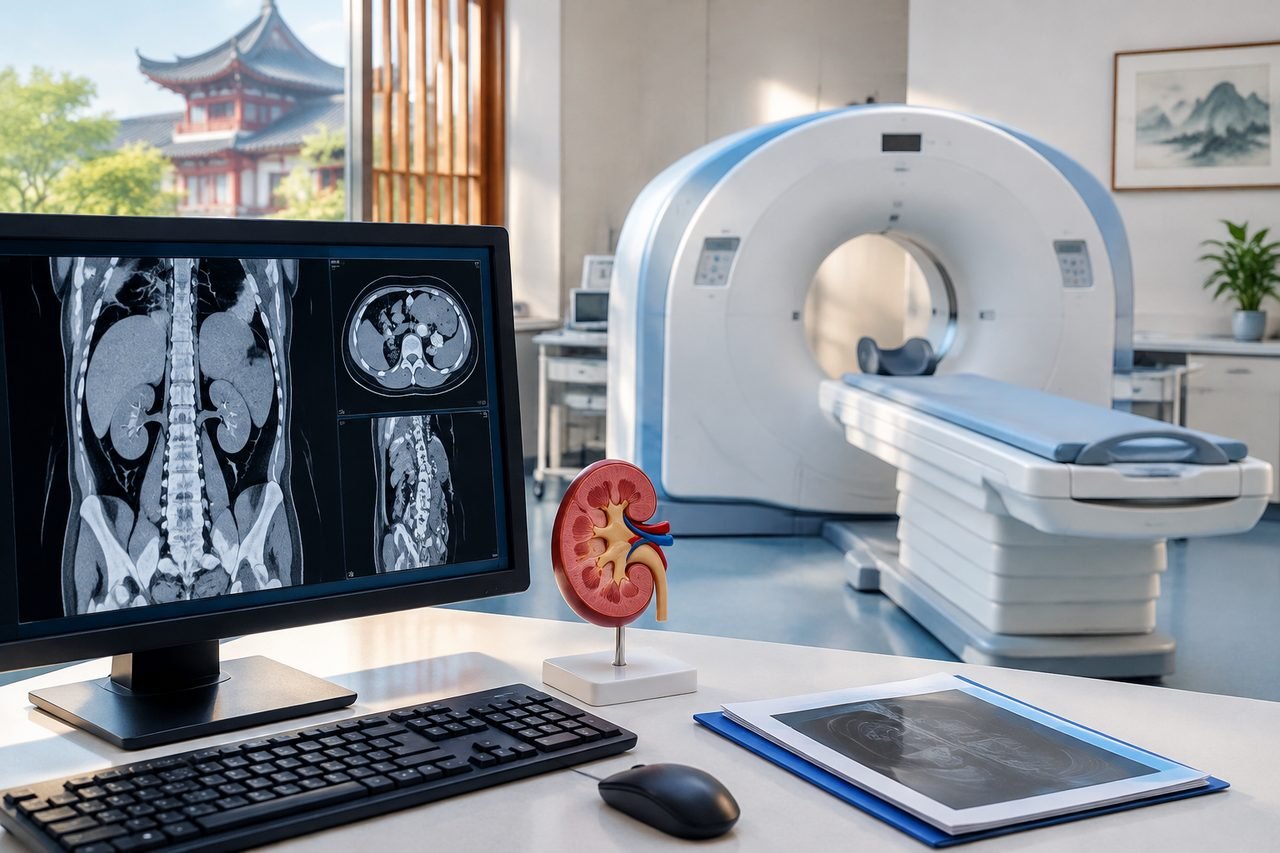
The most useful starting point is the imaging itself, not only the radiologist's conclusion. Non-contrast CT of the urinary tract is widely used to identify stone position and size, and it also shows whether the kidney is obstructed. Ultrasound can show obstruction and is often used in follow-up, but it does not always show the stone clearly. Plain X-ray may miss stones that are not radio-opaque.
For an overseas review, ask the imaging centre for the DICOM files or a shareable image link, plus the written report. A report alone may state 'stone in the left kidney' without saying whether it is in the upper, middle or lower pole, or how close it is to the ureteropelvic junction. Those details matter for planning.
Blood tests and a urine test are also relevant. Kidney function, infection markers and urine culture help the treating team judge whether the situation is stable enough for planned treatment or whether something needs attention first. If you have current fever, severe pain or reduced urine output, that is a local emergency, not a reason to wait for an overseas appointment.
- Current imaging files or a shareable link, not only the report
- The written radiology report with stone size and position
- Recent kidney function and urine test results
- A list of previous stone procedures, stents or surgeries
- Current medicines, including blood thinners, and allergies
Previous stone procedures and stents change the plan
If you have had shock wave lithotripsy, ureteroscopy, or percutaneous stone removal before, say so clearly and give the dates. Previous treatment can leave residual fragments, narrow the ureter, or create scar tissue that affects how a new stone can be reached. It also tells the urologist which approaches have already been tried and what the outcome was.
A ureteric stent is a common example. A stent may be placed to relieve obstruction or to prepare for a later procedure. Whether a stent is present now, when it was placed, and whether it is due for removal are practical questions for the treating team. Do not assume a stent can simply be left in place or removed on a fixed schedule without the urologist's assessment.
Staged treatment is also possible. Some stone situations are managed in more than one step, with drainage or a temporary measure first and definitive stone removal later. The treating urologist decides whether staging is appropriate for your case, based on infection risk, kidney function, stone burden and your general health. This is not something to plan around a fixed travel window before the clinical team has reviewed the imaging.
How stone location relates to the available procedures
Different stone positions point toward different procedures. Shock wave lithotripsy uses external waves to break up suitable stones, and it works best for certain sizes and positions. Ureteroscopy passes a scope through the urinary tract to reach stones in the ureter or kidney and can use laser energy to fragment them. Percutaneous nephrolithotomy accesses kidney stones through a small tract from the skin, and is generally considered for larger or more complex kidney stones.
The choice is not made by the patient from a website. It depends on stone size, location, hardness, kidney anatomy, infection status, prior surgery and the patient's overall health. A urologist may also discuss observation for a small stone that is not causing problems, or a temporary drainage procedure if there is obstruction or infection.
For percutaneous removal specifically, the procedure involves a tract from the skin into the kidney. Further treatment or drainage may be needed, and the treating team will explain what applies in your case. There is no guarantee of complete stone clearance, and no universal rule about who is suitable. Ask the urologist directly about the planned approach, the alternatives, and what would happen if fragments remain.
Questions to ask before agreeing to treatment in China
Once the imaging is reviewed, the useful conversation is about what the treating team proposes and why. Ask which procedure is recommended for your stone position and size, what the alternatives are, and what the expected recovery and follow-up involve. Ask whether any further imaging or tests are needed before a decision, and whether the plan is a single procedure or staged.
Ask about the hospital's written estimate and what it covers. Hospital fees, our coordination fees and travel costs are separate, and the scope of a quote can vary. Rather than assuming what is included, ask the named hospital or provider to confirm in writing which consultations, imaging, procedures, medicines, rooms and follow-up visits are included, excluded, or still undecided.
Ask about language and communication. If you do not speak Chinese, confirm whether the urology team can discuss the plan in English, or whether interpretation is needed. Ask who will explain the consent discussion and whether you will have the chance to ask questions before sedation or surgery.
Ask what happens if the stone cannot be cleared in one procedure, or if a stent is left in place. Ask when follow-up imaging would be done and who would review it. These are practical questions that affect travel planning, and the answers belong to the treating team.
Preparing your records and taking the next step
A useful first enquiry is short. Send a brief summary of your situation, the main question you want answered, and the imaging and reports you already have. You do not need to send a complete medical archive or payment details at the first contact. Our team can review what is available, identify what is missing, and suggest the relevant next step. This initial review is free and is not a diagnosis or a promise of acceptance.
If you want a records-based opinion before travelling, a proxy consultation is an optional route, not a prerequisite for every appointment. The treating hospital decides whether it can accept your case and what treatment is suitable. No outcome is guaranteed, and the urologist's assessment after seeing your imaging is what determines the plan.
If you have fever, severe pain, vomiting or reduced urine output, seek local urgent care first. Do not delay necessary treatment to wait for an overseas review. Once your situation is stable, you can share the imaging and reports with us and ask the specific question you need answered about stone location and treatment options in China.
Sources & scope of this guide
References and official service information relevant to this guide.
This is general planning information and has not been individually reviewed by a doctor. Medical decisions and personal treatment advice come from your treating clinicians.