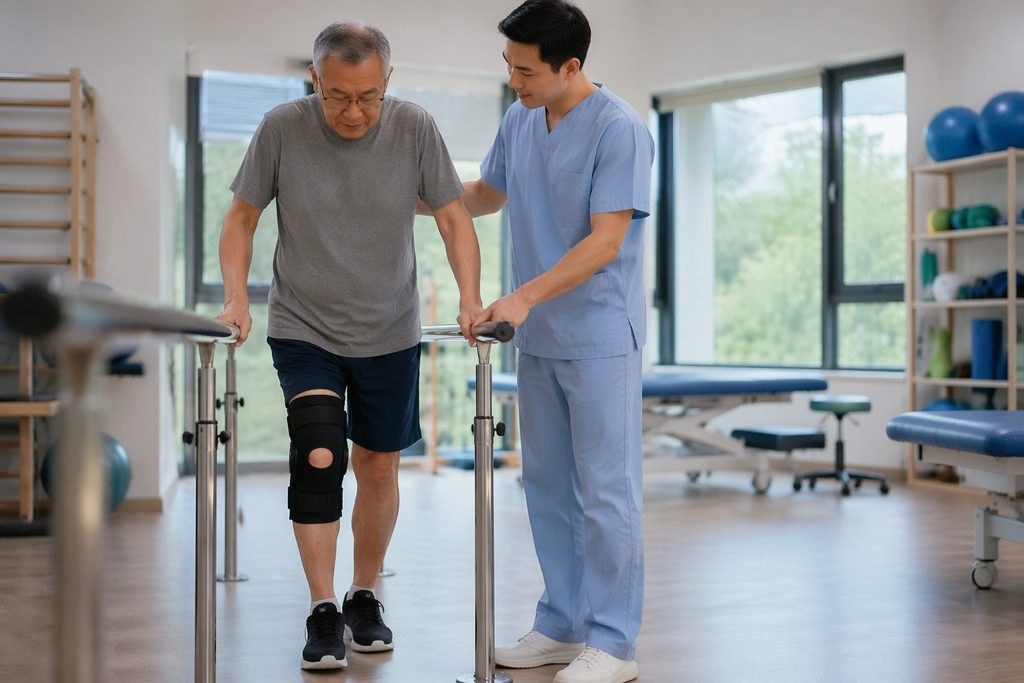
What a China review can and cannot decide while local care continues
A records-based orthopedic opinion can discuss whether your knee alignment, symptom pattern and previous treatments point toward continued non-surgical management, partial knee replacement or total knee replacement. It cannot examine your knee, test stability under load or confirm surgical suitability without an in-person assessment. The Chinese clinician can give reasoning and questions to take back to your local team, but the decision to change or continue local treatment stays with you and your current clinician.
This matters because knee osteoarthritis care is often a sequence rather than a single decision. Injections, physiotherapy, weight and activity adjustments, bracing and pain management may already be working partly. A remote review should not be used to interrupt something that is helping. Instead, it can clarify whether the remaining symptoms are the kind that might eventually need surgical assessment, and what information a surgeon would want before that conversation.
Ask the Chinese team to state, in writing, what their opinion is based on and what they cannot confirm from records alone. A useful reply will separate 'this imaging shows' from 'this would need examination' and from 'this depends on your local clinician's findings'.
The records that make a knee osteoarthritis review useful
The quality of a remote opinion depends heavily on what is sent. For knee osteoarthritis, the most useful items are usually recent weight-bearing X-rays, any MRI or CT reports, operation notes if you have had arthroscopy or previous surgery, and a clear timeline of injections, physiotherapy, medications and their effects. Alignment studies, such as full-length standing X-rays, are sometimes used to assess mechanical axis; whether they are needed for your case is a question for the reviewing clinician, not a universal requirement.
Injection history deserves particular attention. The type of injection, the date, the response and any side effects help a reviewer understand what has already been tried. If you have had multiple injections, a simple table with dates and outcomes is more useful than a stack of discharge summaries. Similarly, physiotherapy notes should describe what was attempted, for how long and whether strength, range of motion or pain changed.
Imaging should be sent in a format the receiving team can open. DICOM files on a disc or secure link are more useful than photographs of films. If you only have reports, say so clearly. The Chinese clinician can still comment on the reported findings, but they should know that they are not seeing the original images.
A short cover summary in English or Chinese helps: your age, main symptoms, how long you have had them, what you can and cannot do, current treatments, and the specific question you want answered. Keep it to one page. The detailed records can follow.
- Recent weight-bearing knee X-rays and reports
- MRI or CT reports, and images if available
- Injection log with dates, type and response
- Physiotherapy notes describing duration and effect
- Previous knee surgery or arthroscopy records
- Current medications and any relevant health conditions
- Your one-page summary and main question
Partial versus total replacement: what the review can and cannot settle remotely
Partial knee replacement and total knee replacement are different operations with different selection criteria. Total knee replacement resurfaces damaged joint surfaces with artificial components, and assessment includes symptoms and function. Partial replacement is generally considered when arthritis is confined to one compartment and the remaining knee structures are suitable. A records-based review can discuss whether your imaging and history appear consistent with one or the other, but it cannot confirm compartmental wear or ligament function without examination and sometimes without further imaging.
This distinction matters for planning. If your local clinician has already recommended total knee replacement, a remote review may help you understand the reasoning and what alternatives exist. If partial replacement is being considered, the review may highlight what the surgeon would need to verify in person. Neither review should be treated as a booking for surgery. Hospital acceptance and final surgical planning belong to the treating hospital after it has assessed you.
Ask the reviewing clinician to explain which findings would favor each option and which findings would make them recommend waiting or continuing non-surgical care. That explanation is often more valuable than a yes-or-no answer.
How to keep your local clinician involved without creating conflict
The simplest way to avoid conflict is to be transparent. Tell your local clinician that you are seeking a records-based opinion from a Chinese orthopedic team and ask whether they have any concerns about sharing records. In many cases, the local clinician will be willing to provide a summary or clarify imaging findings. If they are not, you can still proceed with the records you already hold, but the review may be more limited.
When you receive the Chinese opinion, do not treat it as an instruction to stop local treatment. Instead, bring it to your next local appointment as a discussion document. Ask your local clinician which points they agree with, which they disagree with and why. Differences of opinion are common in osteoarthritis care and are not necessarily a sign that one side is wrong.
If the Chinese team recommends a specific test or image, ask your local clinician whether it is appropriate and available locally. Do not arrange tests independently without understanding who will interpret them and how they fit into your overall care. A remote opinion can suggest questions, but the responsibility for ordering and interpreting tests usually stays with the clinician who knows your knee.
Keep a written record of what each side has advised and when. If you later travel to China for assessment, this timeline helps the Chinese team understand what has already been tried and what has changed.
What a China review reply does and does not confirm
A reply from a Chinese orthopedic team after reviewing records is an opinion, not a hospital acceptance letter. It does not confirm that you are a surgical candidate, that a particular procedure will be performed, that a bed will be available or that your insurance will cover anything. It also does not replace an in-person consultation, which may lead to a different conclusion once the clinician examines your knee.
What the reply can do is clarify the reasoning behind different options, identify missing information and help you prepare questions for your local clinician or for a future visit to China. It can also tell you whether the Chinese team thinks a face-to-face assessment would be worthwhile, and what they would want to see if you came.
If you are considering travel to China for assessment or treatment, ask the hospital what its process is for international patients, what records it requires and what costs are involved. These are administrative questions that vary by hospital. Do not assume that a remote opinion guarantees an appointment or a procedure.
If the reply is unclear or does not address your main question, ask for clarification. A good review should be understandable to you and your local clinician, not just to another specialist.
Practical next steps and what to do if a step cannot be completed
Start by gathering the records listed above and writing your main question in one or two sentences. If you do not have recent imaging, ask your local clinician whether new X-rays are appropriate before seeking a remote opinion. If you cannot obtain certain records, say so in your enquiry; the reviewing team can tell you whether they can still provide a useful opinion.
You can send a brief summary through the ChinaSpecialistCare enquiry form, email or WhatsApp. An initial enquiry is free and does not require buying a proxy consultation. If you later want a records-based opinion from a hospital specialist, that can be arranged separately, and the scope and any coordination fee are agreed before work begins. Hospital consultation fees are paid to the hospital.
If a step cannot be completed, for example if imaging is unavailable or your local clinician declines to share records, do not delay necessary local care. Continue with your current treatment and ask the Chinese team what they can assess with the information you do have. A limited review is still useful if its limitations are clear.
If you decide to travel to China for an in-person assessment, confirm appointment availability, language arrangements and what the hospital requires before making travel plans. Do not book travel on the assumption that surgery will be recommended. The hospital decides suitability after assessing you.
For general planning around knee replacement in China, the related procedure reference explains what the operation involves and what preparation is typically discussed. Use it alongside this guide, not as a substitute for individual clinical advice.
Sources & scope of this guide
References and official service information relevant to this guide.
This is general planning information and has not been individually reviewed by a doctor. Medical decisions and personal treatment advice come from your treating clinicians.