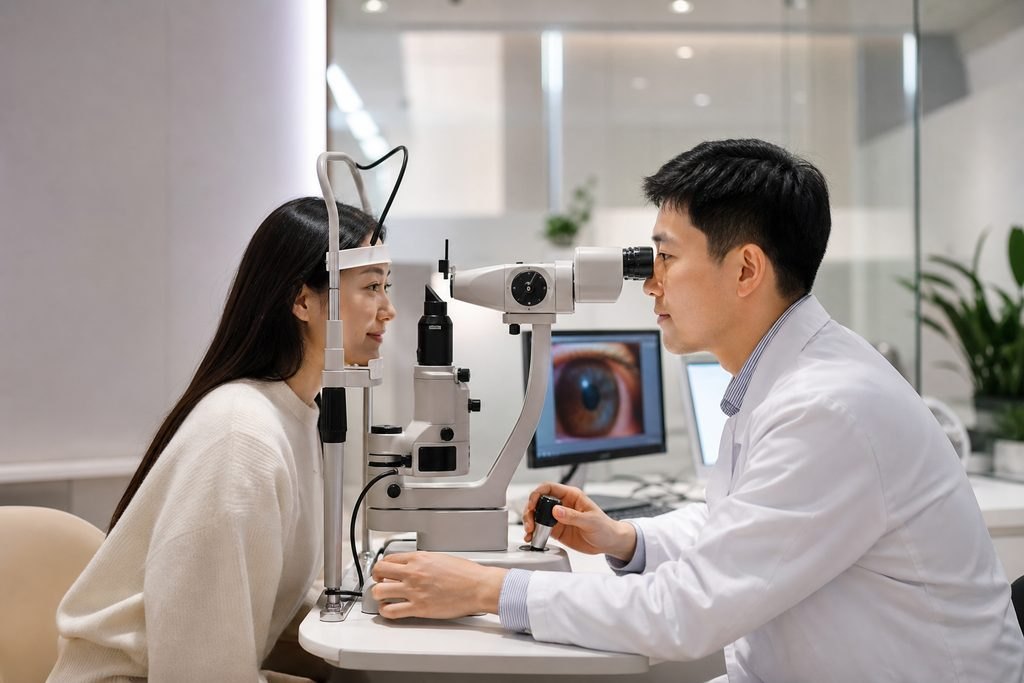
Why a treatment name is not enough
A patient may write "I had LASIK in 2019" and consider the history complete. For a clinician assessing laser vision correction, that sentence leaves almost every decision-relevant fact unanswered. It does not say which eye was treated, what refractive error was targeted, what the cornea looked like before or after, whether the correction was complete, or whether the eye has been stable since.
Laser vision correction and lens procedures are different options, and suitability depends on eye health and assessment. Aftercare matters. That means the assessment is not a simple name-matching exercise. Two people who both had a laser procedure can have very different corneas, tear films, residual prescriptions and symptoms. The treating clinician has to reconstruct the current state of the eye, not just the label of the past operation.
The practical consequence is that your history should be written as a short clinical narrative, not a list. Each statement should help the reader understand what the eye has been through and what it can support now.
What to record for each eye separately
Write the history eye by eye. Right and left can differ in treatment date, technique, target, outcome and complications, and a single combined sentence hides those differences. For each eye, state the date or approximate year, the type of procedure as it appears in your records, and whether it was a laser or a lens procedure. If you do not know the exact technique, say so rather than guessing from a brand name.
Then describe the result in functional and measured terms. What was your refraction before treatment, and what is it now? Are you wearing glasses or contact lenses again, and for what activities? Is your vision clear, variable through the day, or affected by light, glare, halos or dry eye? Have you been told the correction was incomplete, overcorrected or unstable? These details matter more than the original marketing name of the procedure.
Include any additional eye treatment, not only the refractive procedure. Cataract surgery, corneal cross-linking, retinal treatment, glaucoma laser or eye injections all change the picture. A glaucoma laser is not a vision correction procedure, and listing it without context can confuse the history. State what it was for and when it happened.
Finally, note what remains unresolved. If a previous clinic mentioned a thin cornea, irregular topography, dry eye or a need for further review, write that down. An open question is useful information, not a weakness in your summary.
- For each eye: date, procedure type as documented, and whether it was laser or lens based.
- Refraction before and after, current glasses or contact lens use, and whether vision is stable.
- Symptoms: dryness, glare, halos, fluctuating vision, pain or light sensitivity.
- Other eye treatment and any unresolved concern previously raised.
The records that make the description verifiable
A written summary is a starting point, but the clinical team will want the source documents. Ask the previous provider for the operative report, the pre-operative assessment, and the post-operative measurements. If you were treated abroad, request these in a language the receiving team can read, or ask what translation or interpretation arrangement they need.
The most useful items are usually the ones that describe the cornea and the refractive outcome. Topography or tomography, corneal thickness measurements, refraction, and a current eye examination help the clinician understand whether the eye is stable and what the surface can support. If you do not have these, say which are missing rather than filling the gap with an assumption.
Do not send a complete medical archive in the first message. A brief summary with the key dates, procedures and current symptoms is enough for an initial enquiry. The team can then tell you which specific documents it needs and how to share them securely. This keeps the first step manageable and avoids sending sensitive material before anyone has asked for it.
If a record is unavailable, explain why. A missing operative note from many years ago is different from a record that was never created. The clinician can decide how much weight to give the available evidence, but only if you are clear about what exists.
How previous results shape technique selection
Previous treatment changes the questions a clinician asks about technique. A cornea that has already had laser treatment has less tissue available and a different surface profile. A history of dry eye, irregular astigmatism or unstable refraction can affect whether a laser procedure is appropriate at all, and which one. In some cases the discussion moves toward lens-based options or toward no further refractive surgery.
This is why the assessment matters more than the name of the operation you had. The clinician needs to know whether the current refraction is stable, whether the cornea is healthy enough, and whether symptoms are explained by the previous treatment or by something else. The same technique name can be suitable for one eye and unsuitable for another.
Ask directly how the previous results affect the options. A useful question is: "Given my prior treatment and current measurements, which techniques are you considering, and which are you excluding?" A second useful question is: "What would make you decide not to proceed?" The answers tell you how the team is reasoning, not just what it offers.
No outcome is guaranteed, and suitability for a specific technique has to be confirmed by the treating clinician after assessment. A remote review of records can inform the discussion, but it does not replace the examination needed for a final decision.
Testing and eye review: what to ask before you travel
If you are considering care in China, ask how the testing, treatment and postoperative eye checks would be arranged. The sequence matters because the clinical decision depends on measurements taken during assessment, not only on records from another country. Ask which tests would be repeated, which can be reviewed from your existing documents, and how the results would be explained to you.
Ask how many review visits are expected after treatment and where they would take place. If you plan to return home soon after treatment, ask how the follow-up would be handled and what the treating team would need from a local eye care professional. Do not assume a particular schedule; confirm it with the provider.
Ask about language and communication. Will the consultation and the report be in English, or will interpretation be needed? Who explains the findings and the consent discussion? These are practical questions that affect how well you understand the plan.
Ask what the written estimate or treatment plan includes and what remains undecided until after assessment. Scope can vary between providers, so request the specific provider's written explanation rather than relying on a general expectation.
- Which tests would be repeated in China, and which existing records can be used?
- How are treatment and postoperative eye checks arranged, and where?
- What follow-up would be needed if you return home, and what would the local provider receive?
- What language arrangements are available for consultation, consent and reports?
A practical way to write your summary
Keep the first summary to one page. Start with your main question, then give the eye-by-eye history, the current refraction and glasses or contact lens use, your symptoms, and the records you can provide. End with what you want to know: whether any laser vision correction technique might be suitable, what testing would be needed, and how the visit would be organised.
Avoid copying a full clinic report into the message. A short, structured summary helps the team identify what is missing and respond with a relevant next step. If you are unsure how to describe a result, write what you were told and by whom, and mark it as reported rather than measured.
An initial enquiry is free and does not require buying a proxy consultation. The team can review the available information, point out gaps and suggest how to proceed. The hospital and its clinicians decide suitability, and any treatment plan depends on their assessment.
Sources & scope of this guide
References and official service information relevant to this guide.
This is general planning information and has not been individually reviewed by a doctor. Medical decisions and personal treatment advice come from your treating clinicians.