Why two totals for the same operation rarely mean the same thing
Lumbar decompression aims to relieve pressure on lower-spine nerves, and surgery is considered according to symptoms and assessment. That single sentence hides most of what a quote is actually pricing. One hospital may quote a single-level decompression with a short admission; another may quote a multi-level procedure, a different ward, or a plan that includes fusion. The totals will differ, but so will the product.
This is the central trap for overseas patients. A lower number is not automatically better value, and a higher number is not automatically more complete. Until you know which levels are being treated, which procedure is proposed, and what the figure includes, you are comparing labels rather than care.
The practical move is to stop asking "what is the total?" first and start asking "what exactly is this total for?". That reframing is the whole basis of fair comparison.
Match the clinical scope before you match the money
Two quotes are comparable only when they describe the same clinical plan. The first thing to pin down is the number of spinal levels involved. A one-level decompression and a three-level decompression are different operations with different operating time, different implant or instrument needs, and different recovery expectations. If one quote says "lumbar decompression" and another says "L2–L4 decompression", they are not the same item.
Second, ask whether any additional procedure is proposed alongside the decompression. Decompression is not fusion, and the two are frequently confused in conversation. If one hospital is quoting decompression alone and another is quoting decompression plus stabilisation, the difference in total reflects a difference in surgery, not a difference in pricing efficiency.
Third, ask how mobility and later reviews would be planned. A quote that assumes early mobilisation with physiotherapy support is not the same as one that assumes a longer supervised stay. These are clinical decisions for the treating team, but they change what the quote needs to cover.
A useful question to send each hospital is simply: "Please state the levels to be treated, the exact procedure name, and whether any second procedure is included or still undecided." If the answer is vague, the quote is not yet comparable.
The itemised categories that decide whether a quote is complete
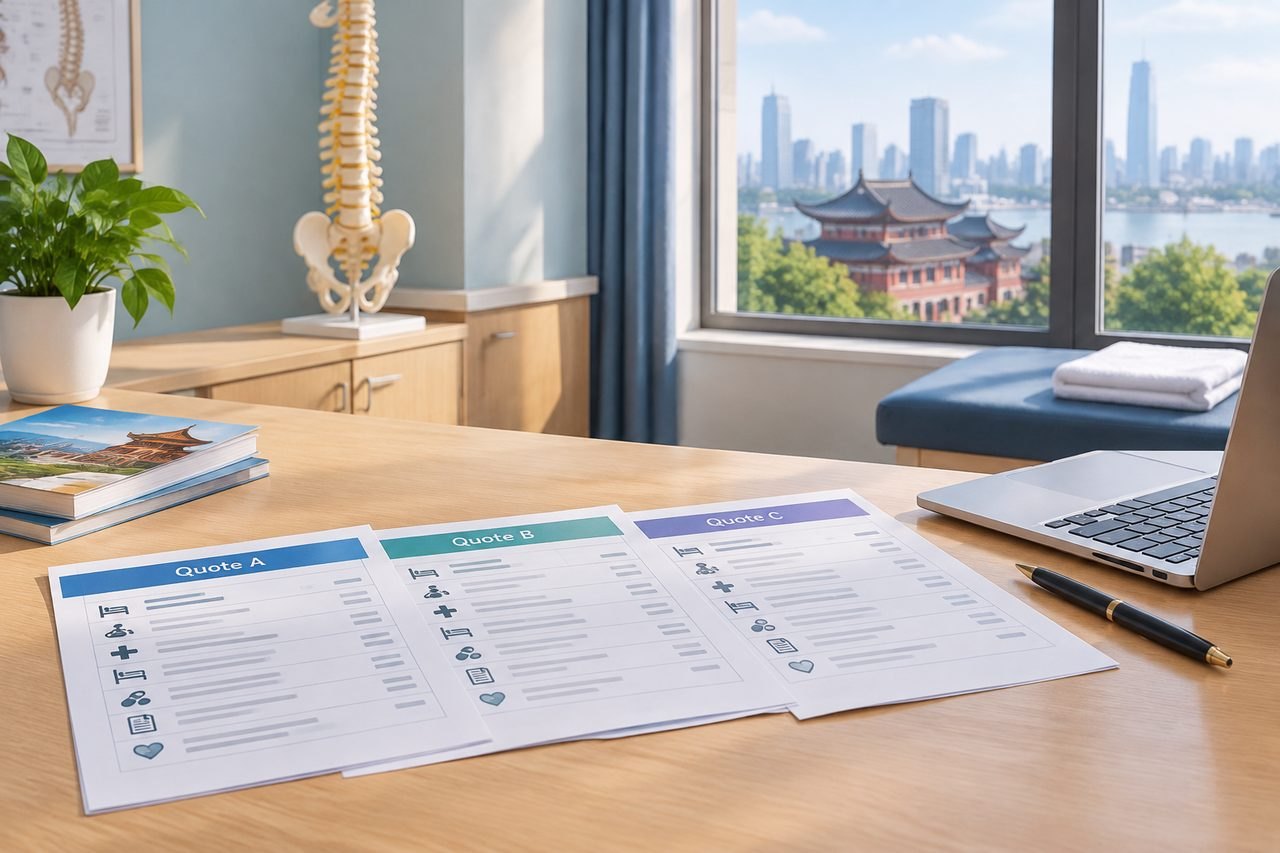
Once scope matches, compare structure. Ask each hospital for a written itemised quote that separates the main categories rather than presenting one figure. The categories worth requesting are consistent across providers even if the wording differs.
Ask for the surgical and theatre component, the ward or room category, the expected length of admission, investigations and imaging performed in China, medicines and consumables, and any rehabilitation or physiotherapy element. Then ask explicitly what is excluded and what is still undecided.
The "undecided" column matters most. Some items cannot be fixed before assessment: the final number of levels, whether a second procedure is needed, or how long inpatient care will run. A quote that hides these as a single total is harder to compare than one that names them.
Do not assume any component is billed separately or included by default. Ask the named hospital what its own written quote contains. That question, asked directly, is more useful than any general rule about how Chinese hospitals structure bills.
- Surgical and theatre component, with the procedure name and levels stated.
- Ward or room category and the admission length the quote assumes.
- Pre-operative investigations and imaging performed in China.
- Medicines, consumables and any implants, named where possible.
- Rehabilitation or physiotherapy element, if quoted.
- A written list of exclusions and items still undecided.
Ward choice, surgeon input and follow-up change the comparison
Two quotes for identical surgery can still differ because of the ward. A standard ward and an international or private ward are different products with different room charges, staffing ratios and language support. Neither is automatically right. The question is whether both quotes describe the same ward category, because if they do not, the totals are not comparable.
Surgeon input is another variable. Ask who would perform the procedure, how the team is structured, and whether the quoted fee assumes the same level of senior involvement in both hospitals. You are not choosing a named surgeon through an article; you are checking whether the two quotes describe equivalent clinical input.
Follow-up is the third variable. Ask what reviews are included, where they would happen, and what the plan is if you return home before the review schedule finishes. A quote that includes in-person follow-up in China is not the same as one that assumes follow-up elsewhere. Ask each hospital to state its own arrangement in writing rather than assuming a standard.
These three questions — ward, surgeon input, follow-up — often explain a gap between totals that otherwise looks arbitrary.
A short sequence for requesting and reading quotes
Send the same written request to each hospital so the replies can be placed side by side. Start with your diagnosis, imaging reports and the specific question your treating clinician at home has raised. Then ask for the itemised quote in the structure above.
When replies arrive, read them in a fixed order. First confirm the clinical scope matches: same levels, same procedure, no hidden second operation. Second confirm the ward and admission assumptions match. Third compare the itemised categories. Only then look at the totals.
If a reply is incomplete, do not fill the gaps with assumptions. Send one follow-up listing exactly what is missing: the levels, the procedure name, the ward, the admission length, the exclusions and the undecided items. A hospital that answers those points gives you something comparable; one that does not has not yet quoted the same service.
A reply confirms what that hospital has written down. It does not confirm hospital acceptance, a final price, or that the plan will not change after assessment. Those remain clinical and administrative decisions for the treating team.
When a step cannot be completed, and what to do next
Sometimes a hospital will not itemise before seeing the patient, or will only give a range. That is not necessarily a refusal to be transparent; it may reflect genuine uncertainty about the number of levels or the need for a second procedure. In that case, ask for the range to be tied to stated assumptions: "This range assumes two levels and a five-day admission; it would change if a third level is treated." An assumption-based range is comparable; a bare range is not.
If a hospital cannot answer the scope questions at all, treat that as information. It means you cannot yet compare that quote fairly, and you should either ask again more specifically or set it aside until the clinical picture is clearer.
New severe neurological symptoms need prompt local assessment, not overseas planning. If your symptoms are worsening, that takes priority over any quote comparison.
For the comparison itself, an initial enquiry is free and does not require buying a proxy consultation. You can send a brief summary of your diagnosis and main question, and ask what records each hospital needs before it can quote. ChinaSpecialistCare can help with records handling, interpretation and specialist appointment requests where that is useful, but clinical assessment, suitability and final pricing belong to the treating hospital.
Your next step is concrete: write one short request listing the levels, procedure, ward, admission length, exclusions and undecided items, and send the same wording to each hospital. Compare the replies in that order, and only then compare the totals.
Sources & scope of this guide
References and official service information relevant to this guide.
This is general planning information and has not been individually reviewed by a doctor. Medical decisions and personal treatment advice come from your treating clinicians.