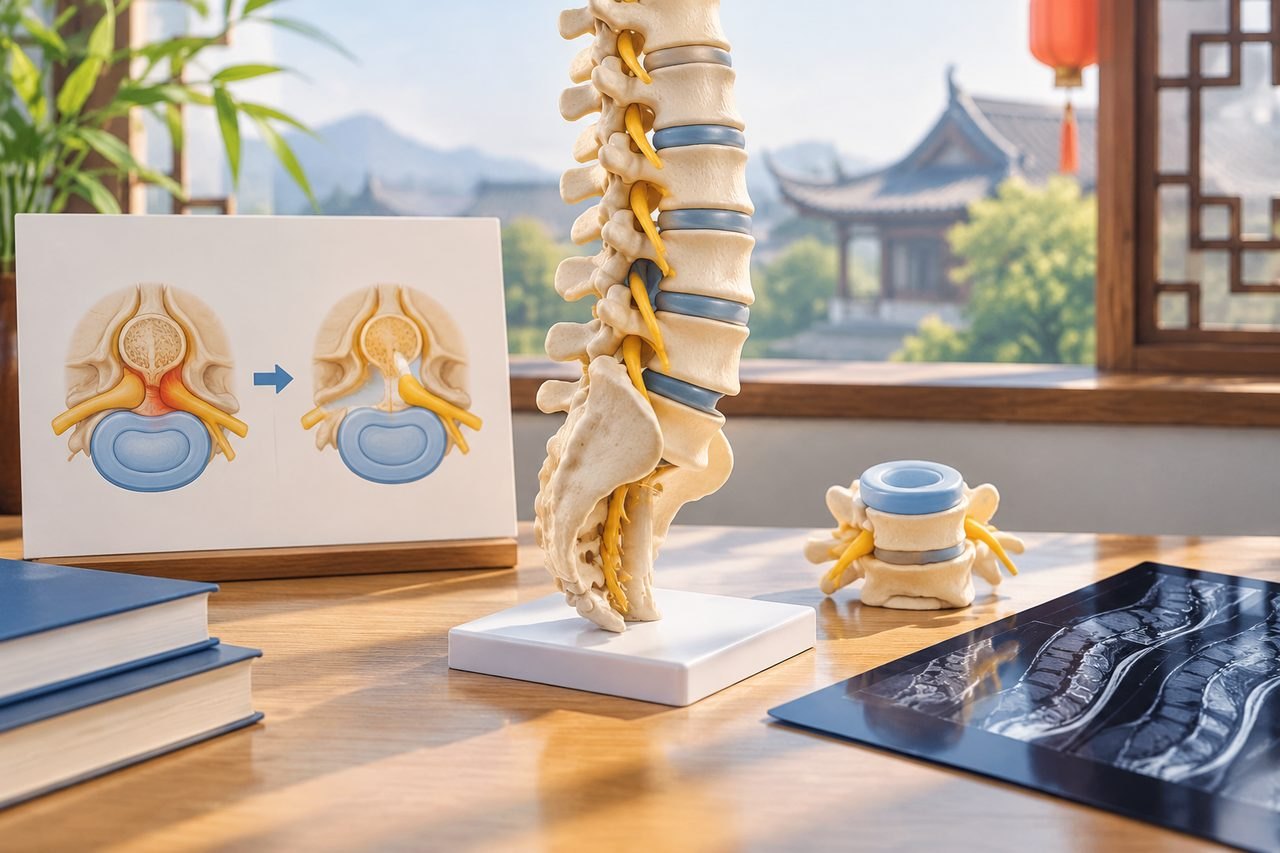
What Lumbar Decompression Is Designed to Address
Lumbar decompression is a procedure that aims to relieve pressure on nerves in the lower spine. The decision to consider surgery is based on your symptoms and the findings of a clinical assessment, not on a scan alone. This is the central point for any overseas patient: the operation has a defined anatomical target, and the symptoms it is intended to improve are those linked to nerve compression at specific levels.
The word decompression describes the goal, not a single fixed operation. Different surgical approaches can be used to reach the compressed nerves, and the appropriate route depends on the level or levels involved, the cause of the pressure, your overall health and the surgeon's judgement. This is why a general description of lumbar decompression cannot tell you exactly what will be done in your case.
The most useful question you can bring to a consultation is not simply whether decompression is possible, but which spinal level or levels are being considered and why. If the proposed target does not match the symptoms that bother you most, that mismatch needs to be discussed before any travel planning.
What Decompression Does Not Do
Lumbar decompression is not the same as lumbar fusion. Fusion is a different procedure with a different purpose, and the two should not be treated as interchangeable. If a surgeon proposes fusion, or decompression combined with fusion, ask directly what the fusion is intended to stabilise and why it is being added.
Decompression also does not promise that all back pain will resolve. Back pain and leg or nerve-related symptoms can have different causes, and relieving pressure on a nerve does not automatically address every source of pain. Some patients may still have symptoms after surgery, and the treating team should explain what improvement is realistic to expect and what is not.
Decompression is not a treatment for every spinal problem. It does not correct deformity, it does not reverse nerve damage that has already become permanent, and it does not replace non-surgical management where that remains appropriate. Whether surgery is needed at all is a clinical decision based on your assessment, not a service that can be arranged on request.
Why the Spinal Level Changes the Decision
The lumbar spine is not a single segment. Symptoms, examination findings and imaging need to point to the same level or levels before surgery is planned. If the imaging shows narrowing at one level but your symptoms suggest another, the team needs to reconcile that before proceeding.
This matters for overseas patients because the level or levels involved affect the proposed operation, the approach, the extent of the procedure and the recovery plan. A person with single-level compression and a person with multilevel disease may be offered different operations, and one may be a candidate for a less extensive procedure than the other.
Ask which levels are being considered, whether more than one level is involved, and whether the plan addresses all of them or only the most significant. If the answer changes between consultations, that is a signal to clarify what new information changed the recommendation.
Symptoms That Need Local Assessment First
New or worsening severe neurological symptoms require prompt local assessment. This is not a situation for overseas planning or for waiting on a records review. If you develop sudden weakness, loss of bladder or bowel control, saddle numbness or rapidly worsening leg function, seek urgent medical care where you are.
For less urgent symptoms, the assessment still needs to establish whether the pattern is stable, improving or deteriorating. A records-based opinion can discuss the available information, but it cannot replace an in-person examination, and it does not establish final eligibility or hospital acceptance.
If your symptoms are changing quickly, tell the clinical team before you travel. The treating hospital decides whether and when a procedure is suitable, and that decision depends on your condition at the time of assessment.
This is also where the level question becomes practical rather than academic. A person whose leg pain follows a single nerve root and whose imaging shows one clear compression point presents a different decision from someone with narrowing at several levels, back-dominant pain and no clear nerve pattern. The first situation may point toward a focused decompression; the second may need the team to weigh which level, if any, is driving the symptoms that matter most to you.
That distinction changes what you should ask. If your main problem is leg pain that worsens on walking and eases when you sit, say so plainly and ask whether that pattern fits the level being proposed. If your main problem is back pain, ask what the operation is expected to do for that specific symptom, because decompression targets nerve pressure rather than every source of back pain.
Symptoms can also change between the time you send records and the time you are examined. A nerve-related deficit that is improving, stable or worsening leads to different conversations. This is why a records-based opinion is a starting point for discussion, not a substitute for the examination that the treating hospital will perform before it decides on surgery.
If you are taking medicines for pain or other conditions, do not change them on your own before a clinician has reviewed your situation. Bring the current list to the consultation and let the treating team advise on what should continue, pause or be adjusted around any procedure.
Finally, keep a short written record of how your symptoms behave over the weeks before travel: what brings them on, what relieves them, and whether walking distance or leg strength is changing. That record is more useful to a surgeon than a general description of back pain, and it helps the team match the proposed level to the problem you actually experience.
Questions to Ask Before Planning Care in China
The quality of your preparation depends on getting specific answers, not on collecting a large file. Ask which spinal levels need treatment, what the proposed procedure is, and whether any additional procedure such as fusion is being recommended. Ask what the operation is intended to improve and what it is not expected to change.
Ask how mobility will be managed after surgery, what restrictions you should expect, and how later reviews would be arranged. If you are travelling from another country, ask how follow-up would work once you return home and what records you would need to take with you.
Ask what the written plan and estimate include, what remains undecided, and what would need to be confirmed after an in-person assessment. These are provider-specific questions, and the answers should come from the hospital and surgical team rather than from a general guide.
It is also reasonable to ask whether a second opinion is appropriate, what alternatives exist, and what the risks and uncertainties are for your individual situation. A clinician can discuss evidence-based risk estimates with you; no estimate guarantees an individual result.
- Which spinal level or levels are being considered, and why?
- Is the proposed operation decompression alone, or decompression with fusion?
- What is the operation intended to improve, and what may remain unchanged?
- How would mobility, restrictions and later reviews be planned?
- What does the written plan and estimate include, and what is still undecided?
Records, Coordination and the Next Step
For an initial enquiry, a brief summary is enough: your main symptoms, what has already been diagnosed, relevant imaging or reports you already have, and the specific question you want answered. You do not need to send a complete medical archive or payment details at first contact. After initial contact, the team can explain how to share records securely.
ChinaSpecialistCare provides information and non-clinical coordination. Diagnosis, suitability, hospital acceptance and treatment decisions belong to the treating hospital and licensed clinicians. Hospital consultations, tests, treatment and rooms are paid to the hospital or relevant provider; coordination fees are separate. An initial case review is free and does not require buying a proxy consultation.
The practical next step is to clarify the clinical question before making travel plans. Ask which levels need treatment, whether another procedure is proposed, and how mobility and later reviews would be planned. If the answers are not yet clear, that is the point to resolve, not a reason to book flights.
Sources & scope of this guide
References and official service information relevant to this guide.
This is general planning information and has not been individually reviewed by a doctor. Medical decisions and personal treatment advice come from your treating clinicians.