Why the MRI Conclusion Alone Is Not Enough
A lumbar disc herniation diagnosis report often ends with a short conclusion such as 'L4-L5 disc protrusion' or 'L5-S1 disc herniation with nerve root compression'. That sentence tells you something is visible on the scan. It does not tell the receiving clinician whether the finding matches your leg symptoms, how long the problem has been present, or whether the compressed structure is causing the weakness or numbness you feel.
The mismatch matters because disc bulges appear on many scans without causing leg pain. A clinician reviewing your case in China needs to connect the image to your body: which leg, which part of the leg, whether the pain travels below the knee, whether coughing or sitting worsens it, and whether you have noticed weakness, foot drop or changes in bladder or bowel control. Those details change the clinical question from 'is there a herniation' to 'is this herniation the cause of the problem we are treating'.
When you send only the written conclusion, the reviewing team may need to ask for the image files or disc before giving a meaningful opinion. Ask the imaging centre for the DICOM files or a disc, not just the printed report. If you already have them, note the format so the receiving hospital can confirm it can open them.
The Leg Symptom Details That Change the Assessment
Leg symptoms are the part of the history that helps decide whether a herniation is clinically significant. A report that says 'nerve root compression' is more useful when paired with a description of where the pain or numbness travels. Radicular pain follows a nerve pattern, for example down the back of the leg or along the outer shin into the foot. That pattern helps a clinician match the symptom to a specific nerve level.
Describe the quality and behaviour of the symptom, not only its location. Is it sharp, burning, electric or dull? Does it change with standing, walking, sitting or lying down? Does it wake you at night? Have you noticed any weakness, such as difficulty lifting the foot, tripping, or the leg giving way? Has the numbness spread or become constant? These are the details a spine team uses to judge severity and urgency.
Also record what you have already tried. Previous nonsurgical care such as physiotherapy, anti-inflammatory medication, activity modification or injections is relevant because it shows what has and has not helped. Bring the dates, the type of treatment and the response, even if the response was partial or temporary. Do not stop or change any prescribed medicine on your own; the treating clinician decides what continues.
If you have any new or worsening weakness in both legs, saddle numbness, or loss of bladder or bowel control, that is a reason to seek urgent local medical assessment rather than continue planning an overseas consultation.
What a Useful MRI Report Should Include
A useful report for a lumbar disc herniation review goes beyond the level of the disc. It should describe the type of herniation, whether the disc material is contained or extruded, whether it contacts or displaces a nerve root, and whether the spinal canal or the exit foramen is narrowed. It should also note the presence of other findings such as facet joint changes, ligament thickening or signal changes in the vertebral bodies, because these can influence the treatment discussion.
The report should state the level and side clearly. 'L4-L5 disc herniation' is less useful than 'left paracentral L4-L5 disc extrusion contacting the traversing left L5 root'. If the report uses vague wording such as 'possible' or 'mild', ask the imaging centre whether a more specific description is available. You are not asking for a new diagnosis; you are asking for the existing images to be described precisely.
If you have had more than one MRI, bring the dates and the reports together. A comparison can show whether the finding is stable, improving or changing. Do not assume that a newer scan automatically replaces an older one; the timeline can be clinically relevant.
Keep the original report in the language it was written in, and consider a certified translation if the receiving hospital requires one. Ask the hospital what language and format it accepts before paying for translation.
How the Report Guides the Choice Between Nonsurgical Care and Surgery
The MRI and leg symptoms together help the clinical team judge whether nonsurgical management is still reasonable or whether an operation should be discussed. Many people with a lumbar disc herniation improve with nonsurgical care, but the decision depends on the pattern of symptoms, the presence of weakness, the response to previous treatment and the imaging findings. A report that shows a large extrusion compressing a nerve, combined with progressive weakness, raises a different question from a small bulge with intermittent pain.
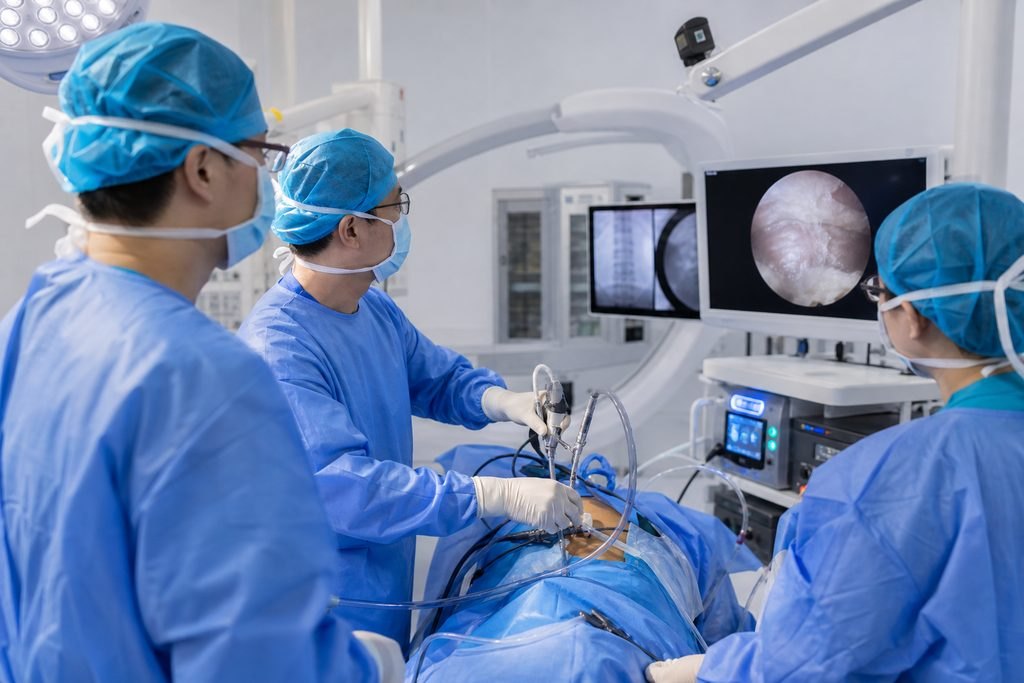
If surgery is considered, the approach is not decided by the MRI alone. Minimally invasive describes an approach rather than a specific operation; it can be used for different spinal operations, including decompression or fusion. The treating surgeon decides whether a minimally invasive route is suitable for your anatomy and problem, and what the alternatives are. Ask what the proposed operation is intended to achieve, what the alternatives are, and what the risks and expected recovery involve for your situation.
Do not treat a small incision as proof that an operation is minor. Any spinal operation has its own risks and recovery considerations, and the treating team should explain them. If you are comparing options, ask for the clinical reasoning in writing so you can review it with your local doctor if you wish.
Preparing Records for a China Spine Review
A China hospital review is more productive when the records are organised before you send them. Start with a short summary: your main symptom, when it began, which leg is affected, what you have tried, and your single most important question. Then attach the MRI report, the image files or disc, any previous imaging, and a list of current medicines with doses. If you have nerve conduction studies, X-rays or CT scans, include them as well.
Do not send passport numbers, payment details or a complete medical archive in the first message. A brief summary is enough for an initial enquiry. After first contact, the team can explain how to share larger files securely. If a document is missing, say so rather than guessing; the receiving clinician can then tell you whether it is needed.
Ask the hospital or coordination team what it needs in advance: whether it accepts DICOM files, whether it needs translated reports, and whether it wants the actual images or only the report. These are administrative questions to confirm with the specific provider, not assumptions to make from another country's practice.
If you are considering travel, keep the clinical decision separate from the travel decision. The hospital decides whether it can accept your case and what assessment is needed. An initial enquiry does not commit you to treatment, and a proxy consultation is optional rather than a prerequisite for every appointment.
Questions to Ask Before You Commit to a Plan
Before agreeing to any treatment plan in China, ask the clinical team to explain how your leg symptoms and MRI findings fit together. Ask which nerve level is involved, whether the finding matches your symptoms, and what the nonsurgical alternatives are. Ask what would make the team recommend surgery, and what the expected recovery and restrictions would be for your situation. Ask who will make the final decision about suitability and what happens if the assessment changes after you arrive.
Ask for the written plan to state what is included, what is excluded and what is still undecided. If a cost estimate is provided, ask which hospital fees, clinician fees, tests, medicines and follow-up visits it covers, and which are paid separately. Do not rely on a verbal summary alone. The hospital's own written quote is the authoritative document for its charges.
If you are not ready to travel, a records-based opinion can help you understand the options while you remain at home. It is a review of the information you provide, not a final clearance or a guarantee of acceptance. The treating hospital still decides suitability after any in-person assessment.
A practical next step is to prepare a one-page summary of your leg symptoms, the MRI report and the image files, then send a brief enquiry. An initial enquiry is free and does not require buying a proxy consultation. The team can then tell you what information is missing and which specialist route may be relevant.
Sources & scope of this guide
References and official service information relevant to this guide.
This is general planning information and has not been individually reviewed by a doctor. Medical decisions and personal treatment advice come from your treating clinicians.