
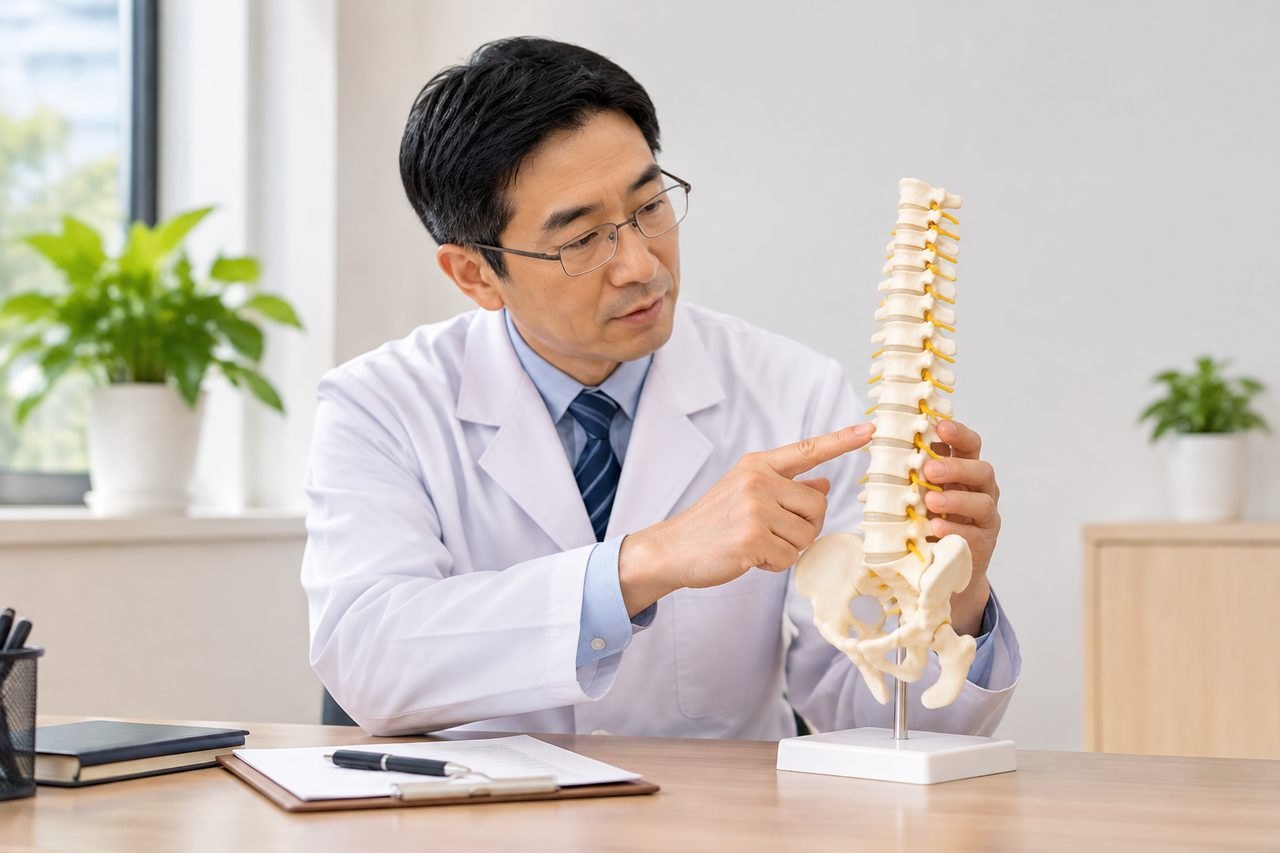
Decompression and fusion are not interchangeable
The most useful first step is understanding that these are two different answers to two different problems. Lumbar decompression — often a laminectomy or similar procedure — removes bone, ligament or other tissue that is narrowing the spinal canal or a nerve exit. Its aim is to give compressed nerves more room. Lumbar fusion joins two or more vertebrae so that a segment no longer moves, usually with bone graft and often with instrumentation such as screws and rods.
A fusion is sometimes performed together with decompression when the surgeon judges that removing bone would leave the spine unstable, or when there is a deformity or abnormal movement at that level. In other situations, decompression alone may be enough. The decision depends on the diagnosis, the imaging, the symptoms and the individual's overall health, and it belongs to the treating surgical team after a proper assessment.
This matters for overseas planning because the two operations differ in scale, hospital stay, rehabilitation and cost. If you arrive expecting decompression and the surgeon recommends fusion, your preparation and budget assumptions may no longer fit. Settling the likely procedure before travel is therefore a clinical question, not a logistics detail.
What the surgeon needs to see before advising you
A recommendation made without adequate imaging and a clinical examination is weak. For lumbar spine surgery, the surgeon generally needs to correlate symptoms with imaging rather than treat a report in isolation. Ask what your current records actually show and what, if anything, is missing.
Useful records to gather include your MRI report and images, any CT or standing X-rays, the radiology reports, a summary of your symptoms and how long they have lasted, treatments already tried such as physiotherapy or medication, and relevant medical history. If you have had previous spine surgery, the operative notes and prior imaging are important. Ask the receiving team whether they want the images themselves, not only the written report, and in what format.
A common planning error is assuming that a single MRI report settles the operation. It does not. The surgeon will want to know whether your pain and any leg symptoms match the level and type of compression seen, and whether there are features such as instability, slippage or curvature that change the plan. Those are questions for the clinical team, and the answers may only become clear after they review the full picture.
Questions that change the plan
Before committing to travel, it helps to write down the questions whose answers would genuinely change your decision. These are not a script to send in full; they are the points to raise with the surgical team.
First, what is the working diagnosis, and which structure is pressing on which nerve? Second, is there evidence of instability, deformity or abnormal movement at the affected level, and does that argue for fusion rather than decompression alone? Third, what are the alternatives — continued non-surgical management, a different type of decompression, or a less extensive operation — and why are they or are they not suitable for you? Fourth, what does the proposed operation involve in terms of approach, implants and expected hospital care?
Also ask about the risks the surgeon considers most relevant to you, and what the plan is if the findings during surgery differ from the imaging. These are legitimate questions, and a surgeon should be able to explain the reasoning. You are not expected to make the clinical choice yourself; you are trying to understand whether the recommendation is well founded and whether you have enough information to consent.
Fusion raises questions that decompression may not
Fusion is a bigger commitment than decompression, and it deserves its own set of questions. Ask which levels would be fused, what type of graft or implant is proposed, and whether the surgeon plans to use your own bone, donor bone or a synthetic substitute. Ask how the team will assess fusion over time and what follow-up imaging or appointments they expect.
Rehabilitation after fusion is a real part of the plan, not an afterthought. Ask what movement restrictions apply in the early period, what physiotherapy is recommended, and who will supervise it. The answers vary between patients and between surgeons, so treat any general statement you read online as a prompt for a question rather than a rule.
If you have other medical conditions, ask how they affect surgical risk and whether any assessment is needed before surgery. If you take medication that affects bleeding or bone healing, ask the treating team how it should be managed; do not change anything yourself. The surgeon and anaesthesia team decide fitness for surgery, and that decision cannot be made from a distance.
Planning care in China around the right procedure
Once the likely procedure is clearer, practical planning becomes more sensible. Orthopaedic and spine services in China are available through public tertiary hospitals and private international hospitals, and the route affects language support, ward type and scheduling. Ask the hospital what it can confirm in writing about the proposed operation, the ward options and the expected length of stay; do not assume a particular ward or timeline.
Cost is a separate question from clinical suitability. Published reference figures for spinal procedures are indicative ranges, not fixed or guaranteed quotes, and the final price requires an individual assessment and written confirmation of the treatment plan and fee scope. Decompression and fusion are different operations, so ask for a quote scoped to the procedure the surgeon actually proposes rather than inferring one from the other. Ask the hospital what its written quote covers and what is arranged separately, including implants, tests, medicines, room and follow-up.
Ask the hospital what its written quote covers and what is arranged separately, including implants, tests, medicines, room and follow-up. Do not assume that any item is included or excluded. Coordination fees, travel and interpretation are separate from hospital charges. A records-based review can help clarify the likely procedure and the questions to put to the surgical team, but it does not replace an in-person assessment or guarantee hospital acceptance.
A sensible next step
Start by gathering your imaging, reports and a short summary of your symptoms and previous treatment. An initial enquiry is free: our team can check what you have, identify obvious gaps and suggest the relevant next step. That is not a diagnosis or a promise of acceptance, and you do not need to buy a proxy consultation to make an initial enquiry.
The hospital and its surgeons decide suitability, the operation and the plan. Your job before travel is to make sure they have enough information to give you a considered answer, and that you understand what they propose and why.
Sources & scope of this guide
References and official service information relevant to this guide.
- Related treatment reference
- Overview | Low back pain and sciatica in over 16s: assessment and management | Guidance | NICE
- Lumbar decompression surgery - NHS
This is general planning information and has not been individually reviewed by a doctor. Medical decisions and personal treatment advice come from your treating clinicians.