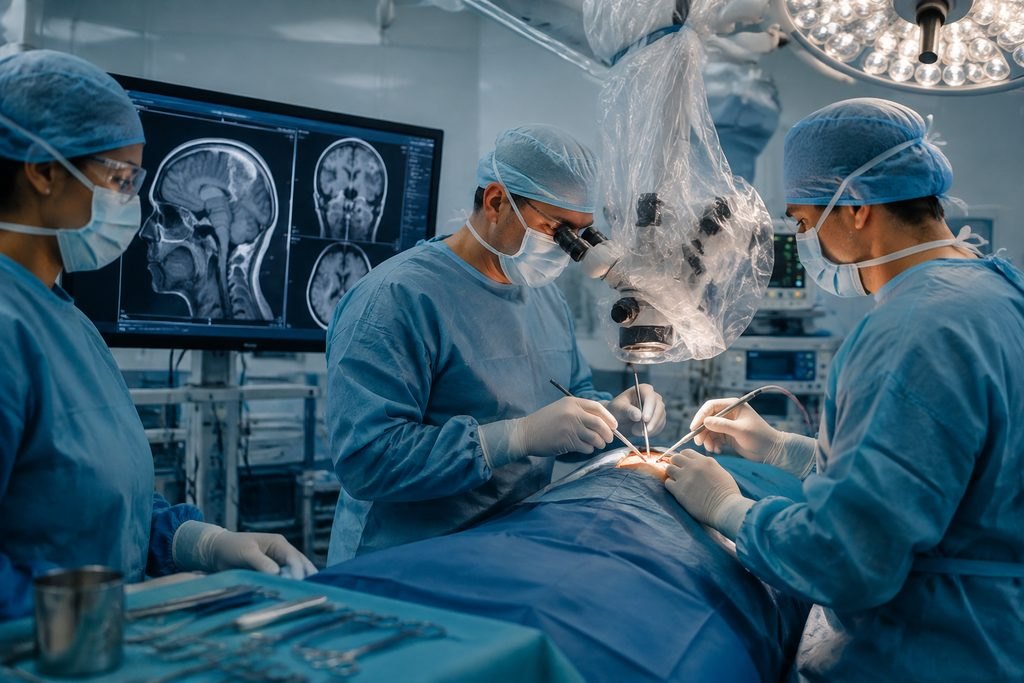
Why location, not the diagnosis label, drives the decision
A meningioma diagnosis on its own does not tell you what should happen next. The same tumour type can sit in a place where it causes few problems and can be monitored, or in a place where it presses on structures that matter for vision, hearing, balance, speech or movement. That is why a specialist does not begin with the question "should this be removed?" but with "where is it, what is it touching, and what is it doing to this patient?"
Location also changes what an operation would involve. A tumour near the skull base sits close to nerves and blood vessels, while a tumour over the brain's outer surface may be approached differently. These are surgical-planning questions, not something you can settle from a radiology report alone. The treating neurosurgeon needs the images themselves, not only the written impression, to judge how the tumour relates to surrounding anatomy.
This is the first reason location matters for an overseas enquiry. It tells you whether your case is straightforward for a records-based discussion or whether the team will want more imaging detail before saying anything useful. It also tells you which specialists should look at the file: a skull base tumour may need input beyond a single neurosurgical opinion.
Growth history: the comparison your scans must support
A single scan shows the tumour now. Two scans separated in time show whether it is changing. That comparison is often as important as the tumour's position, because a stable tumour and a growing tumour at the same location can lead to different discussions. If you have earlier imaging, it is worth asking the receiving team whether they want those older studies alongside the most recent ones.
This is a practical point for international patients, because older scans are often left behind. If you only send the latest MRI report, the specialist may be unable to comment on growth. Ask directly: which prior scans do you need, in what format, and do you want the original image files rather than the radiologist's summary? The answer will be specific to the hospital and the case.
Growth history also interacts with symptoms. A tumour that has enlarged slightly but causes no new problems is a different conversation from one that has grown and is now affecting vision. The treating clinician weighs both. Your job before an enquiry is to make that weighing possible by supplying the timeline, not to interpret it yourself.
What a China-based specialist review can and cannot settle
A records-based review can give you a considered opinion on what the imaging shows, how the location relates to your symptoms, and what management options are worth discussing. It can also identify what is missing from your file. It cannot examine you, test your vision or balance in person, or confirm that a particular hospital will accept your case.
That distinction matters when you are deciding whether to travel. A remote opinion is a step toward a decision, not the decision itself. Final suitability for surgery, observation or another approach belongs to the treating hospital and its clinicians after they have assessed you and your records. No review can promise that an operation will be offered, or that a particular surgeon will take the case.
For a meningioma, the location question often determines how much uncertainty remains after a paper review. A tumour in a sensitive area may need in-person assessment and possibly additional imaging before the team can give you a clear plan. A more accessible tumour may allow a firmer preliminary discussion. Either way, treat the remote opinion as a way to prepare better questions, not as a final answer.
Surgery, observation or further assessment: how the discussion is framed
Meningioma management depends on the tumour's location, the symptoms it causes and the overall clinical assessment. Surgery is not the only possible approach. Some tumours are monitored with repeat imaging, some are treated, and some need more information before either path is chosen. Which applies to you is a clinical judgement, not something a guide can assign.
When you speak with a specialist, the useful question is not "do I need surgery?" but "what are the options for a tumour in this location, and what would make you favour one over another?" That invites the clinician to explain the reasoning: what the location makes difficult, what the risks of operating there would be, and what monitoring would involve. It also surfaces whether further tests are needed before a recommendation is possible.
If surgery is discussed, ask how the location affects the approach, what the team would need to confirm beforehand, and what the alternatives are. If observation is discussed, ask what would trigger a change in plan. These are the questions that turn a general diagnosis into a decision you can actually weigh.
Preparing your records so location can be assessed properly
The quality of a remote review depends on what you send. For a meningioma enquiry, the most useful items are usually the actual imaging files from your most recent scan, any earlier scans that allow comparison, the radiology reports, a clear summary of your symptoms and when they started, and a list of treatments or medications you are currently receiving. Ask the receiving team which of these they want and in what format before you send a large file.
Do not send passport numbers, payment details or a complete medical archive at the first contact. A short summary is enough to begin. Once the team confirms interest, you can share records through the channel they specify. If you are unsure whether an older scan is relevant, ask rather than assume it is not.
It also helps to write down your own questions before the review. What do you most want to know: whether the tumour is growing, whether your symptoms are explained by its position, whether surgery is an option, or what monitoring would involve? A focused question gets a more useful answer than a general request for an opinion.
- Most recent imaging files, not only the written report.
- Earlier scans that allow the team to compare growth over time.
- Radiology reports for each study you send.
- A short symptom timeline: what changed, when, and how it affects daily life.
- Current medications and any previous treatment for the tumour.
Practical next step for an overseas patient
If you are considering care in China for a meningioma, the sensible first move is a free initial enquiry with a short summary of your situation and your main question. The team can then tell you what is missing from your records and which type of review fits your case. A proxy consultation is optional and is not required before every appointment or operation.
Before you commit to travel, confirm with the specific hospital what its assessment process involves, what records it needs, and how it would discuss surgery, observation or further assessment with you. Those answers belong to the treating team, and they will depend on where your tumour sits and what your imaging shows. Use the enquiry to clarify the path, not to skip it.
Sources & scope of this guide
References and official service information relevant to this guide.
This is general planning information and has not been individually reviewed by a doctor. Medical decisions and personal treatment advice come from your treating clinicians.