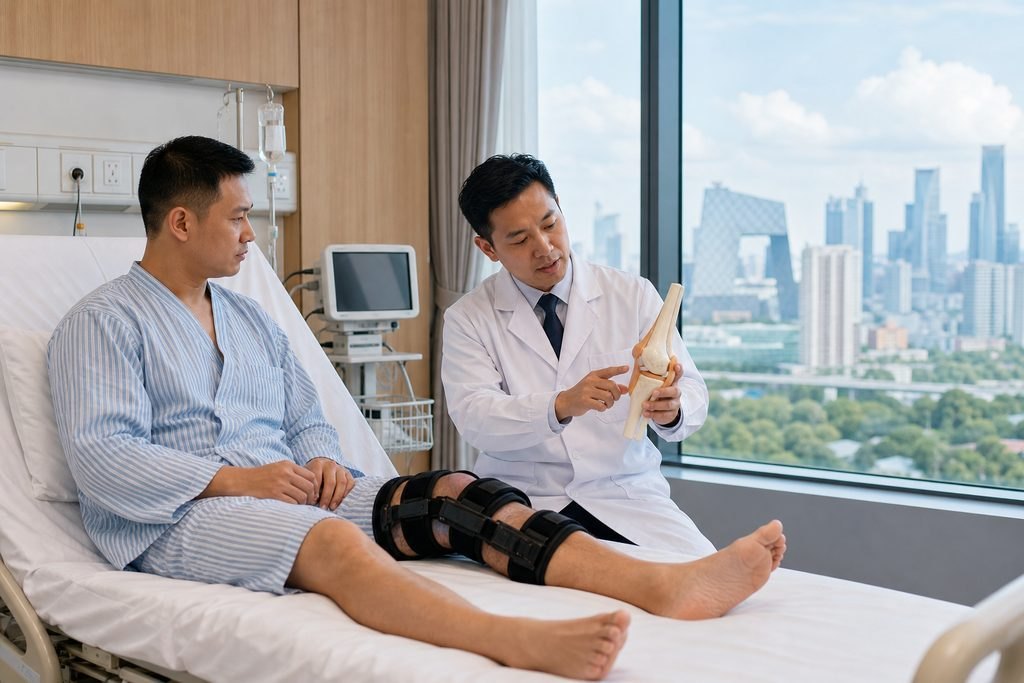
What a changed recommendation usually reflects
A changed recommendation is common enough that it should not be treated as a contradiction. Meniscus repair and partial meniscectomy are different procedures, and the choice depends on the tear characteristics and the condition of the wider knee. A clinician who has not seen the original MRI images, or who is working from a short summary, may reasonably reach a different view. The useful question is not which recommendation is correct in the abstract, but which facts each recommendation rests on.
Three facts do most of the work. First, the tear location and pattern as described on the MRI report and visible on the images. Second, what has already been done for the knee, including any previous arthroscopy, injections, bracing or physiotherapy. Third, the goal you are trying to reach, whether that is returning to a sport, reducing daily pain, or avoiding a larger operation later. If any of these is missing or vague, a changed recommendation is hard to evaluate.
This is why a records-based review can be useful before travel. It is not a diagnosis and it does not confirm that a procedure will be offered. It does show whether the records you have are sufficient for a specialist to explain the reasoning, and it identifies what is missing.
The MRI details that matter more than the report conclusion
An MRI report often ends with a one-line conclusion, and that line is what gets forwarded. The conclusion is a summary, not the whole picture. For a meniscal tear, the location relative to the blood supply, the tear pattern, the size, and whether the tear is stable or displaced all influence what can be done. The report may also describe cartilage, ligament or alignment findings that change the priority.
If you are seeking a second view, ask the imaging department for the actual images, not only the report. A specialist reviewing images can form an independent opinion; a specialist reading only a conclusion is limited to commenting on that conclusion. Ask whether the images are available on disc or through a secure link, and whether the original report is in English or needs translation.
Do not assume that a newer scan is automatically required. Whether additional imaging is needed is a clinical decision for the treating team, and it depends on the quality of what you already have and the question being asked. The practical step is to ask the receiving clinician what they would need to see, rather than to order tests in advance.
Previous knee treatment and what it tells the next clinician
A history of previous knee treatment is not background detail; it is part of the decision. If you have had arthroscopy before, the operative report describes what was found and what was done. If you have had injections, the type and timing matter. If you have completed a course of physiotherapy, what changed and what did not is useful information.
Gather these records in a simple order: imaging reports and images, operative notes, discharge summaries, injection records, and a short note of your current symptoms and function. A one-page summary in your own words is often more useful than a large unorganised file, because it tells the clinician what you are trying to decide.
The goal is not to send everything. The goal is to send what answers the question being asked. If the question is whether repair is possible, the tear description and the state of the cartilage matter. If the question is whether surgery is needed at all, the response to non-surgical care matters. Ask the receiving team what they want before you send a full archive.
Repair, partial meniscectomy or non-surgical care: what each depends on
Meniscus repair and partial meniscectomy are different procedures with different implications. Repair aims to preserve meniscal tissue, and it depends on the tear being in a location and pattern that can heal. Partial meniscectomy removes the torn portion, and it depends on the tear being the source of the symptoms. Non-surgical care may be appropriate for some tears, particularly where symptoms are settling or where the tear is not causing mechanical problems.
These are not ranked options. Each depends on the individual knee, and the treating clinician is the person who can weigh the trade-offs. What you can do is make sure the records allow that judgement to be made, and ask directly what each option would mean for your goal.
Useful questions for the clinical team include: what in my imaging supports this recommendation; what would need to be different for the alternative to be preferred; what does rehabilitation involve after each option; and what happens if I do nothing for now. The answers are specific to your knee, and they are the reason a records-based discussion is more useful than a general comparison.
What to verify before committing to care in China
If you are considering care in China, the practical questions are about the provider, not about the country. Ask the hospital or clinic what records they need, how they will review them, and who will explain the plan. Ask whether the review is a records-based opinion or an in-person assessment, and what each can and cannot confirm. A records-based opinion does not establish final eligibility or hospital acceptance; those are decisions for the treating hospital and licensed clinicians.
Ask for the written scope of any coordination service you are considering, including what is included, what is excluded, and what remains undecided. Hospital consultation fees, tests, treatment and rooms are paid to the hospital or relevant provider, and coordination fees are separate. Do not rely on a verbal estimate for a procedure; ask what the written quote covers and what it does not.
Rehabilitation instructions depend on the actual procedure performed, so they cannot be settled before the procedure is decided. Ask the treating team what rehabilitation would involve for each option under discussion, and who would supervise it. If you are travelling, ask how follow-up would be arranged and what would happen if a complication occurred after you returned home.
A practical order for resolving the disagreement
Start with the records, not the decision. Obtain the MRI images and the full report, the operative notes from any previous knee surgery, and a short summary of your current symptoms and goals. Then ask the clinician whose recommendation changed what specifically prompted the change. A written answer to that question is more useful than a general second opinion.
If the answer is that the original recommendation rested on a detail that is now unclear, the next step is to clarify that detail. If the answer is that the two clinicians are weighing the same facts differently, that is a genuine clinical disagreement, and it is reasonable to seek a third view with the full records available. If the answer is that the recommendation changed because your symptoms changed, that is a different situation and should be assessed on its own terms.
Do not delay necessary local care while pursuing an overseas enquiry. If your knee is locking, giving way, or causing severe pain, that needs prompt local assessment. An overseas records review is a planning step, not a substitute for urgent care.
If you would like help organising records, requesting a specialist appointment, or arranging interpretation for a consultation in China, you can start with a brief summary through the enquiry form. An initial enquiry is free and does not require buying a proxy consultation. The hospital decides suitability, and a review does not confirm that any procedure will be offered.
Sources & scope of this guide
References and official service information relevant to this guide.
This is general planning information and has not been individually reviewed by a doctor. Medical decisions and personal treatment advice come from your treating clinicians.