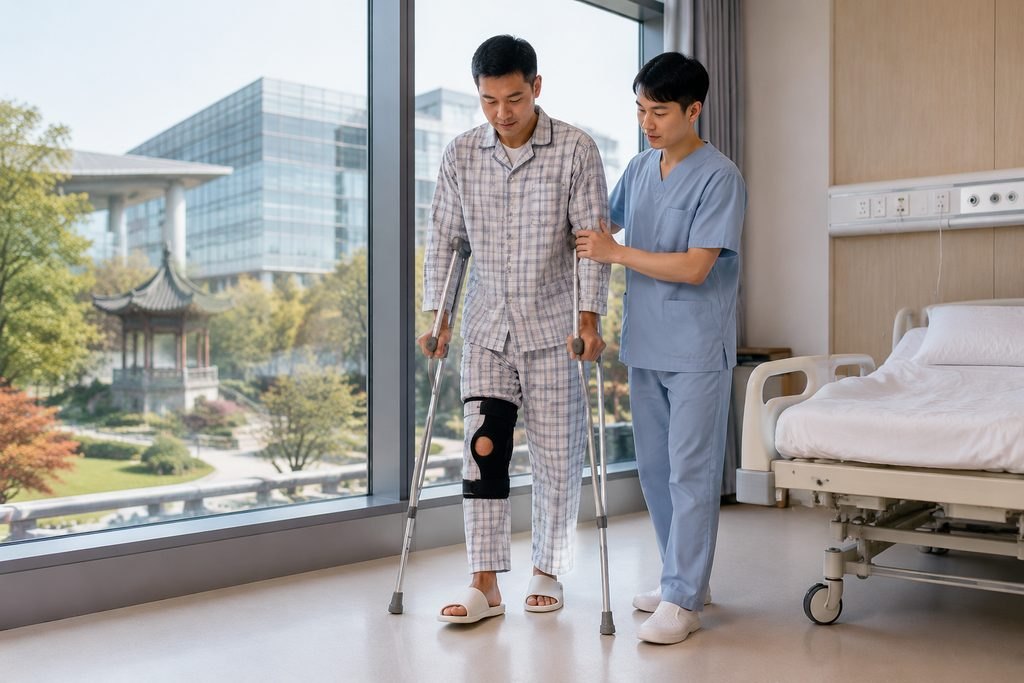
What a parallel review can and cannot decide
A meniscal tear review in China is a records-based exercise. You send imaging, operative notes if any, and a short history; a specialist or a coordination team helps route that material to an orthopedic clinician. The output is an opinion about the tear and the knee, not a command to stop what you are doing. Your local clinician remains the person who examines you, knows your response to treatment and holds responsibility for your ongoing plan.
The distinction matters because meniscus repair and partial meniscectomy are different procedures. Tear characteristics and the wider condition of the knee affect which direction is reasonable, and rehabilitation instructions depend on the actual procedure performed. A remote reader can comment on the images and the record. They cannot confirm how your knee behaves under load, how it has responded to physiotherapy, or what your local team has already tried and observed.
So treat the review as a second set of eyes on the same evidence, not as a replacement pathway. If the two opinions differ, that difference is useful information for a conversation with your current clinician, not an instruction to switch.
The records that make a meniscal review useful
The quality of a remote opinion is limited by what the reader can see. For a meniscal tear, the MRI images themselves matter more than the radiologist's summary paragraph, because tear location, pattern and extent are read from the pictures. Ask your imaging centre for the DICOM files or a disc, not only the printed report. If you have had more than one scan, send both so the reader can see change over time.
Alongside imaging, a short clinical summary helps: when the knee first became symptomatic, what movements provoke it, whether it locks, catches or gives way, and what treatment you have already had. That includes physiotherapy, injections, bracing, activity modification and any previous knee surgery. Operative notes and discharge summaries from earlier procedures are worth including if they exist.
You do not need to send a complete medical archive at first contact. A brief summary plus the key imaging is enough for an initial check of what is present and what is missing. The team can then tell you which additional documents would actually change the picture. Sending everything indiscriminately slows the process and adds nothing.
One practical point: records travel better in a consistent format. Label files clearly by date and type, and keep a simple list of what you have sent. If a document is in another language, ask whether translation is needed before the review, rather than assuming it will be handled.
Questions that keep the two plans from colliding
The risk in a parallel review is not that it happens, but that it produces advice your local team never sees. You can prevent that by deciding in advance what you want the review to answer. Vague requests produce vague replies. Specific questions produce something you can actually take back to your clinician.
Useful questions include: given this tear's location and pattern, what does the imaging suggest about repair versus removal; what additional information would change that view; and what does the reviewing clinician consider the main uncertainty in my case. You can also ask whether the review team sees any feature of the wider knee condition that deserves attention. These are questions about reasoning, not requests for a verdict.
It also helps to tell the reviewing team what your local plan currently is. If you are in physiotherapy, say so. If surgery has been discussed but not scheduled, say that. A reviewer who knows the current direction can comment on it directly instead of offering a generic menu of options.
Finally, ask how the opinion will be delivered. A written summary you can forward is more useful than a verbal impression. Confirm whether it will state the limits of a records-based assessment, because that framing helps your local clinician interpret it correctly.
How to sequence the steps without pausing treatment
Nothing about an overseas review requires you to interrupt local care. The sensible order is: continue what you are doing, gather records in parallel, request the review, then take the result to your existing clinician. If your local team has scheduled something time-sensitive, keep that appointment. A remote opinion that arrives later is still useful; a delayed local assessment may not be.
Start with a short enquiry describing the knee, the tear as you understand it, and what you want the review to address. After that first contact, the team can explain how to share imaging and records securely. Do not send passport numbers, payment card details or a full medical archive at the enquiry stage.
Once records are received, the next step is usually a check of whether the material is sufficient and which clinician or specialty is relevant. Only then does a substantive opinion become possible. If something is missing, that should be raised with you rather than guessed at.
If a step cannot be completed, there is a fallback. If imaging cannot be exported, a detailed radiology report plus a clear clinical summary still gives a reader something to work with, though the opinion will be more limited and should say so. If translation is unavailable, ask whether the review can proceed in the language you have. If no clinician is available for the specific question, that is worth knowing early rather than after payment.
What a reply confirms, and what it leaves open
A written opinion confirms that a clinician has read your records and formed a view. It does not confirm that you are a candidate for any particular procedure, that a hospital would accept you, or that a specific surgeon would take your case. Those decisions belong to the treating hospital and licensed clinicians, and they depend on examination and local assessment.
It also does not establish that a procedure is available on any particular schedule, or what it would cost. If you later want an estimate, ask the named provider what its written quote includes, excludes and leaves undecided. Do not assume that any component is billed separately or included; ask.
If travel to China becomes a serious consideration, the questions to confirm with the specific hospital include how appointments are arranged, what language support exists, what the admission process requires and how follow-up after discharge would work. These are provider-specific matters, not China-wide facts, and they should be answered in writing by the institution involved.
Keep the review result in perspective. It is one input among several, and your local clinician's examination remains central. If the two views align, that is reassuring. If they diverge, the divergence itself is worth discussing rather than resolving by choosing the answer you prefer.
Where coordination helps, and the next step
Confirmed coordination can help with practical, non-clinical tasks: organising records into a usable form, arranging interpretation, and requesting a specialist appointment or a records-based opinion. It does not decide clinical questions, prescribe treatment, or promise that a hospital will accept a case. Those remain with the clinicians involved.
If you want to explore this, an initial enquiry is free and does not require buying a proxy consultation. A brief summary of the knee, the tear and your main question is enough to start. From there, the team can tell you what is missing and what the relevant next step would be.
The most useful thing you can do now is keep your local care in place and prepare your imaging and history in parallel. That way, whatever the review concludes, you are not choosing between two plans under time pressure.
Sources & scope of this guide
References and official service information relevant to this guide.
This is general planning information and has not been individually reviewed by a doctor. Medical decisions and personal treatment advice come from your treating clinicians.