Why tear location changes the operation being discussed
Meniscus repair and partial meniscectomy are different procedures, not two names for the same operation. Repair aims to preserve meniscal tissue; partial meniscectomy removes torn tissue. Which one is considered depends on tear characteristics and the condition of the wider knee, not on the word 'tear' by itself.
Location is one of those characteristics. A tear in a region with limited blood supply behaves differently from one in a better-vascularised zone, and the pattern matters too: a clean longitudinal tear is not the same problem as a complex degenerative tear. That is why a report line such as 'medial meniscal tear' is a starting point, not an answer.
For an overseas patient, this distinction changes the question you are asking. You are not only asking whether surgery is needed. You are asking which procedure is being proposed, why that procedure fits this tear, and what the alternative would mean for your knee.
What the MRI report usually does not tell you
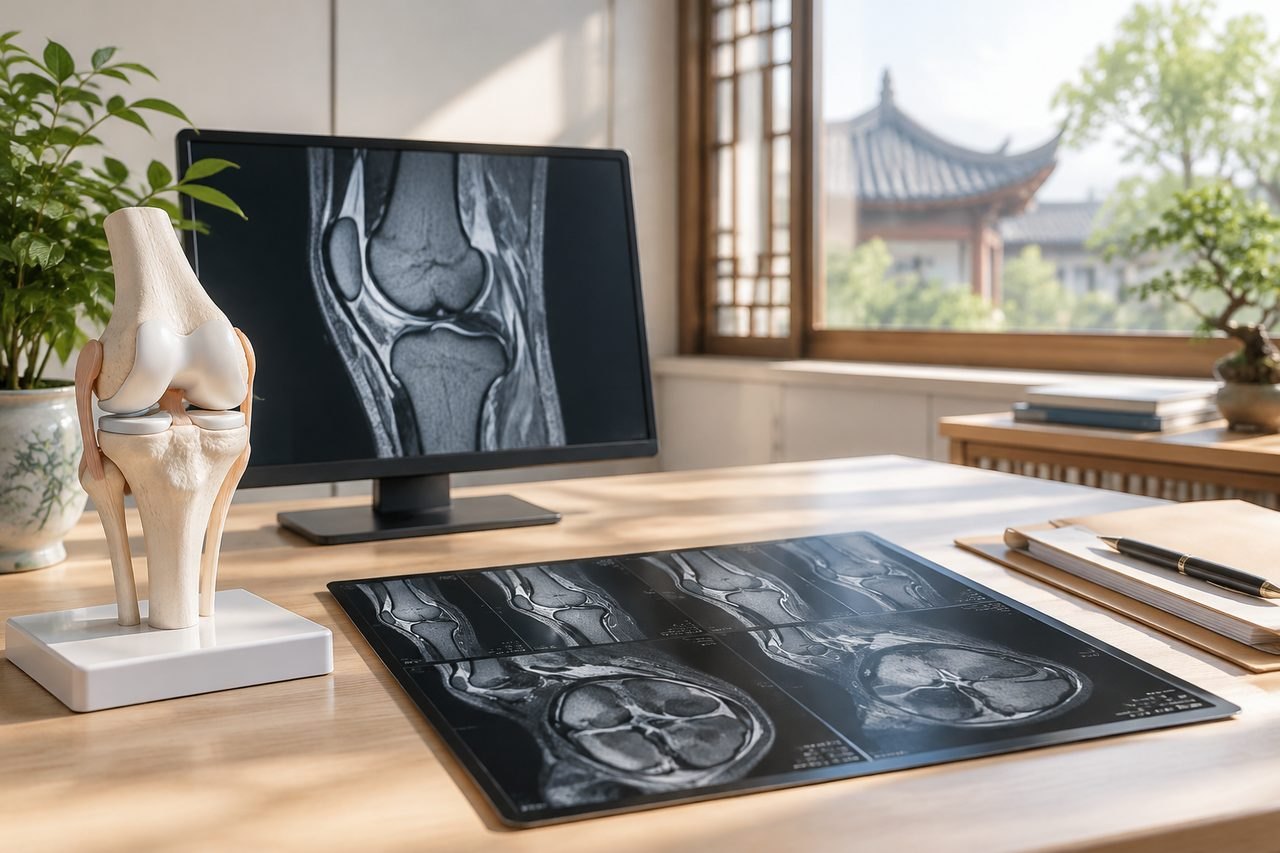
A radiology report describes what the radiologist saw. It does not select an operation. Reports vary in how precisely they describe tear location, extent, pattern and stability, and they may not fully capture cartilage, ligament or alignment issues that influence the surgical plan.
This is why sending only the written report to a surgeon is often not enough. The images themselves let the treating surgeon examine the tear on the sequences that matter and correlate it with your examination findings. If the images are not available, the review is limited, and you should be told that limitation rather than given a confident plan.
A practical consequence: when you ask about care in China, ask whether the surgeon will review the actual MRI images or only the report. The answer determines how much weight the opinion can carry.
Records that make a tear-location review possible
The goal is a file that lets a surgeon understand your knee over time, not just on one day. Start with the MRI images on disc or via a secure download link, plus the full written report. Include the date of the scan and the name of the facility.
Add your knee history: when symptoms began, what happened at the time of injury if there was one, whether you have had locking, catching, giving way or swelling, and how the knee behaves now with walking, stairs, sport or work. Note any previous knee surgery, injections or physiotherapy, and what helped or did not.
Include current medications and relevant conditions, since these can affect surgical planning and anaesthesia discussions. If you have X-rays or a CT scan, include them. If you have a recent examination note from an orthopaedic clinician, include it. Do not send passport numbers or payment details at the enquiry stage; those are not needed to begin.
- MRI images, not only the report, with the scan date
- A short timeline of knee symptoms and any injury
- Previous knee treatment, surgery, injections or physiotherapy
- Current medications and relevant medical conditions
- Any X-rays, CT scans or recent orthopaedic examination notes
Questions that turn an MRI report into a decision
Ask the surgical team to explain the tear in plain terms: where it sits, what pattern it follows, how extensive it is, and whether it appears stable or unstable. Then ask how those features affect the choice between repair, partial meniscectomy and non-surgical management for your knee.
Ask what would make repair more or less suitable in your case, and what the trade-offs are. Repair and partial meniscectomy differ in rehabilitation demands and in what they mean for the meniscus long term; the treating surgeon should explain those differences for your situation rather than in general.
Ask what else in the knee influences the plan, such as cartilage wear, ligament stability or alignment. Ask whether further imaging or examination is needed before a recommendation can be made. Ask what the rehabilitation instructions would be after the specific procedure proposed, because those instructions depend on the actual operation performed.
Finally, ask what is still uncertain. A good review states its limits. If the surgeon cannot judge repairability from the records alone, that should be said directly.
Previous knee treatment and why it belongs in the file
If you have already had knee surgery, the previous operative report matters more than a one-line summary of it. It records what the surgeon saw inside the joint, what was removed or repaired, and which compartments were involved. That record changes how the current tear is read: a new tear in a knee that has already lost meniscal tissue is a different problem from a first tear in an intact meniscus, and the range of sensible options narrows or shifts accordingly. Arthroscopy images or video, if the hospital gave you copies, add detail that a written report compresses.
Previous conservative treatment matters for the same reason. A documented course of physiotherapy, activity modification or injections, and how your knee responded to each, tells the reviewing team whether non-surgical management has genuinely been tried and what your knee tolerates. It also shows which symptoms persisted despite that treatment, which is often the more useful information. Bring dates and a short description of the response rather than a general statement that physiotherapy did not help.
This history also shapes what you should ask. A knee with prior meniscal surgery is not the same starting point as a first-time tear, so ask the surgeon to explain how your previous treatment changes the current recommendation and whether any earlier findings need to be revisited. If the earlier operation was done elsewhere and the report is unavailable, say so plainly; the reviewing clinician can then tell you whether the current images are sufficient to form a view or whether the missing history limits what can be concluded.
One practical point about timing: if your previous surgery was recent, the healing stage of that knee affects how the current tear is interpreted, and the surgeon will want to know how much time has passed and what rehabilitation you have completed since. If it was years ago, the more relevant question is what changed recently and what your knee can do now compared with before. Either way, the previous records are not a formality; they are part of how the tear is judged.
Planning the China review without overcommitting
You can begin with a short summary and the key records. A free initial case review checks the available diagnosis, records and your main question, identifies what is missing and suggests a relevant next step. It is not a diagnosis and does not promise hospital acceptance.
If a records-based opinion from a hospital specialist would help before you travel, that can be arranged as an optional proxy consultation while you remain at home. It is not a prerequisite for every appointment or operation. For a complex knee problem, a review involving more than one relevant specialty may be discussed, with scope and fee agreed first.
If you decide to travel, specialist matching and appointment coordination can be requested, and hospital, treatment and surgery coordination can follow after hospital acceptance. Hospital consultation, test, treatment and room charges are paid to the hospital or provider; coordination fees are separate. Ask for the written scope of any quote, including what is included, excluded or still undecided, and who receives each payment.
Do not delay necessary local care while an overseas enquiry is in progress. If your knee locks, cannot bear weight, or worsens significantly, seek local assessment first.
A useful next step is to gather the MRI images and report, write your main question in one or two sentences, and send that short summary through the enquiry form, email or WhatsApp. You can share fuller records after first contact. The hospital and its clinicians decide suitability and the treatment plan.
Sources & scope of this guide
References and official service information relevant to this guide.
This is general planning information and has not been individually reviewed by a doctor. Medical decisions and personal treatment advice come from your treating clinicians.