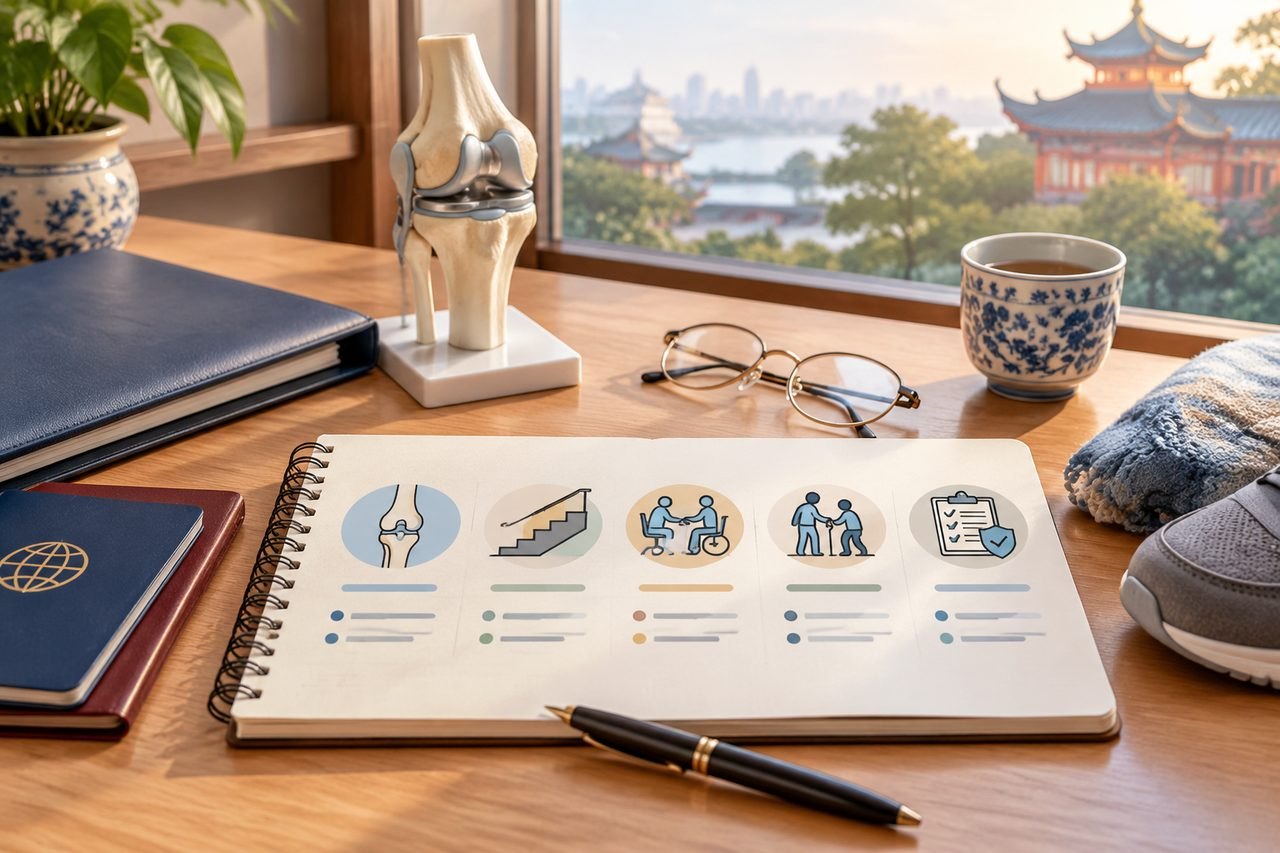
Why the Procedure Type Changes Your Support Plan
Meniscus surgery is not one single operation. A meniscus repair and a partial meniscectomy are different procedures, and the tear pattern and the condition of the rest of the knee affect which approach a surgeon may recommend. Because of this, rehabilitation instructions and mobility restrictions are tied to the procedure actually performed, not to the general label 'meniscus surgery'.
For an international patient, this matters for logistics. If you assume you will walk normally after surgery and book a hotel with no lift and a long walk to the clinic, you may struggle if the surgeon later advises crutches and restricted weight-bearing. If you assume you will be on crutches for weeks and arrange unnecessary equipment, you may waste money and effort. The practical answer is to ask the clinical team for procedure-specific guidance before you finalise travel.
- Ask whether the planned procedure is likely to be a repair or a partial meniscectomy, and whether that decision will be confirmed during surgery.
- Ask what mobility aids the hospital can provide or arrange, and what you should bring or buy yourself.
- Ask whether a knee brace or immobiliser may be needed and who will fit it.
Questions to Ask Before You Book Flights and Accommodation
Once you have a provisional surgical plan, ask the clinical team a short set of practical questions. The answers change what you book. For example, if the surgeon says you may need crutches and restricted weight-bearing for a period after a repair, you will want accommodation with a lift, a room close to the entrance, and a bathroom you can reach without stairs. If the plan is a partial meniscectomy with early walking, your needs may be simpler.
Ask these questions in writing if possible, and keep the replies with your travel documents. A planning example: a patient books a charming guesthouse with three flights of stairs because it is near the hospital. After surgery, the team advises crutches and limited weight-bearing. The patient then has to change hotels at short notice. Asking about mobility restrictions first would have avoided that disruption. This is an illustration of planning logic, not a real patient story.
- Will I need crutches, a walker or a wheelchair after surgery, and for how long should I plan to have them?
- Will I be able to manage stairs, and how many steps can I reasonably expect to manage?
- Will I need someone to help me at the hotel during the first days after discharge?
- What is the plan for my first follow-up visit, and how will I travel to it?
- Can the hospital provide a written mobility plan I can share with my hotel and airline?
Choosing Accommodation and Local Transport That Fits Your Mobility
Accommodation and transport are the two areas where poor planning causes the most difficulty. When you enquire about hotels, ask specifically about step-free access, lift availability, bathroom layout and the distance to the hospital. A hotel that is 'close' on a map may still involve a long walk, uneven pavement or a pedestrian bridge. Ask for photos or a video of the entrance route if you cannot verify it yourself.
For local transport, ask whether the hospital or your coordination service can arrange a car with enough space for a passenger with a straight or slightly bent knee, and whether the driver can help with a folding wheelchair or crutches. If you plan to use taxis or ride-hailing, confirm that the pickup point is step-free. These are practical questions, not medical ones, but they affect how smoothly your recovery period goes.
If you are travelling with a companion, discuss their role in advance. A companion can carry bags, manage doors and help with stairs, but they should not be expected to provide clinical care. Ask the hospital what non-clinical help is reasonable and what should be handled by the clinical team.
- Ask the hotel to confirm step-free access from the street to the room.
- Ask whether the bathroom has a walk-in shower or a tub you would need to step over.
- Ask whether the hospital can recommend accommodation used by other mobility-limited patients.
- Confirm that your transport can accommodate crutches or a folding wheelchair.
Airport Assistance and the Flight Home
Airport assistance and flight clearance are separate from discharge planning. The hospital team decides when you are medically fit to fly and what restrictions apply. The airline and airport decide what assistance they can provide. Do not assume that a fit-to-fly decision automatically means you can manage a standard boarding process.
Ask the hospital what they will provide in terms of a fit-to-fly letter or mobility documentation, and ask the airline well in advance about wheelchair assistance, aisle chairs, seating with more legroom and help with hand luggage. If you are on crutches, ask whether you can keep them with you or whether they must be checked. Confirm the rules with the specific airline, because policies differ.
Plan the journey from the hotel to the airport as carefully as the flight itself. Allow extra time, arrange assistance at the airport entrance, and confirm that your transport can drop you close to the terminal. If you need a wheelchair at the airport, request it when you book, not on the day.
- Ask the hospital when a fit-to-fly decision will be made and what it will include.
- Ask the airline about wheelchair assistance, boarding arrangements and crutch storage.
- Request airport assistance in advance and confirm it before travel day.
- Keep a copy of your mobility plan and fit-to-fly letter with your travel documents.
What to Confirm with the Hospital Before You Travel
Before you commit to travel, ask the hospital or your coordination contact to confirm the practical arrangements that affect your trip. These include whether an appointment is confirmed or provisional, what records they still need, and what mobility equipment will be available. If you are sharing records, send a brief summary first and ask what else is required. Do not send a complete medical archive or payment details in an initial enquiry.
If you have current knee pain, swelling or locking, do not delay local clinical assessment while waiting for an overseas reply. An initial enquiry with ChinaSpecialistCare is free and can help you understand the next step, but it is not a diagnosis or a promise of hospital acceptance. The treating hospital decides suitability after reviewing your case.
- Ask whether your appointment is confirmed or provisional.
- Ask what imaging, operation notes or clinic letters the hospital needs, and in what format.
- Ask what mobility equipment the hospital can provide and what you should arrange yourself.
- Ask who to contact if your mobility needs change before travel.
Sources & scope of this guide
References and official service information relevant to this guide.
This is general planning information and has not been individually reviewed by a doctor. Medical decisions and personal treatment advice come from your treating clinicians.