
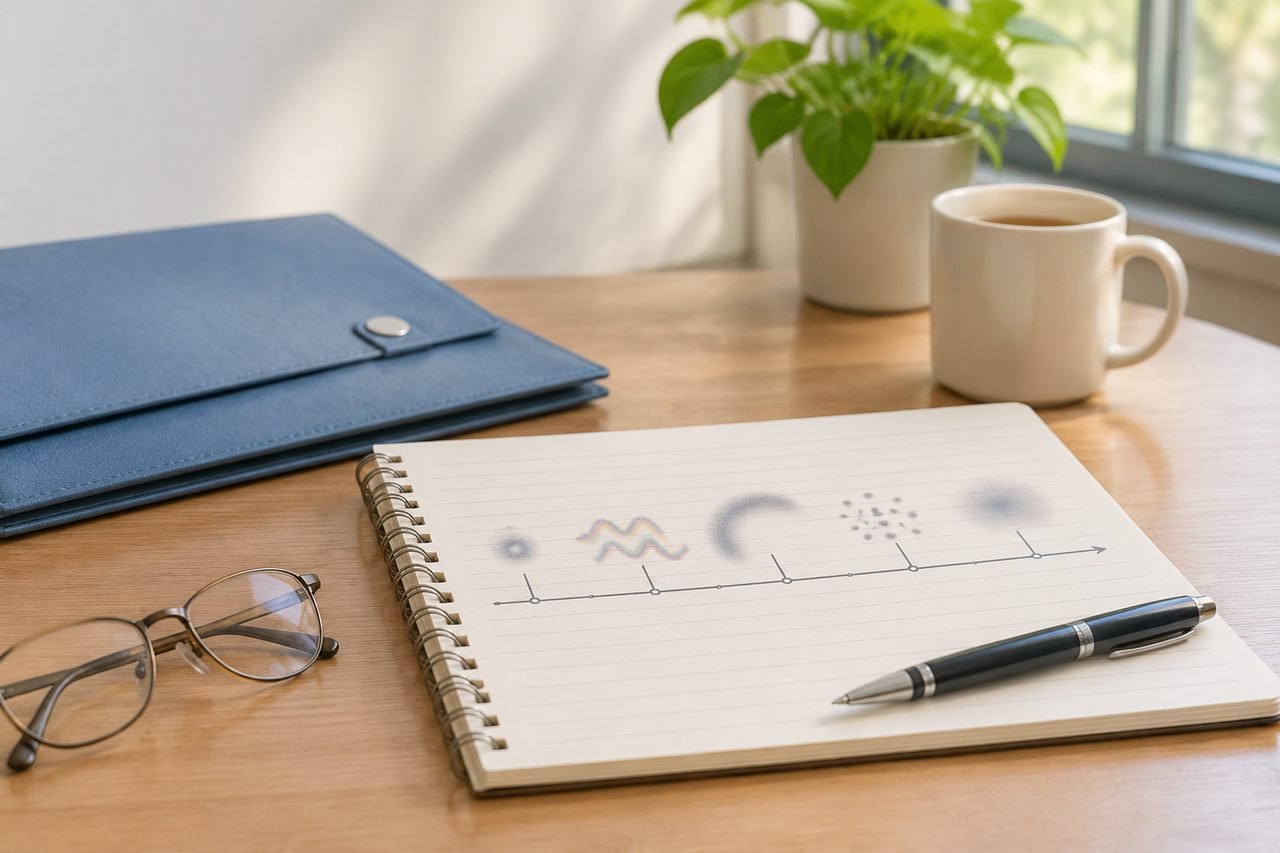
Why the visual detail matters more than the headache label
Many people arrive at a neurology appointment saying they have migraine with aura. That phrase covers a wide range of experiences, and the visual part is the hardest for a clinician to reconstruct afterwards. Aura is a fully reversible focal neurological phenomenon that develops gradually and can precede the headache phase, and visual symptoms are one recognised form it takes. Because the visual disturbance is gone by the time you are in the consulting room, the description you bring is much of the evidence the clinician has.
The same review notes that migraine aura is often clinically difficult to distinguish from other serious neurological conditions such as transient ischemic attacks and epilepsy. That is not a reason to panic about your own symptoms. It is a reason to record them precisely rather than summarise them. "I get flashing lights before a headache" tells a neurologist far less than a dated entry describing a small shimmering patch that expanded over some minutes into a zigzag arc and then left a blind spot.
What to capture for each visual episode
Build the timeline around episodes, not around days. One row or one short block per episode is easier to read than a narrative diary. A systematic review of recorded visual aura symptoms found that patients describe a wide variety of phenomena, including flashes of bright light, foggy vision, zigzag lines, scotoma (a blind or dark area), small bright dots, and a heat-haze or water-like distortion. Those categories are a useful vocabulary, but use your own words first and add a plain-language comparison if one fits.
Record the onset: did the visual change appear suddenly or build up gradually? Record the shape and where it started in your field of view, then whether it moved, expanded or stayed put. Note whether the disturbance was in one eye or across part of the visual field in both eyes, because that distinction is one the clinician will want to clarify. Note positive features (lights, lines, shimmering) and negative ones (missing areas, blurred patches). Then note the end: did it fade, and roughly how long did it last?
The timing questions are central. Guidance from the NHS states that aura symptoms should not last longer than one hour, and a clinical review of migraine with aura describes gradual development, each symptom lasting no longer than an hour, a mix of positive and negative features, and complete reversibility as characteristic. If your record shows something different, that is exactly the kind of detail a neurologist needs to see rather than have smoothed over.
- Date and clock time the visual change began
- Whether onset was gradual or abrupt
- What you saw, in your own words, plus a comparison if useful
- Where it started and whether it spread or moved
- One eye or part of the visual field in both eyes
- When it resolved and how long it lasted
- What followed: headache, nausea, light sensitivity, speech or numbness changes
- What you were doing and any possible trigger
Separating the aura from the rest of the attack
Aura is one phase of a longer event. The NHS describes early symptoms such as tiredness, yawning, food cravings, thirst, mood change, stiff neck and passing more urine, which can begin hours or up to two days before the head pain, with the attack itself usually lasting between four hours and three days. A timeline that only covers the visual minutes will miss the pattern a neurologist may be looking for.
Keep two layers. The first is the visual episode record above. The second is a simple attack log: when the head pain started and settled, whether it was one-sided, whether movement made it worse, nausea or vomiting, sensitivity to light and sound, and what you took and whether it helped. If your attacks cluster around your period, note that too, since menstrual attacks are described as often longer and more severe. Do not try to interpret the pattern yourself; the point is to hand over clean observations.
What else the neurologist will need from you
The visual timeline is one document among several. Bring your existing diagnosis and the records behind it, a current medication list including how often you use acute pain relief, and any previous imaging or neurology letters. If you have been keeping a headache diary in an app, export it rather than scrolling through it on a phone during a short appointment.
Be ready for questions that test the differential. A clinician assessing possible aura will want to know about sudden-onset visual loss, visual symptoms that correspond to a vascular territory, symptoms lasting beyond an hour, a late first onset of aura, or a marked increase in aura frequency, because those features prompt further assessment. A review of aura notes that the relative risk of ischemic stroke is increased in migraine with aura, and that combined hormonal contraception containing estrogen significantly increases stroke risk in women with migraine with aura. Those are clinical matters for your treating clinician, not conclusions to draw from an article. If you use hormonal contraception, say so and ask whether it should be reviewed.
Also flag anything that is not part of your usual pattern. A headache that comes on suddenly and is extremely painful, new weakness or speech difficulty, confusion, seizure, or visual loss calls for urgent local assessment rather than a planned overseas appointment. Do not travel to pursue a routine consultation while an acute or worsening symptom is unresolved.
Practical preparation for a neurology appointment in China
Write the timeline in English and keep it to a few pages. A one-page summary at the front, with the detailed episode records behind it, is easier to use in a consultation than a long diary. If you need interpretation, arrange it in advance and make sure the interpreter has the document beforehand so the appointment is not spent translating your own notes aloud.
Ask the hospital or coordinating team what format they prefer for records, whether they want the timeline translated, and how much appointment time is typically allocated. Those are administrative questions to confirm with the specific provider rather than assume. If you are travelling specifically for a neurology opinion, ask whether the clinician will review records before the visit and what they need in order to do so.
ChinaSpecialistCare can help with specialist matching and appointment coordination for a neurology consultation, with timing and visit preparation discussed in advance. Public tertiary hospitals and private international hospitals are possible routes, and hospital consultation fees are separate from coordination fees. A free initial case review checks the available diagnosis, records and your main question and suggests a relevant next step; it is not a diagnosis or a promise of acceptance. A proxy consultation is optional and not a prerequisite for an appointment.
What the timeline cannot settle
A well-kept record supports a clinical assessment; it does not replace one. Whether your visual episodes are migraine aura, another primary headache disorder, or something that needs separate investigation is a judgement for the treating neurologist after history, examination and, where indicated, further tests. The hospital decides whether to accept an overseas patient and what assessment is appropriate.
Keep the timeline going after the appointment. If the clinician asks you to track a specific feature, or to note response to a treatment change they recommend, the same structure works. Do not alter prescribed medicines on your own in the meantime, and do not treat a normal-looking record as reassurance about a new or different symptom.
To start, send a short summary of your diagnosis, your main question and a sample of your timeline through the enquiry form, email or WhatsApp. The team will tell you what is missing and what the practical next step is. Share fuller records only after that first contact, and keep passport numbers and payment details out of the initial message.
Sources & scope of this guide
References and official service information relevant to this guide.
- payment
- Migraine - NHS
- Migraine with aura (review)
- Clinical features of visual migraine aura: a systematic review
- Migraine Aura: Pathophysiology, Mimics, and Treatment Options
This is general planning information and has not been individually reviewed by a doctor. Medical decisions and personal treatment advice come from your treating clinicians.