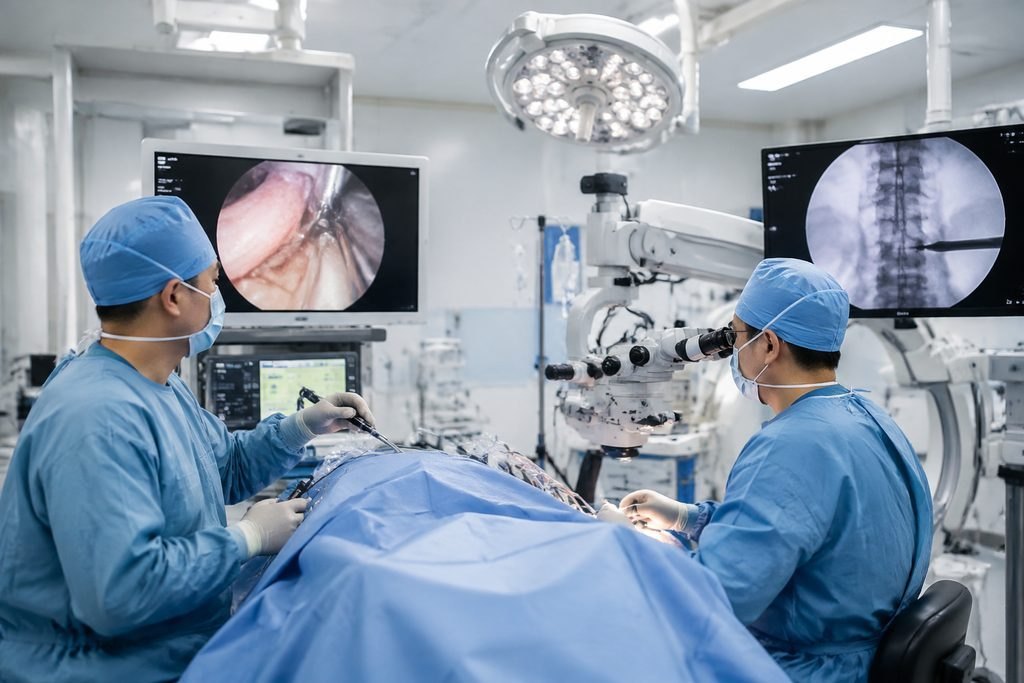
What Minimally Invasive Actually Means for Your Records
Minimally invasive describes an approach, not one single operation. The same approach can be used for different spinal procedures, including decompression or fusion. That matters for your records because the surgeon is not choosing a technique label; the surgeon is choosing an operation for a specific spinal problem at specific levels.
So the first record question is not simply "do I have an MRI?" It is: does the file show the exact proposed operation and the exact spinal levels being discussed? If a previous recommendation says only "minimally invasive spine surgery," that phrase is too broad for a meaningful review. You need the level, the diagnosis, and what the operation is intended to achieve.
A small incision does not make surgery minor. Minimally invasive spine surgery still carries the risks of the specific procedure, the anaesthetic, and the patient's general health. The approach may change recovery logistics, but it does not remove the need for a proper clinical assessment. That is why missing records matter: they can change which operation is even being considered.
Which Missing Records Change the Next Step
Not every missing document has the same weight. A missing discharge summary from an unrelated illness may be useful context. A missing MRI report, or the images themselves, can directly affect whether a spine surgeon can assess the level and the compression. A missing operation note from previous spine surgery can change the whole discussion, because scar tissue, previous instrumentation and prior levels all influence what is safe or reasonable now.
The practical way to sort this is to ask what the treating team needs in order to answer your main question. If your question is "am I a candidate for a minimally invasive decompression at L4-L5?", then the relevant records are the ones that show that level: recent imaging, the radiologist's report, any previous spine operation notes, and a clear description of your symptoms and how they have changed.
If your question is broader, such as whether surgery is appropriate at all, the file needs to show what conservative care has already been tried and what the current neurological findings are. A record that is missing does not automatically stop the process. It defines a limit: the clinician can say what can be assessed now and what remains uncertain until the document arrives.
- Imaging reports and, where available, the actual images or discs.
- Previous spine operation notes, including levels and any implants used.
- Clinic letters that state the diagnosis and the proposed operation.
- A short symptom summary: pain pattern, weakness, numbness, walking distance, and what has changed.
- A list of current medicines and relevant allergies, with the prescribing clinician's details.
Who to Ask, and How to Ask Without Delays
The fastest route is usually the facility that created the record. For imaging, that is the radiology department or the hospital where the scan was done. For an operation note, it is the hospital medical records office or the surgeon's clinic. For a diagnosis or a proposed plan, it is the treating clinician's office. Ask for a copy in the format they can provide, and ask whether an English translation or a summary is available.
A useful request is specific. Instead of asking for "all my records," name the document: the MRI report and images from a given date, the operation note from a named procedure, the clinic letter that recommended surgery. That reduces back-and-forth and makes it easier for the receiving team to see what is still missing.
Do not delay urgent local care while gathering records for an overseas enquiry. If you have new or worsening weakness, loss of bladder or bowel control, or severe pain that is changing quickly, that needs local assessment now. Records can be collected in parallel; they should not become a reason to wait.
What a Records-Based Review Can and Cannot Confirm
A records-based review can help clarify the diagnosis as documented, identify what information is missing, and suggest which specialist or next step is relevant. It can also help you prepare better questions. It does not establish final eligibility, hospital acceptance, or a guaranteed outcome. Those decisions belong to the treating hospital and licensed clinicians who examine you and confirm the details.
This distinction matters when records are incomplete. A reviewer may be able to say that the available imaging shows a problem at a certain level, but still need the actual images or a current examination to judge whether a minimally invasive approach is suitable. The review is a planning step, not a substitute for the clinical assessment that happens in person.
If you want a records-based opinion before travelling, that is an optional step. It is not a prerequisite for every appointment or operation. You can also start with a short summary and ask what the team would need to move forward. The answer will often be a specific document rather than a complete archive.
Confirming the Operation, the Levels and the Rehabilitation Plan
Before you commit to travel, ask the treating team to confirm the exact proposed operation and the exact spinal levels in writing. Ask what the alternatives are, including non-surgical options, and what the evidence-based risks and uncertainties are for your situation. A clinician can discuss risk estimates with you; no estimate guarantees your individual result.
Ask about rehabilitation and review needs as part of the same conversation. Minimally invasive surgery may still require a structured recovery plan, follow-up imaging or wound review, and physiotherapy. The receiving physiotherapist or clinician will make their own assessment; they are not bound to a plan made elsewhere. Ask what is expected in the first weeks and what would need to be arranged locally or in China.
If you are comparing hospitals, ask each one how its written estimate is structured: what is included, what is excluded, and what remains undecided until after examination. Do not assume that a quote from one hospital applies to another. The scope of the operation, the ward type, the length of stay and the implant choice can all change the picture, and the hospital confirms suitability.
A Practical Next Step When the File Is Incomplete
Start with a short summary: your main symptom, the diagnosis you have been given, any previous spine surgery, and the specific question you want answered. Then list the records you have and the ones you know are missing. Send that to the China team through the enquiry form, email or WhatsApp. An initial enquiry is free and does not require buying a proxy consultation.
The team can check what you have, point out what is missing, and suggest the relevant next step. If a specialist appointment is appropriate, coordination can be requested separately; hospital consultation fees are paid to the hospital. If you need help with interpretation or practical arrangements, that can be discussed as a separate service.
Keep the focus on the decision you are actually making. The goal is not to assemble a perfect archive before anyone will speak with you. The goal is to know which missing record matters, who holds it, and whether it changes the next step. Once that is clear, you can decide whether to pursue an appointment, a records-based opinion, or local care first.
Sources & scope of this guide
References and official service information relevant to this guide.
This is general planning information and has not been individually reviewed by a doctor. Medical decisions and personal treatment advice come from your treating clinicians.