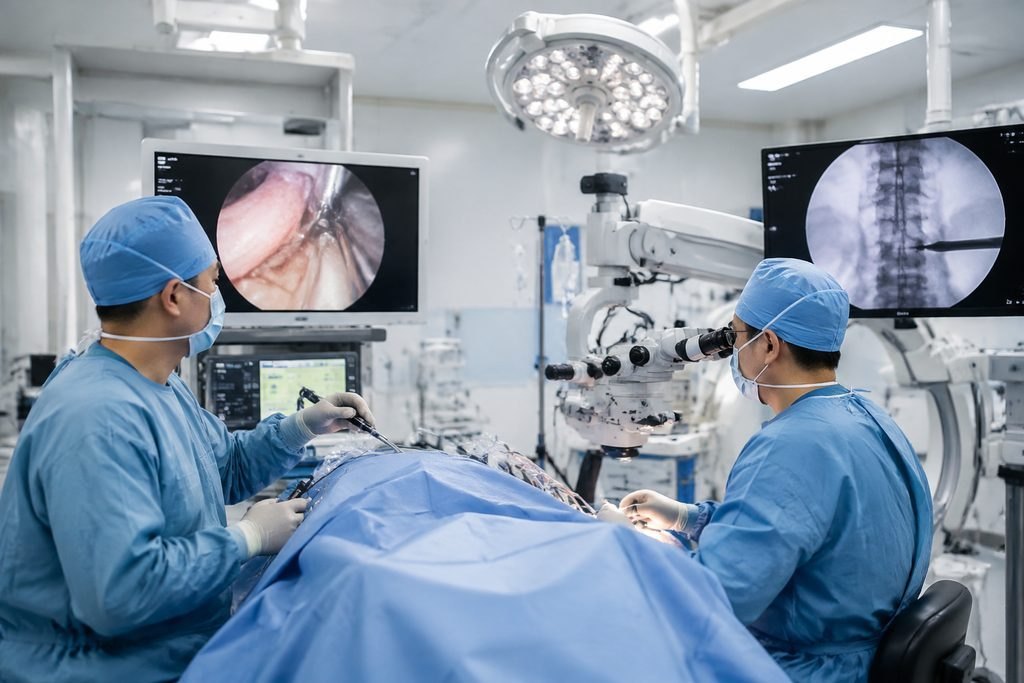
Why the technique label does not answer the treatment-level question
A common misunderstanding is that minimally invasive spine surgery is a single procedure with a standard plan. It is better understood as a way of reaching the spine through smaller access than traditional open surgery. The same minimally invasive approach can be used for different operations, such as decompression or fusion, and those operations differ in purpose, extent and aftercare.
That distinction matters when you are considering care in China. If you ask only whether a hospital offers minimally invasive spine surgery, you may receive a yes without learning whether the proposed operation matches your problem. A more useful question is: what exact operation is being recommended, and at which spinal levels? The answer should identify the levels, the structure being treated, and whether the plan is decompression, fusion, or something else.
The technique label also does not tell you how many levels are involved. A one-level procedure and a multi-level procedure are different in surgical scope even if both are described as minimally invasive. The number of levels can affect operating time, implants, hospital resources and rehabilitation planning. Those are clinical and administrative details for the treating team to confirm, not assumptions you should make from the label alone.
What to ask about the exact proposed operation and levels
When a clinician in China reviews your records, ask for the proposed operation in plain terms. You want to know the name of the procedure, the spinal levels, and the clinical problem each level is meant to address. For example, is the plan to relieve pressure on a nerve, to stabilize a segment, or both? If both, which levels are being fused and which are being decompressed?
Ask whether the recommendation is based on your imaging, your symptoms and your response to non-surgical care so far. A responsible discussion should explain why these levels were selected and what alternatives exist, including non-surgical options where appropriate. You do not need to decide between techniques yourself; you need enough clarity to ask informed questions.
It also helps to ask what would change the plan. If a level is borderline, what findings would lead the team to include or exclude it? If the plan is staged, what happens in each stage? These questions keep the conversation focused on your actual spinal problem rather than on a general technique label.
- The exact procedure name and whether it is decompression, fusion, or another operation.
- The specific spinal levels involved and the reason for each level.
- Whether the plan is one stage or more than one stage.
- What alternatives were considered and why they were not recommended.
- What findings would change the proposed levels or operation.
Records that help a treatment-level discussion
A treatment-level discussion is only as good as the records available. Useful items typically include recent MRI or CT images with the radiologist's report, plain X-rays where relevant, and any earlier spine imaging for comparison. Clinical notes describing your symptoms, examination findings and treatments tried so far also help the reviewer understand the context.
If you have had previous spine surgery, the operative notes and any implants used are important. They can affect whether a minimally invasive approach is suitable at a given level and what revision planning may involve. If you do not have these records, ask the hospital what it needs and how to provide them; do not assume that missing documents can be replaced by a telephone description alone.
For an initial enquiry, a short summary is enough. You can share diagnosis, main symptoms, prior treatments and your specific question. More detailed records can follow once the relevant clinical team is identified. This keeps the first step manageable and avoids sending a complete archive before anyone has asked for it.
Rehabilitation and review questions tied to the levels treated
Rehabilitation planning depends on the operation and the levels treated, not on the minimally invasive label. A decompression at one level and a multi-level fusion can lead to different restrictions and different review needs. Ask the treating team what movements or activities to avoid, for how long, and what warning signs should prompt urgent contact.
Ask who will provide rehabilitation instructions and whether they will be given in writing. If you plan to return home after surgery, ask how follow-up will be arranged and what information your local clinician will need. The receiving clinician or physiotherapist will make their own assessment; the original team's plan is a starting point, not a substitute for local judgement.
Review timing is also a clinical decision. Ask when the first review should happen, what imaging or tests are expected, and how to contact the team between visits. Do not rely on a general timeline from a website or another patient's experience. Your own plan should come from the clinicians responsible for your care.
What a China care enquiry can and cannot confirm
An initial enquiry with ChinaSpecialistCare is a non-clinical intake step. It checks the available diagnosis, records and your main question, identifies missing information and suggests a relevant next step. It is not a diagnosis, and it does not confirm that surgery is needed, that you are suitable for a particular operation, or that a hospital will accept your case.
If a records-based specialist opinion is useful, that can be discussed separately. A proxy consultation is optional and is not a prerequisite for every appointment or operation. The hospital and its clinicians decide suitability, the exact operation and the levels. Our role is coordination and information, not clinical decision-making.
For the treatment-level question specifically, the most useful output from an enquiry is clarity about what the clinical team still needs to see and what questions to put to them. That may include imaging, prior operative notes or a clearer description of your symptoms. It is reasonable to ask what the next step is and what it will and will not establish.
Practical next step for an overseas patient
Start with a short summary rather than a full archive. Include your main spinal problem, the levels already discussed, any previous spine surgery, and the specific question you want answered about treatment levels. Note whether you have recent imaging and reports available. This gives the intake team enough to identify what is missing and which clinical route may be relevant.
A useful summary does not need to be long. Three or four sentences covering your diagnosis, your main symptom, what non-surgical care you have already tried, and the exact question you want answered will usually be enough for a first review. If you have a recent MRI or CT report, mention that it exists and that you can share it on request. Do not send a complete archive before anyone has asked for it, and do not include passport numbers or payment details in a first message.
When you write to the hospital team, put the treatment-level question in writing rather than raising it only in conversation. A short message can ask: which exact operation is proposed, at which spinal levels, and what is the clinical reason for each level. Ask whether the plan is decompression, fusion, or both, and whether it is one stage or more than one. Ask what alternatives were considered. A written reply gives you something to compare and to discuss with your local clinician.
Ask the team to confirm the rehabilitation and review plan in the same written reply. That includes what movements or activities to avoid after surgery, for how long, when the first review should happen, and what imaging or tests are expected at that review. If you plan to return home, ask what information your local clinician will need. The receiving clinician or physiotherapist will make their own assessment, so treat the original team's plan as a starting point rather than a substitute for local judgement.
If you need help coordinating an appointment or arranging a records-based specialist opinion, that can be discussed after the initial review. An initial enquiry is free, and you are not required to purchase a proxy consultation to ask a question. A proxy consultation is optional and is not a prerequisite for every appointment or operation.
Keep local care in place while you explore options abroad. If your symptoms worsen or you develop new weakness, numbness or bladder or bowel changes, seek urgent local assessment rather than waiting for an overseas reply. Do not delay necessary local care for an overseas enquiry.
Sources & scope of this guide
References and official service information relevant to this guide.
This is general planning information and has not been individually reviewed by a doctor. Medical decisions and personal treatment advice come from your treating clinicians.