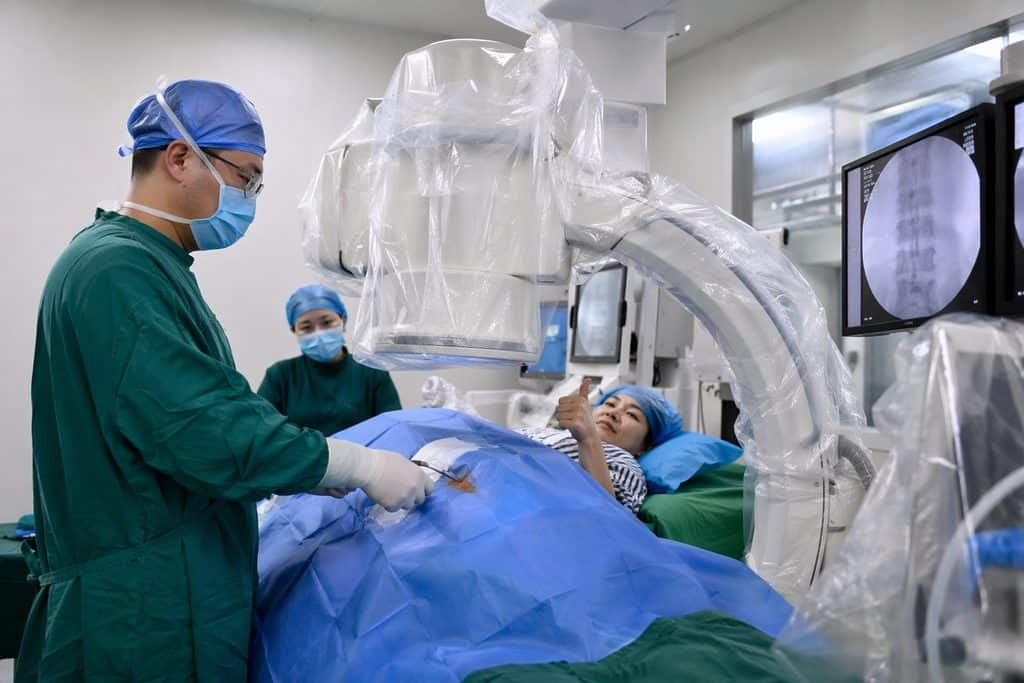
What minimally invasive spine surgery actually means
The term minimally invasive spine surgery does not name a single procedure. It describes a surgical approach that aims to reach the spine through smaller access points rather than a large open exposure. Within that approach, the actual operation can differ substantially: one patient may need a decompression to relieve pressure on a nerve, while another may need a fusion to stabilise a segment. The approach is the method; the procedure is the treatment.
This distinction matters when you are considering care in China. If you search for minimally invasive spine surgery as if it were one standard operation, you may compare hospitals or quotes that are not describing the same thing. One team may be discussing a decompression at one level; another may be discussing a fusion across two levels with instrumentation. Those are different operations with different goals, different risks and different recovery implications.
The source used for this guide, the American Academy of Orthopaedic Surgeons (AAOS), states that minimally invasive describes an approach and can be used for different spinal operations, including decompression or fusion. That is the factual boundary. It does not mean every spinal problem can be treated this way, and it does not mean a smaller access point makes the surgery minor.
A useful first step is to stop thinking about the technique label and start thinking about the clinical problem. What is causing the symptom? Which spinal level or levels are involved? Is the goal to relieve nerve pressure, to stabilise a segment, to correct a deformity, or to address something else? The answers determine whether a minimally invasive approach is even relevant.
What the treatment can address
When a treating team proposes a minimally invasive approach, it is usually because the clinical problem fits an operation that can be performed through smaller access. The AAOS source confirms that decompression and fusion are among the operations that can be performed this way. Beyond that, the source does not establish a universal list of conditions, levels or patient types for which the approach is suitable.
This is where individual assessment becomes essential. A surgeon may consider a minimally invasive approach for nerve compression that requires decompression, or for instability or deformity that requires fusion. But the decision depends on the specific anatomy, the number of levels involved, previous surgery, bone quality, the presence of deformity, and the surgeon's own training and judgement. None of those factors can be assessed from a technique name alone.
It is also important to understand what the approach is not promising. A minimally invasive approach is not a guarantee of less pain, faster recovery, smaller scars in every case, or a shorter hospital stay. The AAOS source does not establish a universal recovery advantage, same-day discharge, or that a small incision makes surgery minor. Any claim that minimally invasive surgery is always easier or always safer than open surgery goes beyond what the source supports.
For an overseas patient, the practical question is not whether minimally invasive surgery is better in general. It is whether the specific proposed operation, at the specific level or levels, is appropriate for your diagnosis and goals. That question can only be answered by the treating clinician who has reviewed your imaging, examined you, and understands your symptoms.
What the treatment cannot address
Minimally invasive spine surgery cannot address every cause of back or neck pain. Many spinal symptoms improve without surgery, and some pain sources are not mechanical or structural in a way that surgery can correct. A surgical approach, minimally invasive or otherwise, targets a specific anatomical problem. If the pain is coming from somewhere else, or if the diagnosis is unclear, surgery may not help.
The approach also cannot change the underlying procedure. If a fusion is needed, a minimally invasive approach may still involve fusion, instrumentation and a recovery process that reflects the fusion rather than the size of the access. The technique label does not remove the biological reality of bone healing, the need for postoperative restrictions, or the possibility of complications.
There are also cases where a minimally invasive approach is not suitable. Significant deformity, multilevel disease, previous surgery with scarring, poor bone quality, or the need for extensive decompression may lead a surgeon to recommend an open approach instead. This is not a failure of the technique. It is a recognition that the approach must serve the clinical goal, not the other way around.
Finally, minimally invasive surgery cannot guarantee a specific outcome. No operation can. The treating team should discuss the expected benefits, the risks, the alternatives, and what happens if the first operation does not achieve the intended result. If that discussion has not happened, it is a gap worth addressing before you commit to travel.
Why the exact proposed operation and levels matter more than the technique label
When you contact a hospital or a coordination service, the most useful information you can provide is not that you want minimally invasive surgery. It is the specific diagnosis, the proposed operation, and the spinal level or levels involved. Without that, a clinical team cannot assess suitability, and any estimate or opinion is based on incomplete information.
Ask the treating team to write down the exact proposed operation in plain language. For example: decompression at L4-L5, or fusion at L4-L5 with instrumentation, or decompression at two levels. Ask which levels are involved and why. Ask whether the approach is expected to be minimally invasive, open, or a combination, and what factors would change that plan during surgery.
This matters for several reasons. First, it allows you to compare like with like if you seek more than one opinion. Second, it helps you understand the recovery implications, because a single-level decompression and a multilevel fusion are not the same recovery. Third, it gives you a concrete basis for asking what the operation can and cannot achieve in your case.
If a hospital or coordinator cannot or will not clarify the proposed operation and levels before you travel, that is a signal to ask more questions. The technique label alone is not enough to make an informed decision.
Questions to ask the treating team before you commit
The following questions are designed to surface the information that changes the decision. They are not a checklist to complete mechanically; they are prompts for a conversation with the clinician who would actually perform or supervise the operation.
What is the exact diagnosis, and which spinal level or levels are involved? What is the proposed operation, and is it a decompression, a fusion, or something else? Is a minimally invasive approach planned, and if so, why is it suitable for this specific problem? What are the alternatives, including non-surgical treatment and open surgery? What are the risks and possible complications? What recovery and rehabilitation will be needed, and what restrictions will apply? What happens if the operation does not achieve the intended result?
Ask also about the team's experience with this specific operation and approach. The AAOS source does not establish credentialing or volume standards, so this is a question for the provider. Ask how many similar cases the surgeon or team handles, and whether there are any factors in your case that make the approach more complex.
For an overseas patient, ask how the plan would be confirmed before travel. Would a records-based review be enough, or would an in-person assessment be required? What imaging and records should you bring? Who will explain the plan and consent process, and in what language? These are practical questions that affect whether a trip is worthwhile.
Rehabilitation, review and the limits of a remote opinion
Minimally invasive spine surgery still requires rehabilitation and follow-up. The approach may influence the early recovery experience, but it does not remove the need for a structured plan. Ask the treating team what rehabilitation is expected, who will supervise it, and how it will be coordinated if you return home. Ask what follow-up imaging or review is needed, and how that will be arranged across countries.
A records-based opinion can be useful for understanding whether a minimally invasive approach is plausible for your diagnosis, and for preparing questions. It cannot establish final eligibility, confirm hospital acceptance, or replace an in-person assessment. The treating hospital decides suitability after reviewing your case. A remote opinion is a step in the process, not the final answer.
If your symptoms are worsening, or if you have new weakness, numbness, or difficulty with bowel or bladder control, seek local urgent care rather than delaying for an overseas enquiry. Spinal symptoms that progress quickly need prompt assessment, and travel planning should not take priority over that.
ChinaSpecialistCare can help you prepare a brief summary and identify the relevant next step. An initial enquiry is free and does not require buying a proxy consultation. You can start by sharing your main question and available records through the enquiry form, email, or WhatsApp. The team will explain what information is missing and what to ask the hospital. The hospital, not the coordinator, decides whether the proposed operation is suitable.
Sources & scope of this guide
References and official service information relevant to this guide.
This is general planning information and has not been individually reviewed by a doctor. Medical decisions and personal treatment advice come from your treating clinicians.