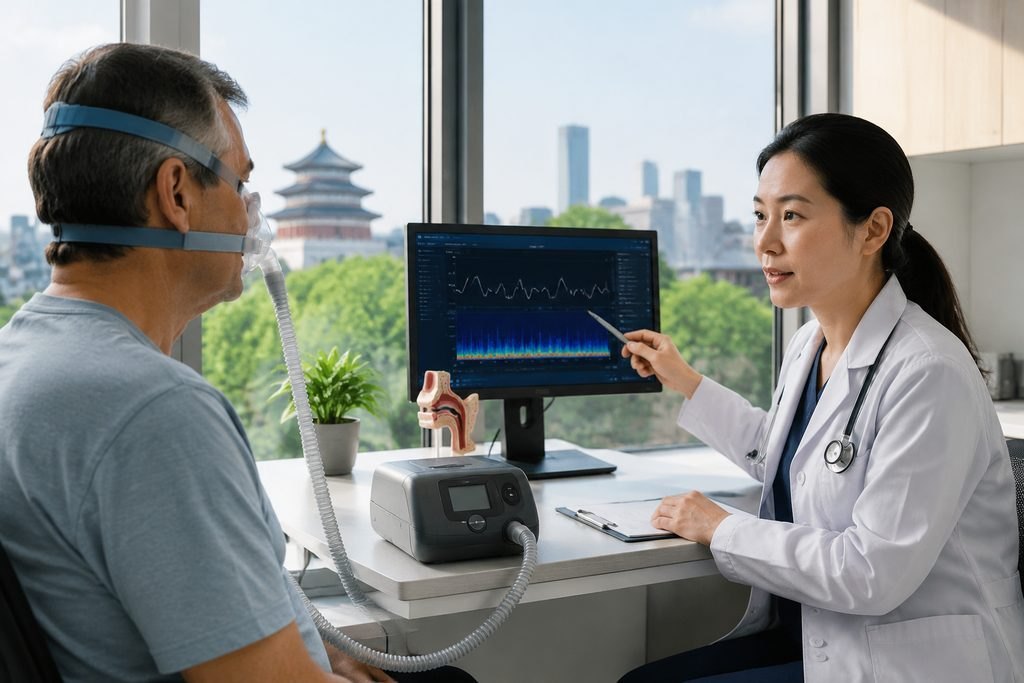
What long-term follow-up for obstructive sleep apnea actually involves
Obstructive sleep apnea is a long-term condition. Follow-up is not a single appointment after a sleep study. It is the ongoing process of checking whether the chosen treatment is controlling breathing pauses during sleep, whether symptoms such as daytime sleepiness are improving, and whether the treatment itself is causing problems that need adjustment.
The NHS notes that treatment can include CPAP or other approaches, and that surgery is suitable only in selected circumstances. That matters for follow-up planning because the follow-up questions differ depending on what treatment you are using. If you use CPAP, the follow-up conversation is largely about mask fit, pressure tolerance, humidification, adherence data and whether the device settings still match your needs. If you have had surgery, follow-up focuses on healing, symptom change and whether further sleep testing is needed. If you are considering surgery, the assessment process is different again.
For an overseas patient, the difficult part is often the handover. You may have a sleep study in one country, start or adjust treatment in China, then return home. Without a clear plan, your home clinician may receive a device but not the reasoning behind the settings, or a surgical report but not the plan for repeat testing. Long-term follow-up works best when both sides know what data will be shared, who will interpret it, and when the next review should happen.
Sleep-study results: what to gather before you travel
A sleep study report is more useful when it includes the raw data and the interpretation, not only a one-line diagnosis. Before an appointment in China, gather the full sleep-study report, the scoring criteria used, the apnea-hypopnea index or equivalent measure, oxygen saturation data, and any positional or REM-related findings. If you have had more than one study, bring all of them so the clinician can see whether the condition has changed over time.
Also gather the treatment history. If you have used CPAP, ask your device provider for adherence data and the pressure settings over time. If you have tried other approaches, such as an oral appliance or positional therapy, bring the details of what was tried, for how long, and what changed. If you have had upper-airway surgery, bring the operative report and any follow-up sleep study done afterwards.
This is not a universal checklist that every patient must complete. It is a set of items to ask the receiving clinician about. Some teams will want the full download; others may only need the summary. The point is to avoid arriving with a diagnosis but no usable data. If records are missing, ask the treating team what they can work with and what they would like you to obtain. Do not delay urgent local care while gathering records for an overseas enquiry.
CPAP and other treatments: what to confirm before and after the visit
If you already use CPAP, the key question is whether the settings and mask interface are still appropriate. CPAP is not a one-time prescription. Weight change, nasal congestion, new medications, alcohol use, sleep position and ageing can all affect how well it works. A review in China may include checking device data, discussing mask options, and considering whether a repeat sleep study is needed. Ask the treating clinician what they will review and what they expect you to bring.
If you are considering surgery, the conversation is different. Surgery is suitable only in selected circumstances, and it is not a routine replacement for CPAP or other care. The assessment usually involves understanding the anatomy of your upper airway, the pattern of your sleep apnea, and your general health. Ask what investigations are needed, what the alternatives are, and what the realistic goals of surgery would be. No outcome is guaranteed.
For any treatment, ask how follow-up will be handled after you leave China. Will the treating team review device data remotely? Will they send a written plan to your home clinician? What symptoms or device readings should prompt you to seek review sooner? These are practical questions, not clinical decisions. The treating team and your home clinician are responsible for deciding what is appropriate for you.
The handover: who does what when you return home
A handover is not just sending a discharge summary. It is an agreement about responsibility. Before you leave China, ask for a written summary that includes the diagnosis, the treatment plan, the device settings if applicable, the results of any tests done in China, and the specific follow-up questions that remain open. Ask who at the China hospital will be available to answer questions from your home clinician, and through what channel.
At home, confirm that your local clinician has received the records and understands the plan. Ask whether they are willing to take over routine follow-up, or whether they prefer that the China team continue to direct treatment. If both sides are involved, clarify who will review adherence data, who will adjust settings, and who will order repeat sleep testing. A short written note from the China team to your local clinician can prevent confusion.
If you use a CPAP device, ask whether the device data can be shared with both teams. If you had surgery, ask what follow-up testing is recommended and when. These are questions to confirm with the named providers, not assumptions about how any hospital works. If a question cannot be answered before you travel, write it down and ask during the appointment.
What to ask the treating team in China
Bring a short list of questions to the appointment. Ask what the treating clinician thinks is driving your sleep apnea, what treatment options they consider appropriate, and what the evidence is for each option in your situation. Ask what would make them recommend surgery rather than CPAP or another approach, and what the risks and alternatives are. Ask how they will judge whether treatment is working.
For follow-up, ask what data they want to see, how often they want to review it, and what would prompt an earlier review. Ask whether they can provide a written plan in English for your home clinician. Ask who to contact if a problem arises after you return home, and what kind of problem would require urgent local care rather than a remote question.
You may also want to ask about the scope of any written estimate or treatment plan. Ask what is included, what is not included, and what remains undecided until further assessment. This is not about expecting a fixed price; it is about understanding what you are agreeing to. The hospital decides suitability and acceptance, and no outcome is guaranteed.
Practical next steps for an overseas patient
Start by gathering your sleep-study reports, treatment history and current device data. Write down your main question: is it whether surgery is an option, whether CPAP settings need review, or how follow-up will work after you return home. Then contact the relevant service to ask what records they need and what the next step is.
For obstructive sleep apnea surgery questions in China, you can review the sleep apnea surgery reference page for general information. If you are not sure whether a specialist appointment is appropriate, a free initial case review can help identify missing information and suggest a relevant next step. This is not a diagnosis or a promise of acceptance, and it does not replace assessment by a licensed clinician.
If your symptoms are worsening, or if you have urgent concerns, seek local medical care first. An overseas enquiry can wait; urgent clinical problems should not. When you are ready, share a brief summary of your situation and ask what the treating team would need to review your case.
Sources & scope of this guide
References and official service information relevant to this guide.
This is general planning information and has not been individually reviewed by a doctor. Medical decisions and personal treatment advice come from your treating clinicians.