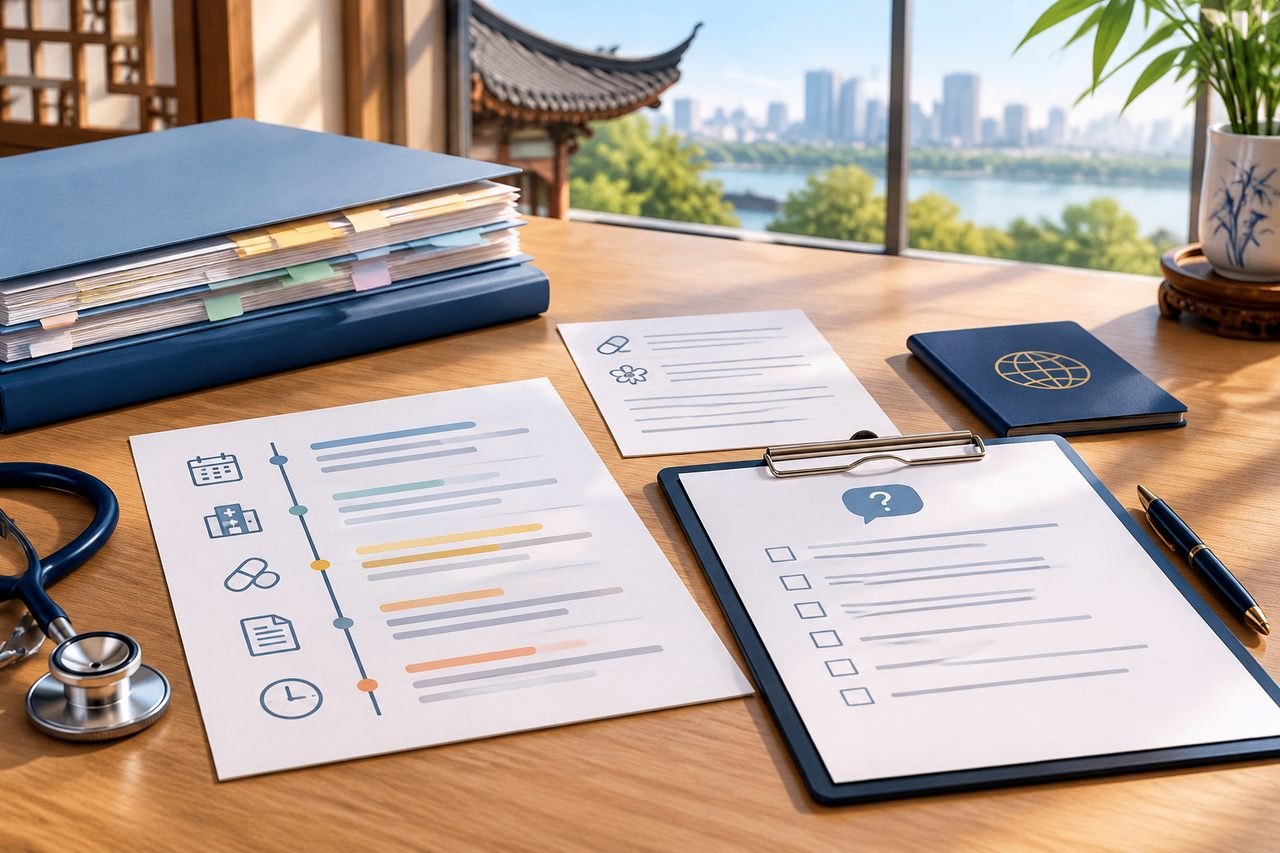
Start with the decision, not the folder
Most patients preparing for a specialist review in China begin by scanning everything they own. That produces a large file and a slow first conversation. The receiving clinician's first useful question is narrower: what decision are you trying to make? A records-based opinion, a treatment plan, a second view on an existing diagnosis, or a decision about whether to travel at all are four different requests, and each one needs different documents.
Write your request in one sentence before you touch the archive. For example: 'I have had recurring abdominal pain for three years, two inconclusive endoscopies and no clear diagnosis; I want to know whether further assessment in China is reasonable.' Or: 'I was advised knee replacement in my home country and want a records-based view on whether the imaging supports that recommendation.' The sentence forces you to decide what the specialist is being asked to answer.
This matters because a long history is not automatically a strong file. A specialist reading 400 pages of unsorted material may miss the one report that changes the picture. A specialist reading a dated timeline, the key imaging reports and a clear question can usually form a view of what is established, what is uncertain and what would need to be examined in person. The clearer your request, the more specific the reply can be.
Keep the first contact short. An initial enquiry is a brief summary, not a complete medical archive. You can describe the main problem, the duration, the treatments already tried, the current question and the country you are in. Detailed records come later, once someone has told you which documents are actually relevant.
Build a one-page timeline that a stranger can read
The single most useful document you can prepare is a chronological timeline on one or two pages. It should be readable by a clinician who has never met you and has no access to your home hospital's records system. Use dates, not 'a few years ago'. Where you only remember the year, write the year and mark it as approximate.
For each entry, record four things: the date, what happened, where it happened, and what changed as a result. 'March 2021, first episode of severe pain, City Hospital emergency department, discharged with painkillers, no imaging' is more useful than 'pain started'. 'August 2022, MRI at Regional Imaging Centre, report said possible inflammation, no treatment change' tells the next clinician what the scan concluded at the time.
Separate facts from interpretation. A report that says 'findings consistent with' is not the same as a confirmed diagnosis, and a specialist needs to know which is which. If two doctors gave you different explanations, record both and note the dates. Do not resolve the disagreement yourself; the point of the review is to have someone look at the same evidence with fresh eyes.
Mark the turning points. The first episode, the first hospital admission, the first surgery, the first treatment that helped, the first treatment that did not, and the most recent change. These are the entries a specialist will read first. Everything else supports them.
If your history involves care in more than one country, say so explicitly and note the language of each report. A clinician reviewing records from three health systems needs to know which documents are originals and which are translations, and whether the translations were done by a certified service or by you.
What to include, what to summarise and what to leave out
A complete archive is rarely the right first submission. It is slow to transfer, hard to read and often contains material that has no bearing on the current question. A better approach is to send a structured summary first and let the receiving team tell you what else they want.
The core set usually includes: the timeline; current medications with doses and start dates; known allergies and reactions; the most recent imaging reports and the discs or files themselves where available; pathology reports if tissue has been examined; discharge summaries from any admission; and the results of any test that changed your treatment. Ask the receiving clinician whether they want the original images or only the reports, because the two are not interchangeable.
Summarise rather than translate everything. A short English summary of a foreign-language report, clearly labelled as a summary and not a substitute for the original, helps the first reader decide whether the full document is needed. Keep the original available and be ready to provide it.
Leave out material that does not bear on the question: routine screening results from years ago, unrelated clinic notes, and duplicate copies of the same scan. If you are unsure whether something matters, list it in a short index rather than sending it. The index itself is useful because it shows the clinician what exists without forcing them to read it all.
One practical caution: do not send passport numbers, payment details or a full medical archive through an initial enquiry form. Share sensitive documents only after first contact, through the channel the receiving organisation specifies.
Write the question sheet the specialist will actually answer
A specialist review is more productive when the questions are specific. Instead of 'please advise', write the questions whose answers would change your next step. For example: does the imaging from 2022 need to be repeated, or is it still adequate for a view? Is the diagnosis established or still uncertain? What information is missing that would change the assessment? Are there treatments available in China that are not available where I live, and what would need to be confirmed before that could be discussed?
Keep the list to a handful of questions. A long list dilutes the answer. If you have ten questions, rank them and send the top five, noting that others can follow.
Include a short section on what you have already tried and what happened. A specialist who knows that two courses of a treatment failed, and how they failed, will not suggest repeating them. Record side effects and reasons for stopping, not just the names of medicines.
State your practical constraints honestly: how far you can travel, how long you could stay, whether you need an interpreter, and whether you are seeking an opinion only or are prepared to travel for treatment. These are not clinical facts, but they change what a useful plan looks like. A recommendation that ignores them is not usable.
Finally, ask what the review can and cannot establish. A records-based opinion depends on the quality of the records and cannot replace an in-person examination. The clinician should be able to tell you which parts of your question can be answered from the file and which require you to be present.
How the review process usually runs, and where it can stall
The sequence is straightforward in principle. You send a brief summary. Someone checks whether the available diagnosis, records and main question are clear, identifies missing information and suggests the relevant next step. That initial review is not a diagnosis and does not promise acceptance. If a records-based specialist opinion is appropriate, it can be arranged while you remain at home; it is optional and not a prerequisite for every appointment or operation.
Where the process stalls is usually at the handover points. Records arrive in a format the receiving team cannot open. Translations are incomplete. The imaging reports are present but the images are not. The question is too broad to answer. Each of these adds a round of correspondence, and each is avoidable with a little preparation.
Another common stall is expecting the review to settle eligibility. It does not. The hospital decides suitability, and a records-based opinion cannot confirm acceptance in advance. If your question is really 'will they treat me', the honest answer is that this is confirmed by the treating hospital after it has reviewed your case, and sometimes only after examination in China.
Timing is also worth asking about rather than assuming. How long a review takes, when a reply is issued and whether a follow-up appointment can be arranged in the same visit are questions for the specific provider. Practices differ between hospitals, and no general rule applies across China.
Practical preparation and the next step
Before you send anything, do three things. First, write your one-sentence request. Second, build the timeline and the medication and allergy list. Third, decide which five questions matter most. These three items take an evening and save weeks of back-and-forth.
Then check the practical side. Ask whether the receiving team needs original images or accepts digital files, whether reports must be translated and by whom, and whether an interpreter is needed for any conversation. If you are considering travel, ask what would need to be confirmed before booking anything, and keep travel arrangements flexible until the clinical picture is clear. Do not treat a provisional appointment as confirmation that treatment will proceed.
Keep a single master copy of your file, with a clear index, and update it as new reports arrive. A well-organised history is useful not only for this review but for any future clinician who sees you.
If you would like help identifying the relevant next step, you can start with a free initial enquiry. Send a brief summary of the main problem, how long it has lasted, what has already been tried and the question you want answered. Detailed records can follow once the team has told you what is relevant. The hospital, not the coordination team, decides suitability and treatment.
Sources & scope of this guide
References and official service information relevant to this guide.
This is general planning information and has not been individually reviewed by a doctor. Medical decisions and personal treatment advice come from your treating clinicians.