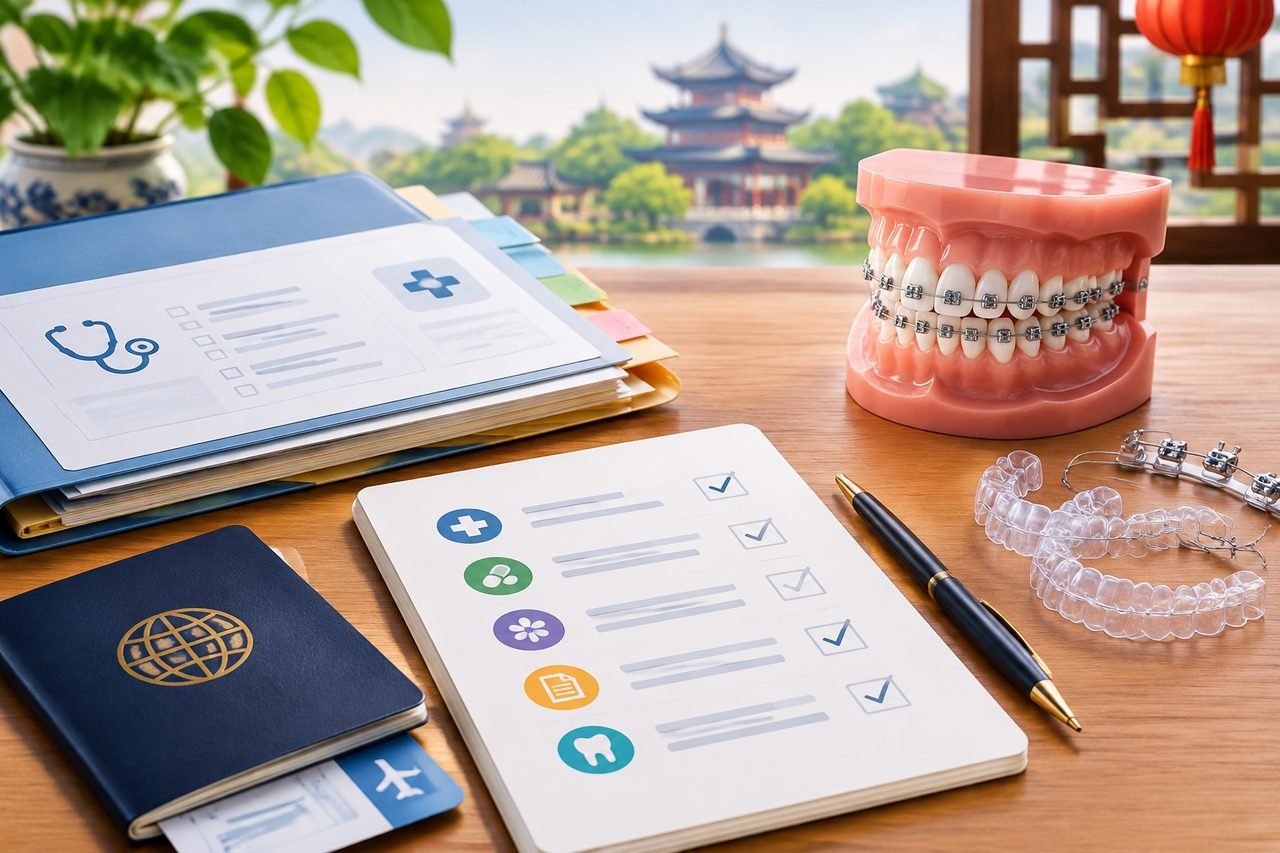
What the orthodontist actually needs from you
Orthodontic treatment starts with an assessment of the teeth and jaws, and the appliance choice depends on that individual assessment. That assessment is not only about how crooked the teeth look. It also involves the bite, the position of the jaws, the condition of the gums and teeth, and how the patient's general health might affect treatment.
For an overseas patient, the practical task is to hand over enough information for the orthodontist to judge whether treatment is appropriate, which appliance is suitable, and what monitoring or precautions might be needed. You do not need to send a complete medical archive at the first contact. A short summary is enough to begin, and the clinical team can then tell you what else they want to see.
Think of the handover as three layers. The first layer is your main question and a brief list of your health conditions. The second layer is the records you already hold: dental X-rays, photographs, models, treatment notes, and any letter from a previous orthodontist. The third layer is condition-specific information that the orthodontist asks for after reading the first two layers. Sending all three at once is not necessary, and it can make the important points harder to find.
Which health conditions matter for braces
The NHS braces information explains that orthodontic treatment involves assessment of the teeth and jaws, that braces need ongoing adjustments, and that retainers are used after treatment. It does not list which medical conditions rule treatment in or out. That decision belongs to the treating orthodontist, who can consider your individual situation.
Some conditions and treatments can affect the mouth, the gums, the teeth, or the ability to attend repeated appointments. Others may affect how well you tolerate a fixed appliance, how often you need review, or whether a particular type of brace is appropriate. Because the source does not set out a list, the useful step is not to guess. Instead, describe your conditions plainly and ask the orthodontist whether they change the assessment, the appliance options, or the review schedule.
If you take medicines that affect bleeding, healing, bone, or the mouth, include them in your summary. If you have a condition that affects your gums or your ability to keep the mouth clean, say so. If you have had previous jaw surgery, facial trauma, or orthodontic treatment, include that too. The orthodontist can then ask follow-up questions rather than working from an incomplete picture.
How to write the summary that travels with your records
A one-page summary is easier for a busy clinical team to use than a folder of unrelated documents. Write it in English, and keep the wording factual. Start with your main orthodontic concern, then list your diagnosed conditions, your current medicines, your allergies, and any previous surgery or hospital care. Add the date of each item where you know it.
Next, list the records you can provide. For example: recent dental X-rays, intraoral photographs, study models, a letter from your current orthodontist, and any treatment plan you have been given. If a record is old, say when it was made. If you do not have a particular record, say that too, so the team can tell you whether they need it or whether they can proceed without it.
Finally, write down the questions you want answered. A short list helps the orthodontist respond to your actual decision. Useful questions include: does my health condition change the appliance options; do I need any tests or reports before treatment can start; how often are adjustments needed; and what happens if I am not in China for part of the treatment. Keep the list to a few items so that each one can be answered clearly.
Bite assessment, appliance scope and what remains uncertain
The bite assessment is the part that decides what treatment is being proposed. Two patients with similar-looking teeth can need different appliances because their bites and jaw relationships differ. The NHS source states that appliance choice requires an individual assessment, so no article can tell you in advance which brace you will be offered.
This is why a records-based discussion is useful but not final. A clinician can review your X-rays and photographs and explain the likely options, but the definitive plan usually follows an in-person examination. Ask the orthodontist to separate what is already clear from what still needs to be confirmed at the visit. That distinction helps you plan without assuming that a remote opinion is the same as a confirmed treatment plan.
It is also reasonable to ask about the scope of the proposed appliance. Does it aim to move teeth only, or does it also involve jaw position? Does it need extractions, or other dental work before or during treatment? Are there alternatives, and what are their trade-offs? These are clinical questions for the orthodontist, and the answers depend on your individual assessment.
Continuing appointments and who adjusts the braces
Braces need ongoing adjustments, and retainers are used after treatment. That means orthodontic care is not a single visit. If you are considering treatment in China while living elsewhere, the practical question is how the repeated visits would be coordinated and who would handle adjustments after you return home.
Ask the orthodontist directly whether the proposed treatment can be coordinated across repeated visits, and whether they are willing to work with a clinician in your home country for part of the follow-up. Some plans may suit a split arrangement; others may not. The answer depends on the appliance, the stage of treatment, and the orthodontist's own judgement. Do not assume that any arrangement is available until the treating team confirms it.
It also helps to ask what would happen if an adjustment is delayed, or if a wire or bracket needs attention while you are away. Ask who you should contact, and what information they would need. These are practical questions, not a test of the clinician. A clear answer tells you whether the plan is realistic for your circumstances.
What to confirm before you commit to a plan
Before you agree to treatment, ask the orthodontist to put the plan in writing. The written plan should state the proposed appliance, the estimated number of visits, what happens at each stage, and what is included or not included in the quoted scope. If a component is undecided, ask for it to be marked as undecided rather than assumed.
You should also ask how your existing health conditions are recorded in the plan, and whether any additional reports are needed from your own doctors. If the orthodontist needs a letter from a specialist, ask what it should cover. This is not a formality; it is part of making the assessment safe and individual.
Finally, keep your expectations separate from the plan. No outcome is guaranteed, and no article can tell you whether treatment is suitable for you. The orthodontist decides that after assessment. Your job is to provide accurate information, ask clear questions, and make sure you understand the answers before you travel or begin treatment.
If you would like help organising your records and questions for an orthodontic assessment in China, you can start with a free initial enquiry. Our team checks the available information and suggests a relevant next step; it is not a diagnosis or a promise of acceptance. You can share a brief summary first, and the clinical team will tell you what else they need.
Sources & scope of this guide
References and official service information relevant to this guide.
This is general planning information and has not been individually reviewed by a doctor. Medical decisions and personal treatment advice come from your treating clinicians.