Why a Focused Question List Beats an Open-Ended Consultation
A first orthodontic appointment in China can move quickly. The orthodontist needs to examine your teeth and jaws, discuss what treatment could involve, and decide whether you are a suitable candidate. If you arrive without a clear agenda, the conversation can drift toward general information that you could have read beforehand, while the decisions that actually affect your life remain unresolved.
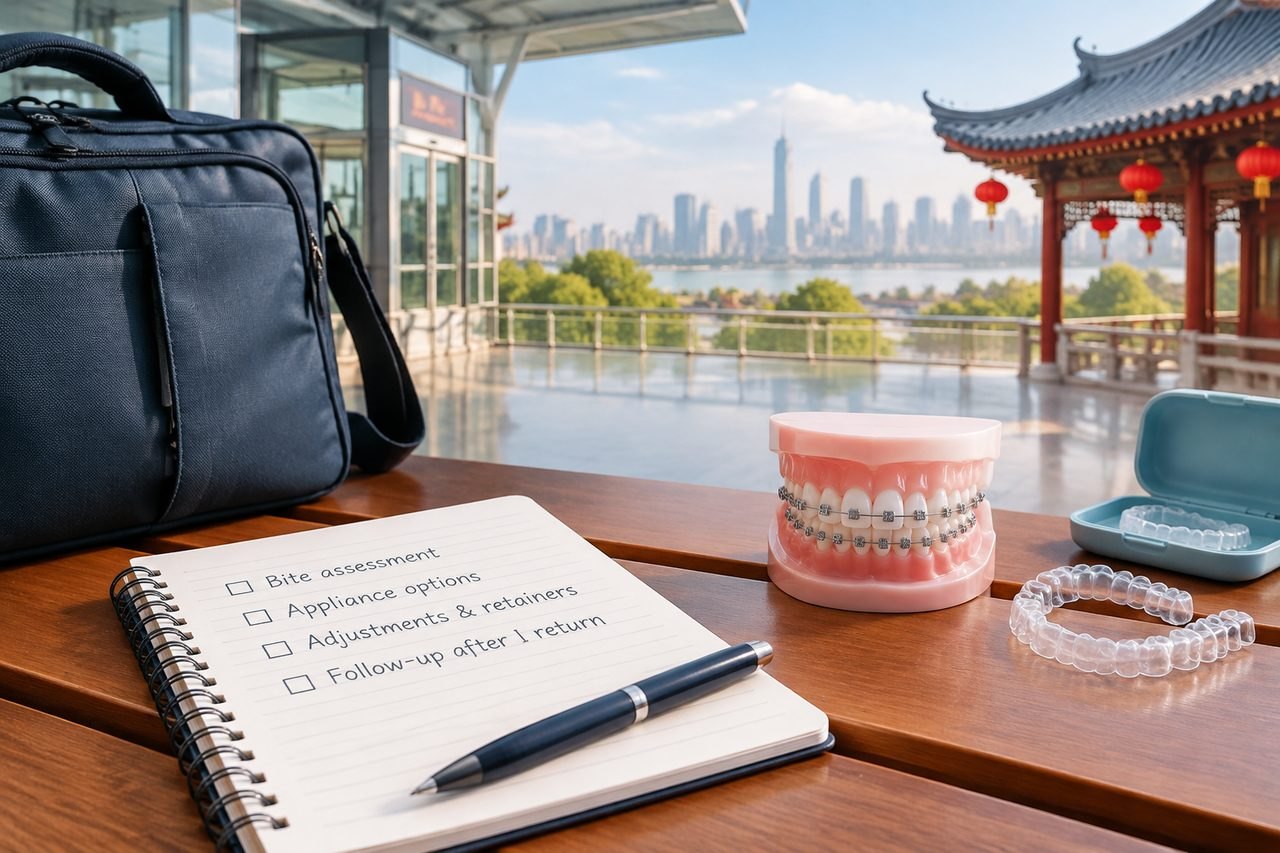
The practical approach is to prepare a short written list. Three or four questions are enough. Write them in English and, if possible, have them translated into Chinese so the clinical team can read them directly. This reduces the risk that a key point is lost in interpretation and gives you a record of what was discussed.
Your list should focus on decisions you cannot make alone: how your bite will be assessed, what appliance options are realistic for your case, how many visits the proposed plan involves, and what happens if you leave China before treatment finishes. These are the questions that determine whether treatment in China is workable for you, not just clinically possible.
What the Bite Assessment Actually Involves
Orthodontic treatment begins with an assessment of your teeth and jaws. This is not a single measurement. The orthodontist looks at how your upper and lower teeth meet, how they fit together when you bite, and whether the jaw relationship itself contributes to the problem. Two people with similar-looking front teeth can need very different plans because their bite and jaw position differ.
At the first visit, ask what records the orthodontist needs to complete this assessment. Common items include dental impressions or intraoral scans, photographs, and X-rays. The specific combination depends on your case and the clinician's judgement. If you already have recent records from your home dentist or orthodontist, bring them. They may reduce duplication, but the treating orthodontist will decide whether they are adequate or whether new images are needed.
Ask directly: "Based on your examination today, what is your preliminary view of my bite, and what further records do you need before you can give me a definitive plan?" This separates what the orthodontist can see now from what still needs investigation. It also tells you whether a second visit will be required before any treatment decision.
Appliance Options: Ask What Fits Your Case, Not What Is Popular
Braces and other orthodontic appliances are not interchangeable. The choice depends on the specific tooth movement required, the bite problem, your treatment goals, and the orthodontist's clinical preference. Fixed braces, clear aligners, and other systems each have different indications and limitations. What works well for one patient may be unsuitable for another.
Rather than asking "Which is best?", ask: "For my specific bite, which appliance options are realistic, and what are the trade-offs between them?" A useful follow-up is whether the proposed appliance can achieve the intended result within a timeframe that fits your circumstances, or whether a different approach would be more predictable.
You should also ask who would provide the treatment. Will the orthodontist you meet today personally manage your case, or will another clinician in the team handle adjustments? This matters if you are planning repeated visits and need continuity. The hospital or clinic decides how its orthodontic service is organised, so ask for a clear answer rather than assuming.
Continuing Appointments and What Happens After You Return Home
Orthodontic treatment requires ongoing adjustments. Braces and aligners are not a one-visit procedure. This is the single most important practical issue for an overseas patient, and it should be discussed openly at the first consultation.
Ask: "If I start treatment here, how many in-person visits would the plan typically involve, and at what intervals?" The answer depends on your case and the appliance chosen. Do not accept a vague reassurance. You need enough detail to judge whether you can commit to the schedule.
Then ask the harder question: "If I return home before treatment is complete, can the remaining adjustments be coordinated with an orthodontist in my home country, and who would take responsibility for that handover?" Some clinicians are willing to share records and communicate with a colleague abroad. Others prefer to manage the entire course themselves. Neither answer is wrong, but you need to know which applies before you begin.
If a handover is possible, ask what records would be provided and what the receiving orthodontist would need. A clear transfer of X-rays, photographs, treatment notes, and appliance specifications makes continuity more likely. The receiving clinician retains independent judgement about whether to accept the case and how to proceed.
Finally, ask about retainers. Retainers are used after orthodontic treatment to maintain the result. Ask when they would be fitted, what type is proposed, and how they would be managed if you are not in China at that stage. This is part of the treatment plan, not an afterthought.
Questions That Clarify Scope Before You Commit
Before you agree to any treatment, you should understand what the proposed plan includes and what remains undecided. Ask the provider for a written summary of the recommended appliance, the estimated number of visits, and the records required. If a written plan is not available immediately, ask when you can expect it.
Cost is part of scope. Rather than asking for a single figure, ask what the quoted fee covers and what it does not. Request the provider's written estimate and ask which items are included, which are excluded, and which are still undecided because the plan is not final. This is more useful than comparing headline numbers that may cover different things.
You should also ask about the practicalities of starting treatment as an overseas patient. Does the clinic require a minimum stay, or can the first phase be completed over a short visit? Are there any appointments that cannot be scheduled remotely? These are administrative questions, and the clinic's answer is the one that matters.
If you are considering orthodontic treatment alongside other dental work, such as jaw surgery, ask how the two would be sequenced. Orthodontics and orthognathic surgery are sometimes combined, and the order of treatment affects the overall plan. The orthodontist and surgeon would need to coordinate, and you should ask whether that coordination is possible at the hospital you are considering.
How to Prepare Records and Communicate Clearly
Good records make the first consultation more productive. Bring any recent dental X-rays, photographs, impressions, or treatment notes you already have. If your previous orthodontist provided a treatment summary, include it. These documents give the Chinese orthodontist a starting point, even if new images are ultimately required.
Prepare a one-page summary of your dental history in English. Include previous orthodontic treatment, extractions, jaw problems, and any relevant medical conditions. If you take medication, list it. This is not a complete medical archive; it is a focused summary that helps the clinician understand your situation quickly.
Language matters. If you do not speak Chinese, arrange interpretation for the consultation. A professional interpreter who is familiar with dental terminology is preferable to relying on a friend or a translation app for clinical discussions. Ask the hospital or your coordination service what interpretation options are available.
During the consultation, take notes. Write down the orthodontist's preliminary assessment, the recommended next step, and any questions that remain unanswered. If something is unclear, ask for clarification before you leave. It is better to spend an extra few minutes than to leave with uncertainty about a plan that could affect you for months.
A Practical Next Step
Before your first orthodontic consultation in China, write your three or four key questions and have them translated. Bring any existing dental records and a short summary of your history. If you would like help preparing those records or arranging an appointment with a suitable orthodontic specialist, you can send a brief summary through the enquiry form. An initial enquiry is free and does not commit you to treatment. The orthodontist will decide whether treatment is suitable after examining you in person.
Sources & scope of this guide
References and official service information relevant to this guide.
This is general planning information and has not been individually reviewed by a doctor. Medical decisions and personal treatment advice come from your treating clinicians.