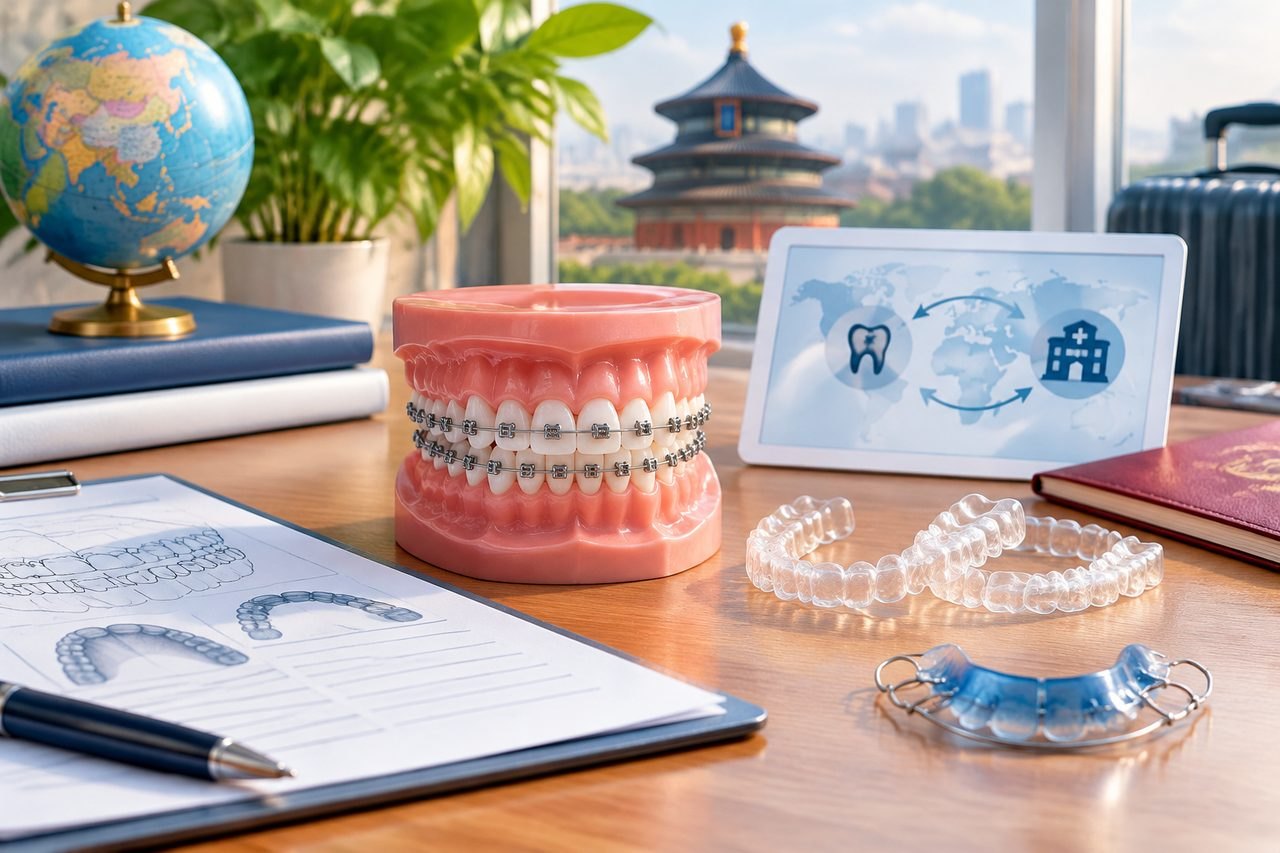
What the two teams actually need to exchange
Orthodontic treatment is not a single appointment. It is a course of care in which the clinician assesses teeth and jaws, plans an appliance, and then adjusts that appliance over time. Because the adjustment schedule is part of the treatment itself, the handover between a clinic in China and your home team is not an administrative formality. It is a clinical question: who will make the next adjustment, when, and against what plan?
The exchange has two directions. Your home team needs to know what the China clinic assessed, what appliance was proposed or started, and what the intended sequence is. The China clinic needs your existing records, your treatment history, and a clear statement of what your home clinician is willing to take on after you leave. Neither side can answer for the other. Ask each team what it needs from the other, in writing, before you commit to a start date.
A useful way to frame the first message is not 'can you treat me in China?' but 'if treatment starts here, what will my home clinician need to continue it?' That single question surfaces the real dependencies: records, appliance type, adjustment intervals, and who accepts responsibility for the next stage.
Bite assessment: what records to ask about, not assume
Orthodontic assessment looks at the relationship of teeth and jaws, not only at how straight the front teeth appear. The specific records a clinic requests depend on the individual case and the clinician's judgement. Rather than assembling a fixed package in advance, ask the China clinic which records it wants for your bite assessment, and ask your home team which of those it can provide or repeat.
Common categories you may be asked about include dental photographs, radiographs, and study models or intraoral scans. Whether any of these is needed, and in what form, is a clinical decision. If your home team already holds recent images or scans, ask whether they are acceptable to the China clinic and whether they remain current enough to rely on. If not, ask what would need to be repeated and where.
Do not send a complete archive in your first message. A short summary of your orthodontic history, the main concern, and the records you already hold is enough to start the conversation. The clinic can then tell you what it specifically needs. This keeps the exchange focused and avoids sending sensitive material before a treating relationship exists.
Appliance scope: what is proposed, and what it commits you to
Appliance choice requires an individual assessment. Different appliances carry different adjustment needs, different appointment rhythms, and different demands on the patient. When the China clinic proposes an appliance, ask what that choice means for the number and spacing of visits, and what would happen if you could not attend one.
The practical question for an overseas patient is not only 'which appliance is best?' but 'which appliance can realistically be continued by my home clinician?' Some home clinicians may be willing to adjust an appliance started elsewhere; others may not. This is their independent clinical judgement, and it is better to learn it before treatment begins than after you return home.
Ask the China clinic to put the proposed appliance, the intended treatment sequence, and the expected adjustment pattern in writing. Ask your home team to confirm, in writing, whether they would continue that plan and under what conditions. If the two answers do not match, that mismatch is the most important thing to resolve before starting.
Continuing appointments: who adjusts what, and where
Braces need ongoing adjustments, and retainers are used after treatment. That means the treatment does not end when you leave China. The handover question is concrete: after your return home, who will perform adjustments, how often, and against whose plan?
Ask the China clinic whether it can coordinate a treatment plan across repeated visits, including visits in China and adjustments at home. Ask your home clinician whether they are willing to take over adjustments, and what records or instructions they would need to do so. Ask both what happens if a planned appointment is missed or delayed.
Get the answers in writing, with names and dates where possible. A verbal understanding between two clinics in different countries is fragile. A short written summary of the plan, the appliance, the adjustment interval, and the named contact at each end gives both teams something to work from. If either team will not commit in writing, treat that as information about the limits of the arrangement.
How to run the exchange without losing the thread
In cross-border orthodontic care, the practical risk is not a clinical disagreement. It is a message that never reaches the right person, or a record that arrives in a format no one can use. A simple structure reduces that risk.
Start with a one-page summary: your main orthodontic concern, your treatment history, the records you hold, and the specific question you want answered. Send it to both teams. Ask each to reply to the same list of questions so you can compare answers directly.
Keep a single running document with dates, names, and what was agreed. When the China clinic gives you a plan, send it to your home team and ask for a written response. When your home team states a condition, send it back to the China clinic. You are the courier between two clinical teams, and the document is what keeps the handover honest.
If language is a barrier, ask each clinic whether it can provide written communication in a shared language, and confirm who will translate clinical instructions. A translated summary is not the same as a clinician reading the original record. Ask what the receiving clinician will actually review.
- One-page summary of concern, history, records held, and questions.
- The same question list sent to both teams for comparable answers.
- A dated log of who said what, and what remains undecided.
- Written confirmation of the proposed appliance and adjustment plan.
- Named contact at each clinic for the continuing phase.
What to confirm before you commit, and the next step
Before starting orthodontic treatment in China, confirm four things in writing. First, the China clinic's proposed assessment and appliance plan, including what it will and will not do. Second, your home clinician's willingness to continue adjustments, and the conditions attached. Third, how records will be transferred and in what format. Fourth, who to contact at each end if the plan changes.
None of this guarantees that treatment can be coordinated across repeated visits, that a particular clinic will accept your case, or that you are fit to travel. Those are decisions for the treating clinicians and the hospital. What the exchange does is make the dependencies visible before you commit, so that a plan which cannot be continued at home is identified early rather than after treatment has started.
If you would like help requesting a specialist appointment, organising interpretation, or passing records between teams, ChinaSpecialistCare can coordinate that non-clinical work. An initial enquiry is free and needs only a brief summary, not a complete archive. You can also review the complex orthodontics service page for how assessment and appliance planning are approached.
For anything urgent or worsening, seek local care first. An overseas enquiry should not delay assessment of a current problem.
Sources & scope of this guide
References and official service information relevant to this guide.
This is general planning information and has not been individually reviewed by a doctor. Medical decisions and personal treatment advice come from your treating clinicians.