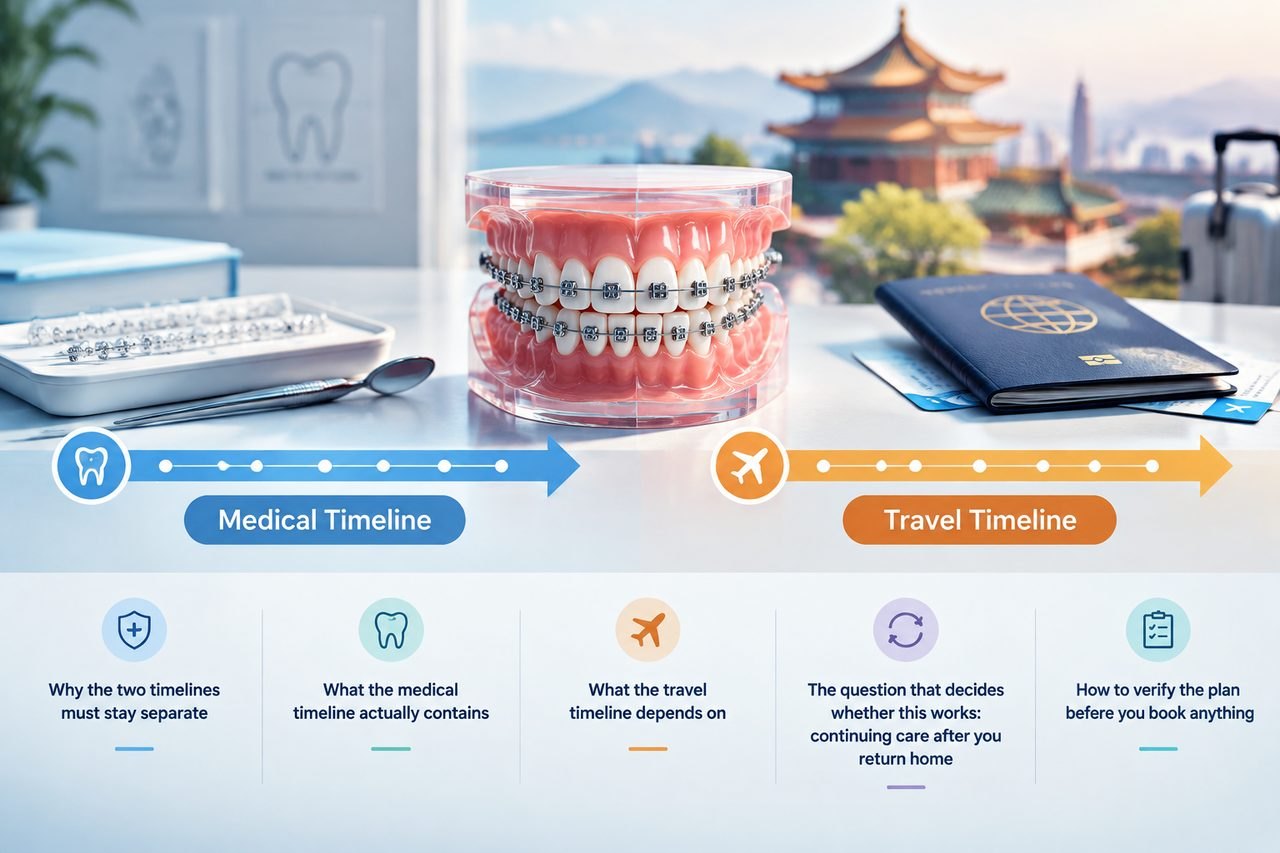
Why the two timelines must stay separate
Orthodontic treatment is not a single appointment. It involves assessment of the teeth and jaws, an appliance plan, and ongoing adjustments, with retainers used after the active phase. Each of those stages has its own clinical timing, and that timing is decided by the treating orthodontist, not by flight prices or hotel availability.
The practical mistake is to book travel around an assumed treatment schedule. If you book flights before the clinician has confirmed the assessment findings and the appliance scope, you may need to change dates, extend a stay or return sooner than planned. Separating the two timelines means the clinical plan comes first and the travel plan is built to fit it.
This article answers one question: how do you confirm the medical steps and the flight and accommodation arrangements separately? It does not tell you whether orthodontic treatment is suitable for you, whether a particular clinic can accept you, or how long your own treatment will take. Those are clinical decisions for the treating team.
What the medical timeline actually contains
The medical timeline is the sequence of clinical stages the orthodontist expects. It normally begins with an assessment of the teeth and jaws, which may include records such as photographs, radiographs or impressions depending on the clinician's judgement. The assessment leads to a proposed appliance type and a treatment plan. Active treatment then involves adjustments at intervals set by the clinician, and retainers are used after the active phase.
Each of those stages can change once the clinician examines you in person. An assessment based on records sent from abroad may support a provisional plan, but it cannot replace the in-person examination. That is why the medical timeline should be treated as a provisional sequence until the treating orthodontist confirms it.
When you ask a clinic about orthodontic treatment in China, the useful question is not only what the plan is, but which stages require you to be physically present and which can be handled remotely. Adjustment appointments generally require attendance, but the clinician decides the interval and whether any stage can be delegated. Ask directly: which appointments must I attend in person, and which can be done elsewhere?
The answer determines how many trips you may need and how long each stay should be. Without that answer, any travel booking is guesswork.
What the travel timeline depends on
The travel timeline depends on the confirmed clinical stages, not the other way around. Once the orthodontist has confirmed which appointments require your presence and how far apart they are expected to be, you can plan flights, accommodation and any companion arrangements around those fixed points.
Several practical questions sit on the travel side. How long does the clinic expect you to stay for the initial assessment and appliance fitting? How much time should you allow after each adjustment before travelling? Does the clinic require a review before you leave the country? These are questions for the treating team, because the answers depend on your individual clinical situation and the clinic's own arrangements.
Accommodation should be chosen for proximity to the clinic and for the length of stay the clinician confirms, not for a fixed number of nights. If the clinician says a review is needed before you fly, build that into the plan. If the clinician says a stage can be handled remotely, you may not need to stay as long, but confirm that in writing before you book.
Do not treat any of these as fixed rules. Different clinics and different cases produce different schedules, and the treating orthodontist is the only person who can confirm yours.
The question that decides whether this works: continuing care after you return home
The single most important question for an overseas patient is who will handle adjustments after you return home. Braces need ongoing adjustments, and retainers are used after treatment. If you start active treatment in China and then return to your home country, someone must manage the remaining adjustments and the retainer phase.
Ask the treating orthodontist whether the proposed treatment can be coordinated across repeated visits to China, and whether they are willing to work with a clinician in your home country for the stages in between. Some clinicians may agree to a shared-care arrangement; others may not. The answer depends on the clinician's judgement and on whether a suitable local professional is available to take on part of the care.
If shared care is not possible, you face a choice: plan repeated trips to China for adjustments, or reconsider whether starting treatment in China is practical for your situation. That is a decision only you and the treating team can make, but you need the answer before you commit to anything.
Ask this question early, in writing, and keep the reply. A verbal assurance at a first consultation is not the same as a confirmed arrangement for the full course of treatment.
How to verify the plan before you book anything
Verification means getting the clinical stages and the travel requirements confirmed in a form you can rely on. Start by asking the clinic for a written outline of the proposed treatment stages, including which appointments require your presence and the expected interval between them. Ask whether the plan is provisional pending in-person assessment, and what could change it.
Next, ask what records the clinic needs before it can give you a meaningful plan. The clinician decides which records are relevant, so ask rather than assume. If you already have radiographs, photographs or a previous orthodontic summary, ask whether they are useful and in what format.
Then ask the practical travel questions: how long the clinic expects you to stay for each stage, whether a review is required before departure, and how appointment dates are confirmed. These are administrative questions the clinic can answer, and they let you build the travel plan on confirmed information rather than assumption.
Finally, ask who your point of contact will be for scheduling and for any changes. A named contact makes it easier to confirm dates and to raise problems before they affect your travel.
- Request a written outline of the proposed stages and which require your presence.
- Ask which records the clinician needs and in what format.
- Ask how long the clinic expects you to stay for each stage.
- Ask whether a review is required before you leave the country.
- Ask who handles scheduling and changes, and keep that contact.
What a reply does and does not confirm, and what to do if a step cannot be completed
A reply from a clinic confirms what that clinic is willing to discuss or provisionally plan. It does not confirm that you are suitable for treatment, that a particular appliance is appropriate for you, that the clinic will accept your case, or that a specific schedule will hold once you are examined in person. Suitability and the final plan belong to the treating orthodontist after assessment.
If a step cannot be completed, the fallback is to keep the two timelines separate and proceed only as far as the confirmed information allows. If the clinic cannot confirm the adjustment schedule in advance, do not book non-refundable travel. If shared care after you return home cannot be arranged, ask what alternatives exist before committing. If records are incomplete, ask the clinician what is actually needed rather than sending everything you have.
If you are considering whether ChinaSpecialistCare can help, our role is limited to non-clinical coordination: sharing records, requesting a specialist appointment, and interpretation support where agreed. We do not decide suitability, prescribe treatment or confirm clinical schedules. A preliminary enquiry is free and does not require buying a proxy consultation. You can send a brief summary of your situation and main question, and we will explain what information is missing and what the relevant next step may be.
The hospital and the treating orthodontist decide whether your case is suitable and what the plan will be. Your job is to get their answers in writing before you commit to flights or accommodation, and to keep the medical and travel timelines as two separate plans until both are confirmed.
Sources & scope of this guide
References and official service information relevant to this guide.
This is general planning information and has not been individually reviewed by a doctor. Medical decisions and personal treatment advice come from your treating clinicians.