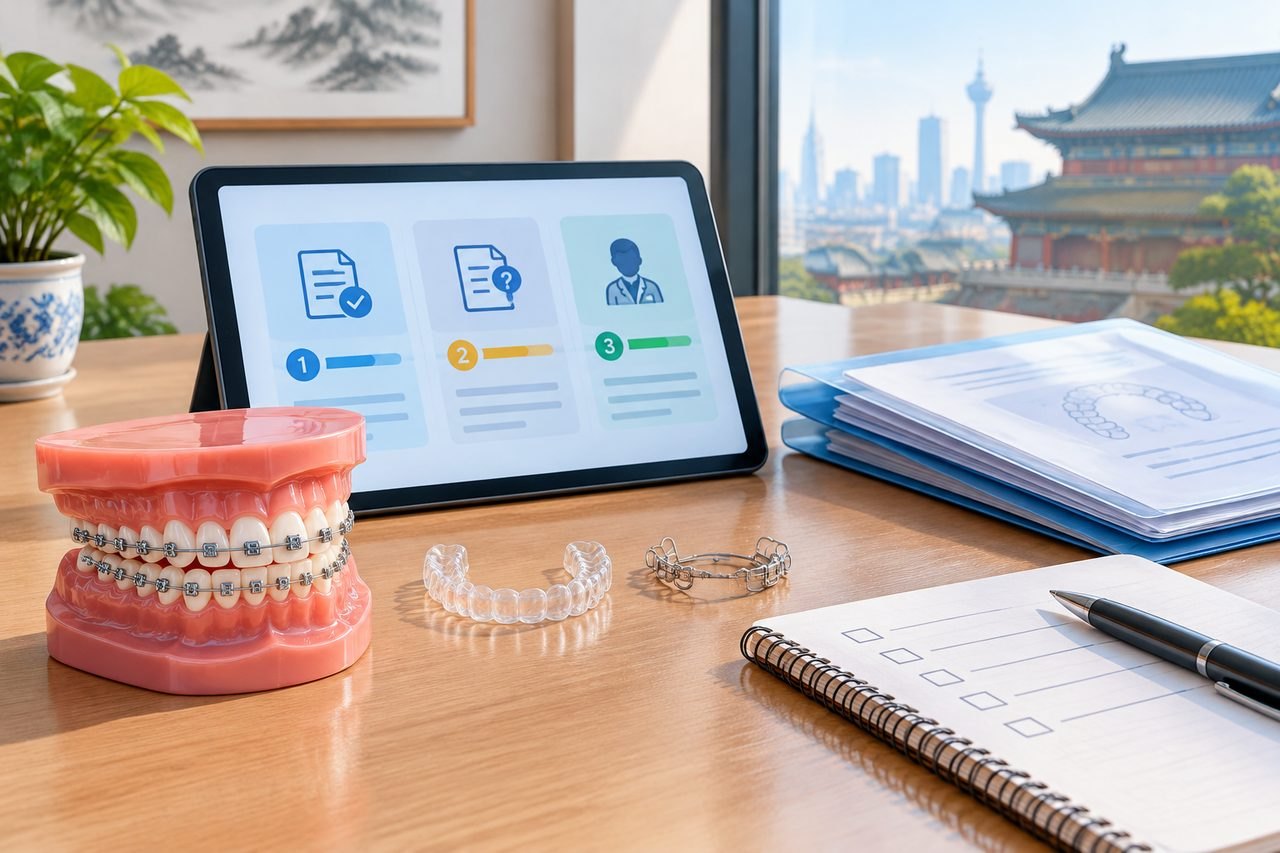
Three stages a hospital reply can describe
When you send an enquiry about orthodontic treatment in China, the first reply is often administrative. It may come from an international office, a coordinator or a clinician's assistant. The message can sound encouraging without confirming that a qualified orthodontist has reviewed your bite, jaw relationship or treatment history. Your first task is to identify which of three stages the reply describes.
Stage one is receipt. The hospital confirms that your message and attachments arrived. This is not an assessment. Stage two is a request for missing records. The hospital has looked at what you sent and wants specific additional items before a clinician can form a view. Stage three is formal assessment. A clinician has reviewed your records and can discuss whether orthodontic treatment is suitable, what appliance options might be considered and what further examination would be needed in person.
These stages are not always labelled clearly. A reply that says 'we have received your information and will arrange a consultation' may still be at stage one. A reply that asks for a lateral cephalometric radiograph, intraoral photographs or a treatment history is at stage two. A reply that discusses bite correction, appliance type or retention is closer to stage three, though it may still be preliminary.
The practical difference is what you can rely on. Only a clinical assessment can address whether orthodontic treatment is appropriate for you, what it would involve and how long it might take. An administrative reply cannot confirm suitability, appointment dates or treatment scope. If the message does not make the stage clear, ask directly: has a clinician reviewed my records, or is this a confirmation of receipt?
What a records request tells you about the assessment
A request for more records is useful information. It means the hospital has looked at your file and identified gaps that prevent a clinician from assessing your case. The specific items requested tell you what the orthodontist needs to evaluate your bite and plan treatment.
Orthodontic assessment involves examining the teeth and jaws. A clinician needs to understand the relationship between the upper and lower jaws, the position of individual teeth, the condition of the gums and supporting bone, and any previous orthodontic or surgical treatment. Records that support this assessment may include dental impressions or intraoral scans, photographs of the teeth and face, radiographs such as a panoramic X-ray or lateral cephalometric radiograph, and a written history of previous treatment.
If the hospital asks for a particular radiograph or scan, ask whether it needs the original file, a specific format or a report from the imaging centre. Some hospitals accept digital files uploaded through a portal; others may ask for physical copies. The hospital's international office can clarify its preferred format.
If you do not have a requested record, say so rather than sending an unrelated document. Ask whether the hospital can arrange the imaging locally during an in-person visit, or whether it prefers you to obtain it at home first. The answer affects how you plan your trip and what you need to bring.
A records request does not mean your case is complex or that treatment is likely. It means the clinician needs more information before forming a view. The absence of a records request does not mean your file is complete either; it may simply mean the hospital has not yet reviewed it.
Bite assessment, appliance scope and what the reply may not cover
Orthodontic treatment involves assessment of teeth and jaws. Braces need ongoing adjustments, and retainers are used after treatment. Appliance choice requires an individual assessment. These points are central to interpreting any hospital reply, because they explain why a preliminary message cannot confirm treatment details.
A bite assessment looks at how the upper and lower teeth meet, whether there is crowding or spacing, and whether the jaw relationship contributes to the problem. The clinician also considers the health of the gums and supporting bone, because orthodontic tooth movement depends on healthy foundations. If gum disease is present, it may need treatment before or alongside orthodontic care.
Appliance scope refers to the type of orthodontic device that might be suitable. Options can include fixed braces with metal or ceramic brackets, lingual braces, or clear aligner systems. Each has different requirements for compliance, adjustment frequency and clinical suitability. A hospital reply that mentions an appliance type without a clinical assessment may be describing what the hospital offers generally, not what is appropriate for you.
Continuing appointments are another area where a preliminary reply may be silent. Braces require ongoing adjustments, typically at intervals determined by the treating clinician. If you are considering orthodontic treatment in China as an overseas patient, you need to understand how many visits the proposed treatment would require, whether any adjustments can be done remotely or by a clinician in your home country, and who would manage retention after the active phase ends.
Ask the hospital whether the proposed treatment can be coordinated across repeated visits and who would handle adjustments after you return home. This is a practical question, not a clinical one, and the answer affects whether treatment in China is feasible for your situation.
Questions to ask before you treat a reply as an assessment
A hospital reply can be read more accurately if you ask a few direct questions. These are not challenges to the hospital; they are requests for clarity that help you plan.
Ask whether a qualified orthodontist has reviewed your records or whether the reply is from an administrative team. Ask what specific records the clinician still needs and whether any can be obtained during an in-person visit. Ask whether the hospital can provide a written summary of the proposed treatment scope, including the type of appliance under consideration and the expected number of visits. Ask who would be responsible for adjustments if you return home before treatment is complete, and what retention arrangements would be needed.
Ask whether the hospital's written estimate, if one is provided, states what is included and what is not. Orthodontic treatment may involve records, appliance fabrication, adjustment visits, retention devices and follow-up. The hospital can explain how its own estimate is structured. Do not assume that a quoted figure covers everything or that a separate charge applies to a particular item; ask the hospital to confirm its own scope.
Ask what would happen if your treatment needs change during the course of care. Orthodontic treatment can involve unexpected findings, and the plan may need adjustment. The hospital can explain how it handles changes to the treatment plan and what that means for scheduling and cost.
If the reply does not answer these questions, send a short follow-up listing the specific points you need clarified. A written reply is easier to refer to later than a verbal explanation.
Planning around repeated visits and continuity of care
Orthodontic treatment is not a single appointment. Braces need ongoing adjustments, and retainers are used after treatment. If you are travelling to China for orthodontic care, the number and timing of visits matter as much as the treatment itself.
Ask the hospital how it would structure the treatment across visits. Some phases may require you to be in China; others may involve remote monitoring or coordination with a clinician in your home country. The hospital can explain what it can and cannot support. Do not assume that all adjustments can be done remotely or that a local clinician will take over your care; ask what arrangements are possible.
Continuity of care after you return home is a separate question. If the hospital proposes retention, ask what type of retainer is planned, how long it should be worn and who would monitor it. The treating clinician's instructions should be followed, and a clinician in your home country may need to be involved. The hospital can explain what information it would provide to support that handover.
If the proposed treatment requires repeated visits to China, consider the practical implications: travel frequency, time away from work or school, and the cost of multiple trips. These are not clinical decisions, but they affect whether the plan is workable for you.
If the hospital's reply does not address visit structure or continuity, ask for a written outline. This helps you compare what different hospitals can offer and make an informed decision.
What to send next and how to move the enquiry forward
If the hospital has confirmed receipt but not started an assessment, send the records it has requested. If it has not specified what it needs, ask for a list. If you have already sent records and received no substantive reply, send a short follow-up asking whether a clinician has reviewed your file and what the next step is.
When you send records, include a brief summary of your main concern, any previous orthodontic treatment, and the outcome you are hoping for. This helps the clinician understand your priorities. Do not send passport numbers, payment details or a complete medical archive in your first message. A short summary and relevant records are enough to begin.
If you would like help organising your records or requesting a specialist appointment, ChinaSpecialistCare can assist with non-clinical coordination. This does not replace the hospital's clinical assessment, and it does not confirm suitability or availability. The hospital decides whether to accept your case and what treatment to recommend.
An initial enquiry is free. You can start with a brief summary through the enquiry form, email or WhatsApp. The team can help you identify missing information and suggest the relevant next step. A proxy consultation is optional and is not required to make an initial enquiry.
The most useful next step is to ask the hospital one direct question: has a clinician reviewed my records, and if not, what do you need from me to begin that review? The answer tells you whether you are at receipt, records request or formal assessment, and what to do next.
Sources & scope of this guide
References and official service information relevant to this guide.
This is general planning information and has not been individually reviewed by a doctor. Medical decisions and personal treatment advice come from your treating clinicians.