Why an appliance name alone is not enough
A statement such as 'I had braces for two years' or 'I wore clear aligners' tells a new orthodontist almost nothing about your current clinical situation. Orthodontic treatment involves assessment of the teeth and jaws, and the same appliance type can be used for very different starting problems and different amounts of movement. Two people who both wore fixed braces may have completely different remaining needs.
The receiving clinician needs to understand the starting point, the direction of movement, what was achieved, what was retained and whether anything has changed since. That is the difference between a treatment label and a treatment result. If you only supply the label, the new team has to reconstruct the history from your current examination and whatever images you can provide, which may leave real uncertainty about what has already been done.
This matters most when you are considering orthodontic treatment in China while living or working elsewhere. The clinical question is not only whether treatment is possible, but whether the proposed plan can be coordinated across repeated visits and who would handle adjustments after you return home. A clear previous-treatment description is the starting point for that discussion.
What to record about the original problem and the result
Write a short factual history in your own words. Start with why treatment was begun: crowding, spacing, an overbite, an underbite, a crossbite, impacted teeth, or a jaw relationship concern. Note whether the clinician described it as a dental problem, a skeletal problem, or a combination, if you were told.
Then describe what changed. Were teeth straightened, extracted, or moved to close spaces? Was the bite changed in any way you can describe, such as front teeth meeting differently? Were elastics, headgear, temporary anchorage devices or other appliances used? Did treatment finish as planned, stop early, or change direction partway through?
Finally, describe the current state. Are you still wearing a retainer, and if so, what type and how often? Has anything shifted since active treatment ended? Do you have any discomfort, difficulty chewing, or concern about the bite? These details help a new clinician understand whether you are dealing with relapse, an unfinished result, or a new problem.
If you do not know some of these answers, say so rather than guessing. 'I was told my bite was corrected but I do not know the technical term' is more useful than an invented diagnosis.
Records that make the description verifiable
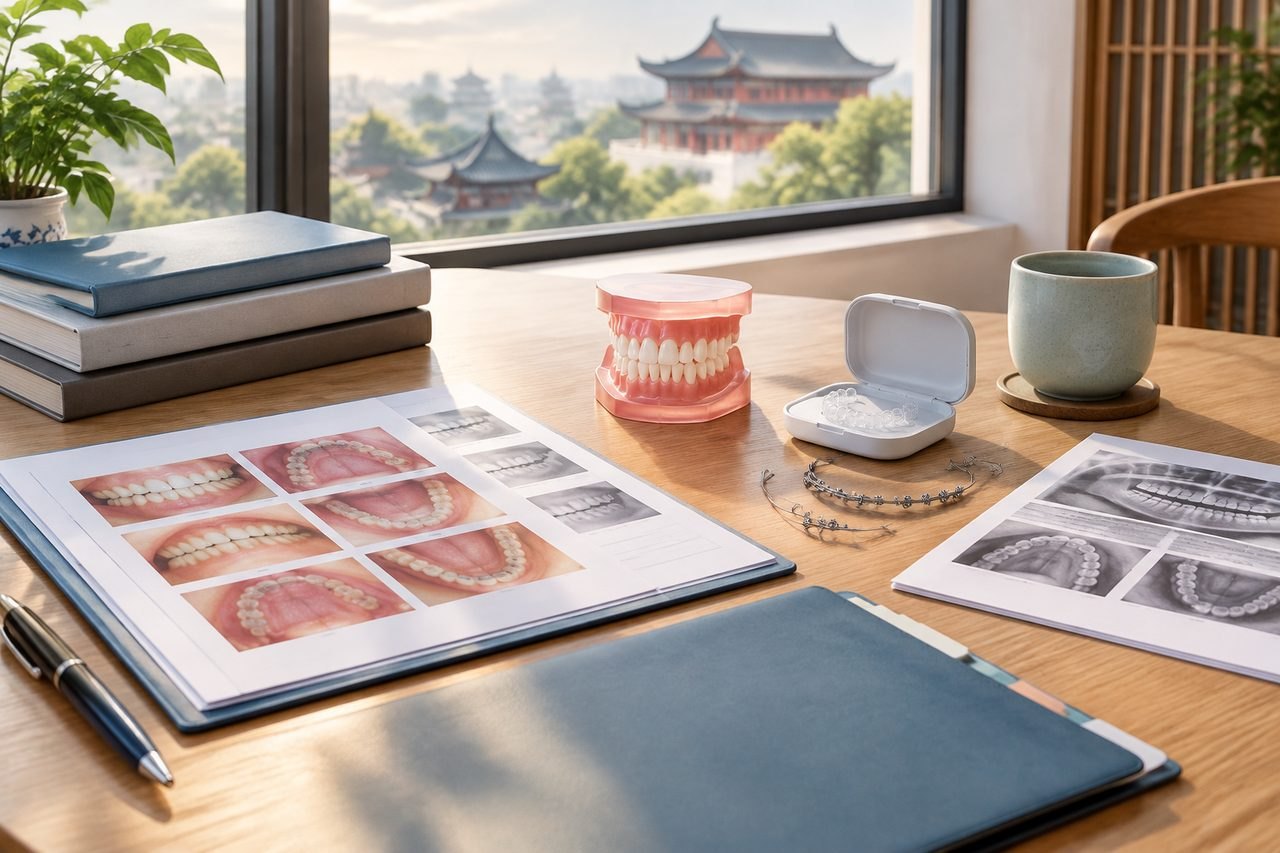
A written summary is helpful, but images and clinical records make it verifiable. Ask your previous clinic for copies of what exists: panoramic and lateral cephalometric radiographs, intraoral and facial photographs, study models or digital scans, and treatment notes or a discharge summary. If you have retainers, keep them and bring them.
Not every clinic will have every item, and some records may be old. That is normal. The useful step is to list what you actually have and what is missing, then ask the receiving clinician whether the available material is sufficient for an initial assessment or whether new imaging would be needed. Do not assume that a particular scan is mandatory; ask what that clinician requires for your situation.
If records are in another language, a brief translation of the diagnosis and treatment summary can help, but do not translate clinical terms yourself if you are unsure. Ask the provider what format and language they prefer before sending a large file.
Bite assessment and appliance scope in a new plan
When you present a clear previous-treatment history, the new clinician can focus the examination on what is actually unresolved. Bite assessment looks at how the upper and lower teeth meet, how the jaws relate, and whether the remaining problem is mainly alignment, mainly bite, or both. Previous treatment results change what is realistic now, because some movement may already have been achieved and some may have relapsed.
Appliance choice requires an individual assessment. Fixed braces, clear aligners, and other systems have different capabilities and different demands on the patient. A history of previous treatment does not automatically mean one option is better; it means the clinician needs to know what has already been done before recommending a route.
Ask directly: what is the remaining problem, what would the proposed appliance aim to change, and what are the alternatives? Also ask whether the plan depends on any records you do not yet have. If the answer is that more information is needed first, that is a legitimate clinical step, not a refusal.
Continuing adjustments and coordination across visits
Orthodontic treatment needs ongoing adjustments, and retainers are used after treatment. That simple fact creates the central practical question for overseas patients: how would adjustments be scheduled, and who would manage them if you are not in China for part of the treatment?
Describe your travel pattern honestly. How long can you stay for the initial assessment and any appliance fitting? How often could you return? Would you be able to attend a clinic near your home for some visits, and would the China team be willing to coordinate with that clinician? These are questions to confirm with the specific provider, not assumptions to make in advance.
Ask what the proposed plan assumes about visit frequency and total treatment duration, and what happens if you cannot attend as planned. Ask who would handle an urgent problem such as a broken appliance or discomfort while you are away. Ask whether the provider has a written process for sharing records with another clinician. The answers will tell you whether the plan is realistically coordinated or whether it depends on you being continuously present.
How to present this in your enquiry and what to confirm next
For an initial enquiry, you do not need to send a complete archive. A short summary is enough to start: the original problem, the appliance used, what changed, what remains, whether you still wear a retainer, and what records you can provide. Add your main question, such as whether the remaining bite problem can be treated and how adjustments would work across your travel pattern.
Then ask the provider what they need next. Confirm whether they want images before an appointment, whether they can review records remotely, and what they would need to see in person. Ask for a written outline of the proposed assessment and treatment scope, including what is included, what is not yet decided, and what would depend on the examination. A records-based opinion can inform your decision, but it does not establish final suitability or guarantee an outcome.
If you have pain, swelling, a broken appliance or another urgent problem, seek local care first rather than waiting for an overseas enquiry. For non-urgent planning, you can start with a brief summary through the enquiry form, email or WhatsApp, and share records after first contact. An initial enquiry is free and does not require buying a proxy consultation. The hospital decides suitability after assessment.
A useful next step is to write your one-page previous-treatment summary now, list the records you have, and send it with your specific question about bite assessment, appliance scope and continuing adjustments. That gives the clinical team something concrete to respond to.
Sources & scope of this guide
References and official service information relevant to this guide.
This is general planning information and has not been individually reviewed by a doctor. Medical decisions and personal treatment advice come from your treating clinicians.