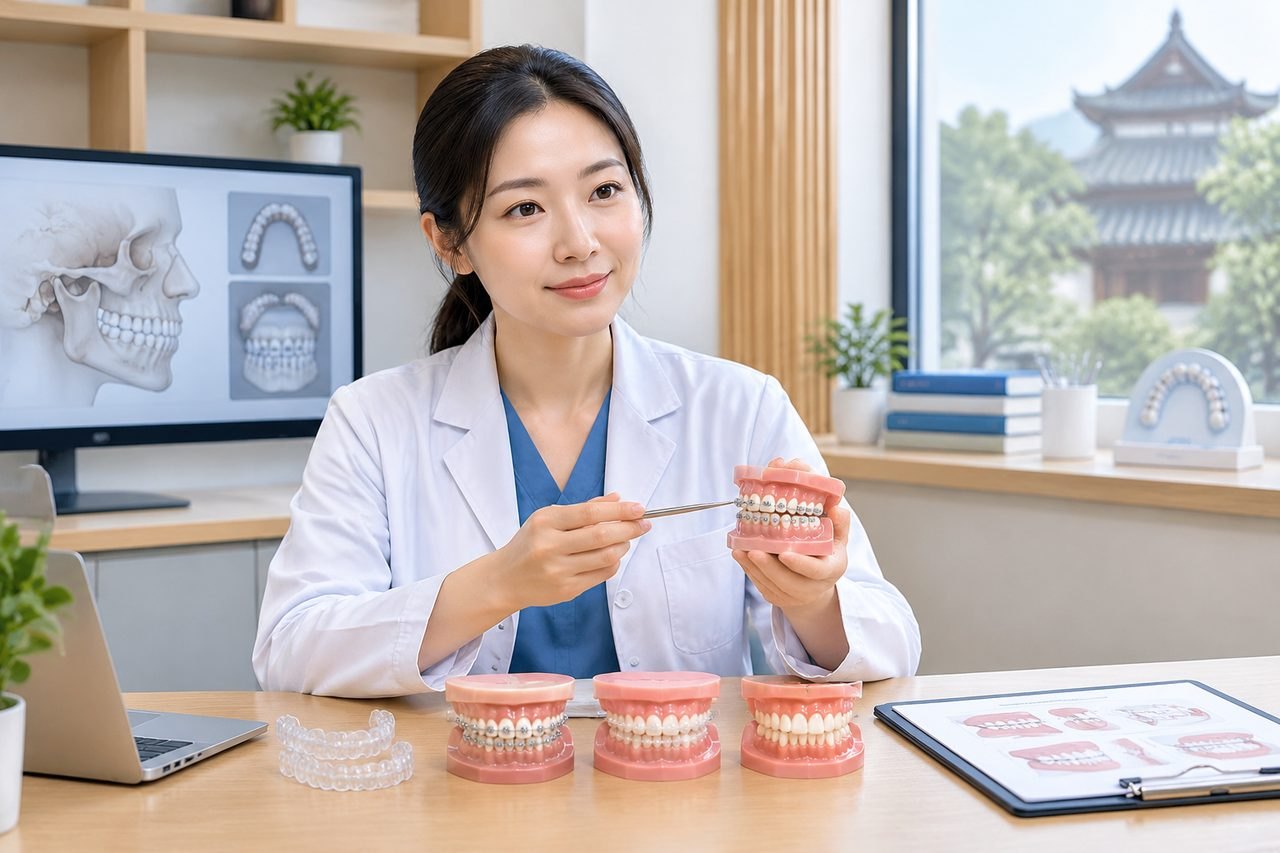
What orthodontic treatment is designed to address
Orthodontic treatment is a planned course of care that starts with an assessment of the teeth and jaws. The clinician looks at how the upper and lower teeth meet, how they are positioned, and whether the bite relationship is creating problems or is likely to create problems later. From that assessment, the team decides whether an appliance is appropriate and which type might suit the case.
The treatment itself works by applying controlled force over time. Braces need ongoing adjustments, which is why orthodontics is not a single appointment but a sequence of visits. After the active phase, retainers are used to help hold the result. This is the general shape of treatment; the specific plan depends on the individual assessment.
So the first thing orthodontic treatment can address is the relationship between teeth and jaws as assessed by a qualified clinician. That may include crowding, spacing, or a bite that does not fit well. What it cannot do is substitute for a full diagnosis of every underlying condition. If there is gum disease, a jaw joint problem, or a skeletal discrepancy, those may need separate assessment and possibly separate treatment.
What orthodontic treatment cannot address on its own
It is just as important to understand the limits. Orthodontic treatment moves teeth and can influence jaw relationships within biological limits, but it does not treat every cause of a poor bite. A significant skeletal discrepancy, where the upper and lower jaws themselves are mismatched in size or position, may require orthognathic surgery rather than braces alone. That decision belongs to the treating team after a full assessment.
Orthodontics also does not replace periodontal care. If the gums and supporting bone are not healthy, moving teeth can be risky. A clinician needs to confirm that the foundation is stable enough before starting. Similarly, orthodontic treatment is not a treatment for tooth decay, damaged teeth, or missing teeth; those need their own dental care.
And it is not a cosmetic shortcut that guarantees a particular look. The final position of teeth is influenced by the starting anatomy, the appliance used, how the patient responds, and how faithfully retainers are worn. No responsible clinician can promise an exact aesthetic outcome before treatment begins. What they can do is explain the realistic goals and the limits of what movement can achieve in your case.
Why the bite assessment matters before any appliance is chosen
The bite assessment is the step that determines whether orthodontic treatment is appropriate at all, and if so, what kind. It is not a formality. The assessment looks at how the teeth and jaws function together, and it informs the choice between different appliance options. Appliance choice requires an individual assessment because what works for one bite pattern may not work for another.
This is also where you learn what the treatment can and cannot change. A clinician may explain that certain movements are achievable while others are not, or that a combined approach is needed. If you are considering care in China, ask how the assessment is conducted, what records are used, and who reviews them. The answer to those questions tells you how the plan is built.
A common misunderstanding is that the appliance itself is the treatment. In practice, the plan and the assessment come first, and the appliance is a tool within that plan. If the assessment is incomplete, the appliance choice may be wrong for the case. That is why a second opinion or a records-based review can be useful before committing to a long course of care.
The continuing appointment problem for overseas patients
Orthodontic treatment needs ongoing adjustments. This is the practical issue that most affects overseas patients, and it deserves a direct answer rather than a vague reassurance. If you start treatment in China and then return home, someone has to continue the adjustments. The question is whether that can be arranged, and who would take responsibility.
Before you commit, ask the treating team in China whether the proposed treatment can be coordinated across repeated visits. Ask what would happen if you cannot return on the planned schedule. Ask who would handle adjustments after you return home, and whether a clinician in your home country would be willing to take over. These are not administrative details; they are part of whether the treatment is feasible for you.
You should also ask how the team would communicate with a clinician abroad. Would they provide records, progress notes, and a clear handover? Would they be available for questions during the transfer? The answers will vary by provider, so ask the specific hospital or clinic you are considering. Do not assume that coordination is automatic.
If the answers are unclear, that is useful information. It may mean that starting treatment in China is not the right choice for your circumstances, or that a different plan is needed. The goal is not to talk you out of care; it is to make sure the plan is realistic before you begin.
Individual differences that change the plan
Two patients with a similar-looking bite can need different treatment. Age, jaw growth status, gum health, tooth condition, and previous dental work all influence what is possible. A growing child may have options that an adult does not, and an adult with gum disease may need periodontal treatment before or alongside orthodontics.
The appliance choice is also individual. Different appliances have different requirements for visits, cooperation, and maintenance. The clinician should explain why a particular option is being recommended for your case and what the alternatives are. If that explanation is missing, ask for it.
Response to treatment varies. Some teeth move more predictably than others, and retention needs differ. This is why a fixed timeline or a guaranteed outcome should be treated with caution. The treating clinician can give an estimate based on experience and the assessment, but they should also explain the uncertainty. You are entitled to ask about the range of possible outcomes and what would change the plan.
What to prepare and what to confirm before deciding
If you are considering orthodontic treatment in China, start by gathering your existing dental records. This may include X-rays, photographs, models, and any previous treatment notes. These help the receiving clinician understand your starting point. Ask the provider what records they need and in what format.
Then prepare specific questions. Can the proposed treatment be coordinated across repeated visits? Who handles adjustments after you return home? What is the plan if a visit is missed? What is included in the written estimate, and what is not? How would the team communicate with a clinician in your home country? These questions turn a general enquiry into a decision you can actually make.
You can also ask whether a records-based review is possible before you travel. This is a way to get an opinion on whether treatment is appropriate for you without committing to a trip. It is not a final decision, and it does not guarantee acceptance or a particular outcome, but it can clarify whether it is worth pursuing.
An initial enquiry is free and does not require buying a proxy consultation. You can start with a brief summary of your situation and your main question. The team can then tell you what information is missing and what the relevant next step might be. The hospital decides suitability; no enquiry can promise that treatment will proceed.
For more detail on the procedure itself, see the related reference on complex orthodontics.
Sources & scope of this guide
References and official service information relevant to this guide.
This is general planning information and has not been individually reviewed by a doctor. Medical decisions and personal treatment advice come from your treating clinicians.