What a Parkinson's handover actually needs to contain
A Parkinson's handover is not a single discharge letter. It is a working record of how your symptoms change through the day, what your medicines do, and who is responsible for adjusting them. If you are considering care in China, the first question is not which hospital is best, but what information the receiving clinician needs to understand your current state without starting from zero.
The core items are usually: your diagnosis and when it was made, your current medicines with exact doses and times, your recent ON and OFF pattern, any dyskinesia or wearing-off, your falls and blood-pressure history, and the name and contact route of the clinician who currently manages your treatment. If you have a deep brain stimulation system, add the device model, implant date, current settings, the programmer or controller you carry, and the centre that has been programming it.
The reason this matters is that Parkinson's care is longitudinal. A clinician meeting you for the first time cannot reconstruct your levodopa response from a single examination. They need your own records of what happens before and after doses, and they need to know which decisions are already in progress. Without that, an appointment may be spent gathering history rather than discussing the question you travelled to ask.
ON and OFF assessments: what to record before you travel
ON and OFF states are your own experience of medication response, and they are difficult to describe accurately from memory. Before any overseas appointment, write down a few days of observations in a simple format: time of each dose, time you feel switched ON, time you notice wearing OFF, and what changes — walking speed, tremor, stiffness, speech, or slowness. Note whether OFF periods are predictable or sudden.
This record is not a substitute for clinical assessment. It is the raw material a neurologist uses to judge whether your current regimen is working and whether a different approach should be discussed. If you have had a formal levodopa challenge or a medication diary done by your local team, bring that too. If you have not, ask your current clinician whether one is appropriate before you travel; do not stop or change medicines to create a test yourself.
The same applies to dyskinesia. Note when involuntary movements appear, whether they are painful, and how they affect eating, walking or sleep. These details change what a receiving team may consider, and they are the kind of information that is easily lost in a short consultation.
Device and follow-up choices: what to confirm, not assume
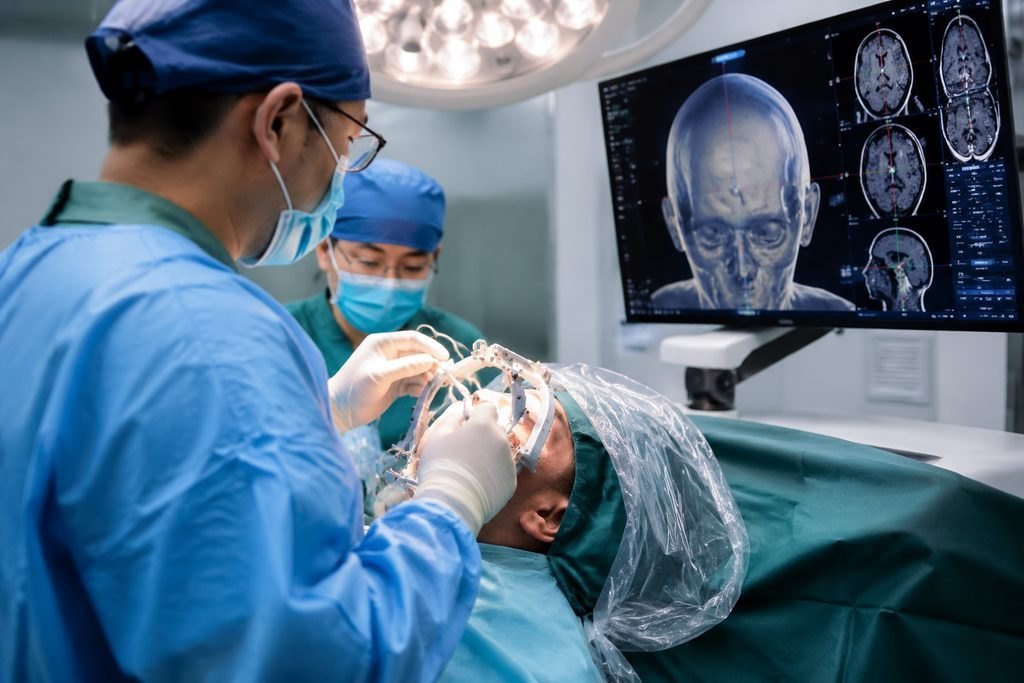
If deep brain stimulation is part of your history or being discussed, the handover has an extra layer. Deep brain stimulation uses implanted electrodes and a pulse generator. It may help selected Parkinson's symptoms but does not cure the disease. That means follow-up is not a one-off review; it includes checking symptom control, side effects, device function and programming settings over time.
Before you plan care in China, ask the receiving service directly whether they can assess and program your specific device, whether they need the original implant records, and how they would handle programming if your device was implanted elsewhere. Ask what they require in writing, and ask who would be responsible for ongoing adjustments. Do not assume that any hospital with a neurology department can manage every device model.
If you do not have a device, the same principle applies to any proposed procedure. Ask what assessments are required before a decision, what the follow-up schedule would look like, and what would happen if you returned home. A clinician in China can discuss whether an option is suitable for you, but suitability is a clinical decision made after assessment, not something confirmed by email.
The return-home handover: who holds responsibility after you leave
The hardest part of overseas Parkinson's care is often the return. If medicines are adjusted in China, your home clinician needs a clear record of what changed, why, and what to monitor. Ask for a written summary in English that lists your medicines, doses, times, any new instructions, and the contact details of the clinician who made the change. Ask whether the Chinese team is willing to communicate with your home clinician if questions arise.
Do not treat a discharge summary as a transfer of care by itself. Responsibility for ongoing prescribing usually stays with the clinician who knows you, unless another arrangement is explicitly agreed. Before you leave China, confirm who will issue repeat prescriptions, who will review blood tests if needed, and how you would contact the team if a problem appears after you return home.
This is also where device patients need a specific answer. If your stimulator settings were changed, ask for the settings in writing and ask your home programming centre whether they can continue from that record. If they cannot, that is a practical problem to solve before you travel, not after.
How to prepare records for a China enquiry without sending everything
An initial enquiry does not require a complete medical archive. Start with a short summary: your diagnosis, current medicines, main question, and whether a device is involved. After first contact, you can be told what specific documents would help — for example, clinic letters, medication lists, recent imaging reports, or device records.
Keep your own copy of everything you send. If records are in another language, ask whether a translation is needed and who should provide it. Do not send passport numbers, card details or a full medical file through an initial form. If you are unsure whether a document is relevant, ask before uploading it.
For Parkinson's specifically, the most useful single document is often a clear medication schedule with times, plus your own ON/OFF notes. A recent clinic letter that describes your examination and current plan is also valuable. Imaging is only useful if it relates to a question the receiving clinician is assessing.
Questions to ask before committing to long-term follow-up in China
Long-term follow-up is a commitment on both sides. Before you plan around it, ask the service what they can confirm in writing: whether they can take over your Parkinson's management, how often they would expect to see you, what happens between visits, and how they handle medication changes when you are not in China. Ask whether they can provide English-language records and whether they work with international patients on an ongoing basis.
Ask about the practical boundaries too. If you need a device check, ask whether that can be arranged and what records they need. If you need a specialist opinion before travelling, ask whether a records-based review is possible and what it can and cannot establish. A remote review can discuss your history and options, but it does not replace an in-person assessment or guarantee acceptance for any procedure.
Finally, ask what would make the plan unworkable. If the answer depends on a test you cannot access, a device model they do not support, or a follow-up interval you cannot manage, better to know before you book. The next step is a short initial enquiry describing your diagnosis, current medicines, device status if any, and the specific follow-up question you need answered. That enquiry is free, and it does not commit you to any paid service.
Sources & scope of this guide
References and official service information relevant to this guide.
This is general planning information and has not been individually reviewed by a doctor. Medical decisions and personal treatment advice come from your treating clinicians.