Why the implant record matters more than a general discharge letter
A partial hip replacement replaces the femoral head, unlike a total hip replacement that resurfaces or replaces both sides of the joint. That distinction changes what the home team needs to know. They are not simply continuing care for a generic hip operation; they are following a specific device in a specific patient.
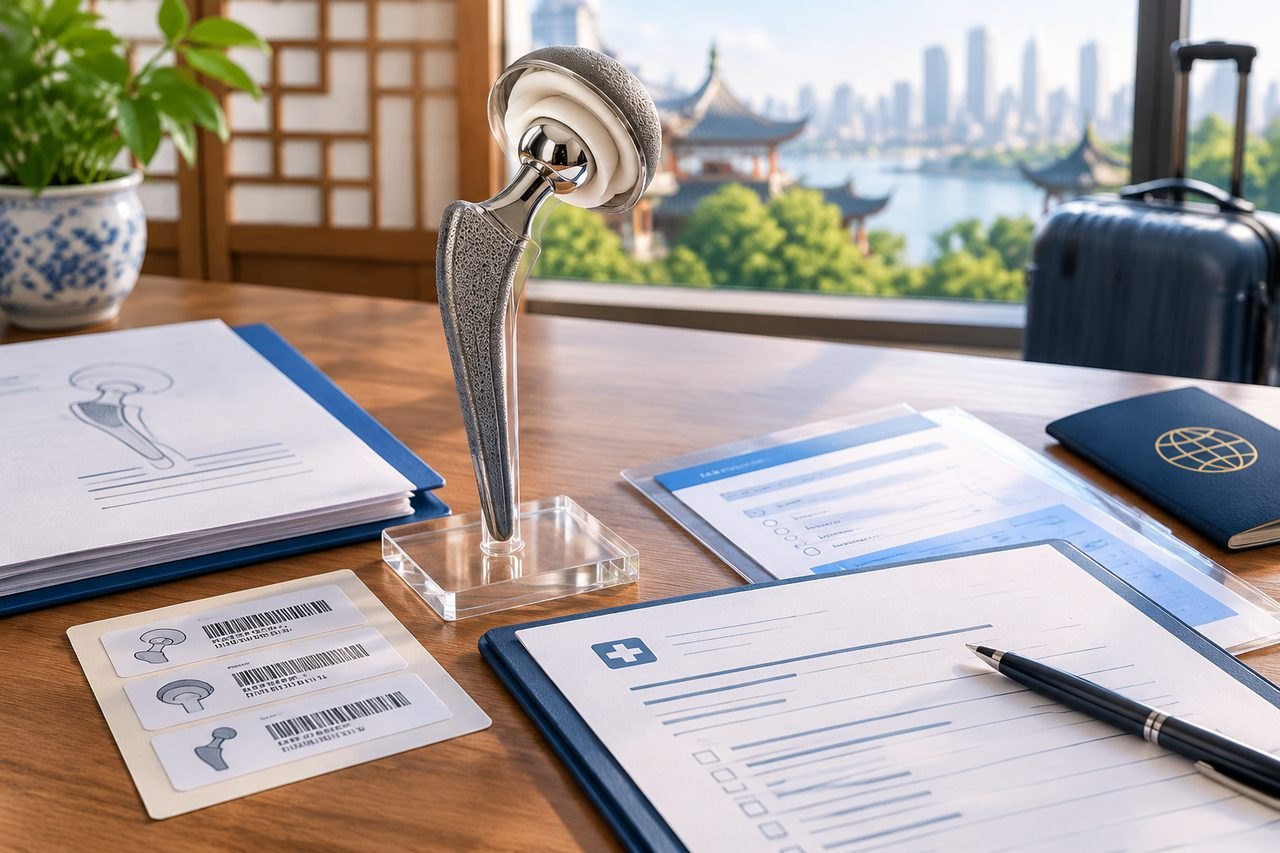
Check that your travel file includes the implant record rather than assuming the discharge letter contains its identifying details. A discharge letter may say 'hemiarthroplasty' or 'partial hip replacement' without naming the manufacturer, model, stem size, head diameter, or bearing material. Without those details, the home team cannot reliably match the component if a future problem arises, and they cannot check whether the device has any relevant field notices.
Ask the Chinese hospital for the implant stickers or a printed implant identification page. These are usually generated at the time of surgery and pasted into the operative record. If the stickers are not in your copy, request a certified copy of the implant log from the operating theatre or the hospital's medical records department. The exact process varies by hospital, so confirm what that hospital can issue and in what language.
The operation note: what the home surgeon actually reads
The operation note is the narrative of what was done. For a partial hip replacement, the home team will look for the surgical approach, the condition of the acetabulum (the socket), whether any bone graft or augmentation was used, and how the hip was reduced and tested. They will also want to know whether the procedure was planned as a partial replacement from the start or converted from another plan.
Ask for the full operative report, not only the discharge summary. If the report is in Chinese, ask whether an English translation is available or whether the hospital can provide a bilingual summary. If not, a certified medical translation may be needed. The receiving clinician needs to be able to read the primary document, not rely on a family member's paraphrase.
The anaesthetic record is also part of the file. It tells the home team what drugs were used, whether there were any airway or blood-pressure problems, and what postoperative pain plan was started. This matters if the patient has other conditions or is on medication that interacts with what was given in China.
Unresolved results and pending tests
Some tests ordered in China may not be finalised before discharge. Blood counts, inflammatory markers, microbiology from any wound swab, and imaging may still be pending. Ask the ward team which results are outstanding and how they will be sent to you. Do not assume the home team can retrieve them from a Chinese hospital system; cross-border record access is not automatic.
If a wound swab or tissue sample was sent for culture, the result may change what the home team does next. Ask for the laboratory report, including the organism name and antibiotic sensitivities if available. If the result is not ready, ask the Chinese team to state in writing what was sent, when the result is expected, and how it will be communicated.
Imaging is another common gap. Ask for the radiology reports and, where possible, the images themselves on a disc or secure link. The home team may want to review the postoperative X-ray to confirm component position and check for any fracture or dislocation that needs attention. A report alone may not be enough for them to make that judgement.
What the receiving clinician needs to decide, and what they cannot decide in advance
The home orthopedic team will decide whether the implant details are sufficient, whether they need additional imaging, and what follow-up interval is appropriate. They may also want to know the weight-bearing status recorded in China, but they will make their own assessment based on the operation performed and the patient's current condition. Do not treat the Chinese instructions as automatically transferable; the receiving clinician's independent judgement applies.
The Chinese hospital cannot confirm acceptance in advance, and it cannot promise that the home team will consider the records complete. Acceptance is a decision for the receiving clinician and their local system. What you can do is provide a clear, structured file so that the home team can make that decision quickly.
If the home team asks for something that was not done in China, they are not necessarily criticising the Chinese care. They are applying their own local standards and may need additional information to continue follow-up safely. Ask them what they need, then request it from the Chinese hospital in writing.
One detail worth clarifying with the receiving team is what they want in the first contact. Some clinicians prefer a short summary with the implant identification and operation date before the full file arrives; others want the complete record set at once. Ask the office which format they prefer, then send that first. It reduces the chance that a large file is set aside because the key implant page is buried inside it.
Another point to confirm is whether the home team wants the original imaging or a report. A radiology report describes what the Chinese radiologist saw, but the home orthopedic team may want to review the actual images to judge component position and bone quality for themselves. Ask whether they want a disc, a secure download link, or both. If the hospital in China can provide images only on physical media, arrange to collect them before you leave rather than requesting them from abroad later.
It also helps to ask the receiving clinician what they would do differently if the implant details were unavailable. That answer tells you how urgently to pursue the stickers. If the home team says they can proceed with the operation note alone but would prefer the implant log, you have time to request it after you return. If they say the implant identity changes their follow-up plan, treat the stickers as a priority before discharge.
Finally, ask whether the home team wants to speak with the Chinese surgical team directly. Some receiving clinicians are willing to have a short professional-to-professional conversation; others prefer everything in writing. If a call is possible, ask the Chinese hospital whether a surgeon or a member of the operating team can be available. This is not a transfer of responsibility, and the home clinician still makes their own decisions, but it can resolve specific technical questions faster than a document exchange.
Communication and responsibilities after you leave China
Before discharge, ask the Chinese hospital who your contact person will be for records requests after you leave. Get an email address or a direct phone number for the medical records office, not just the ward. If you are working with a coordination service, clarify what they can and cannot do after you return home. A coordination service can help request documents and translate them, but it does not provide clinical care or make decisions for the home team.
Set expectations about response times. A records request from overseas may take longer than a local request, and the hospital may require identification or a signed authorisation. Ask what the hospital needs from you to release records to a clinician abroad. The exact requirements are hospital-specific, so confirm them directly rather than assuming a standard process.
Keep a personal copy of everything. Store the implant details, operation note, discharge summary, medication list, and pending results in one place. If you need care urgently before your home appointment, the emergency team will need the implant information immediately. A clear folder or digital file can make that easier.
Practical preparation before you fly home
Ask the Chinese hospital for a discharge summary that includes the diagnosis, procedure name, date, implant details, medications with doses, allergies, and follow-up instructions. Request it in English if available, or arrange a translation. Check that the implant identification is included, not just the procedure name.
Confirm how outstanding results will reach you. If a result is pending, ask for the expected date and the method of delivery. Give the hospital the name and contact details of your home clinician or clinic, and ask whether they will send records directly. If they will not, plan to collect them yourself.
Ask your home clinician's office what they want before your first appointment. Some practices prefer records in advance; others will review them at the visit. Sending the implant details and operation note ahead of time can help the home team prepare, but it does not replace the in-person assessment.
If you are considering a records-based review before you travel home, that is a separate service and not a prerequisite for your home appointment. An initial enquiry to ChinaSpecialistCare is free and can help identify what documents are missing, but the clinical decisions remain with the treating clinicians.
Sources & scope of this guide
References and official service information relevant to this guide.
This is general planning information and has not been individually reviewed by a doctor. Medical decisions and personal treatment advice come from your treating clinicians.