
Home / Orthopedics / Partial Hip Replacement
Orthopedic procedure guide · 半髋关节置换术

Partial Hip Replacement in China

Considering partial hip replacement in China? Start with fracture context, procedure choice and rehabilitation. This guide helps you identify the relevant records, questions for the receiving team and the scope of an individual estimate before a visit is agreed.

Chinese orthopedic surgeon discussing a femoral neck fracture and partial hip implant with an international patient and family member

Medical records & cost enquiry

Partial Hip Replacement: assessment and cost questions

For Partial Hip Replacement, the budget depends on the proposed care and the hospital. A useful estimate needs to distinguish:

  • The fracture or condition and implant plan
  • Fixation and other health needs
  • Admission and rehabilitation

Hospital medical fees, travel and our coordination services are separate. Any paid specialist review or coordination service is explained and agreed before you proceed.

Your next step

Start with your question

Tell us your diagnosis and what you need. Our free initial review checks the information and helps identify a suitable next step; it is not a specialist opinion or a hospital quotation.

Request a case-based estimate

Not ready to send records? Ask us first. Where hospital review is appropriate, we can help request an estimate. No travel commitment or mandatory proxy consultation.

Planning partial hip replacement in ChinaHospital review · individual costs · visit and follow-up

Plan the visit around fracture context, procedure choice and rehabilitation. Agree the assessment route before travel.

Records for the partial hip replacement review

Tell us what you already have: Emergency X-rays and CT, if performed; Time, cause and side of the injury; Pre-fracture walking and independence level. Start with a short summary; after first contact we explain which records the receiving team needs and how to share them.

Confirm the proposed scope and costs

Before asking for a personal estimate, clarify: The fracture or condition and implant plan; Fixation and other health needs; Admission and rehabilitation. The receiving team confirms the proposed scope and hospital charges; coordination is agreed separately.

Visits and care after returning home

Acute fractures need timely local assessment; clarify whether this enquiry concerns planned care or a later review and ask about mobility support. Tell us if you need interpretation or English-language documents, and confirm the relevant arrangements with the receiving team.

What is partial hip replacement?

Partial hip replacement—usually called hemiarthroplasty—replaces the broken femoral head and neck with a stem and ball while keeping the patient’s natural acetabular socket. In contrast, total hip replacement also places a cup and liner in the socket.

This operation is most often used after a displaced intracapsular femoral-neck fracture in an older adult. It should not be confused with partial knee replacement, and it is not usually the standard elective operation for widespread hip arthritis.

A hip fracture is an urgent whole-patient problem

The operation is only one part of care. Pain control, delirium prevention, nutrition, osteoporosis assessment, fall prevention, medical optimisation and early rehabilitation are all important.

Who may be considered?

NICE and AAOS guidance support replacement arthroplasty for displaced intracapsular hip fractures in suitable older adults. Choosing between hemiarthroplasty and total hip replacement depends on the fracture pattern, pre-fracture walking ability, expected independence, cognition, medical fitness, life expectancy and dislocation risk.

When may total replacement be considered instead?

NICE advises considering total replacement for people who previously walked independently outdoors with no more than a stick, do not have a condition making the procedure unsuitable and are expected to remain independently active beyond two years. That does not make total replacement automatically better; hemiarthroplasty is a less complex operation and may fit patients whose health, function or expected benefit favours the smaller reconstruction.

Information needed quickly

The treating team needs the fracture X-rays, time of injury, pre-fracture mobility, living arrangements, cognition, medication—including blood thinners—and major heart, lung, kidney or neurological conditions. Surgery is commonly targeted promptly after admission once correctable medical problems have been addressed.

Key points for this treatment
One sidefemoral head replaced
Fracture carenot routine arthritis surgery
Early movementa central recovery goal
Team caremedical and fall-risk review
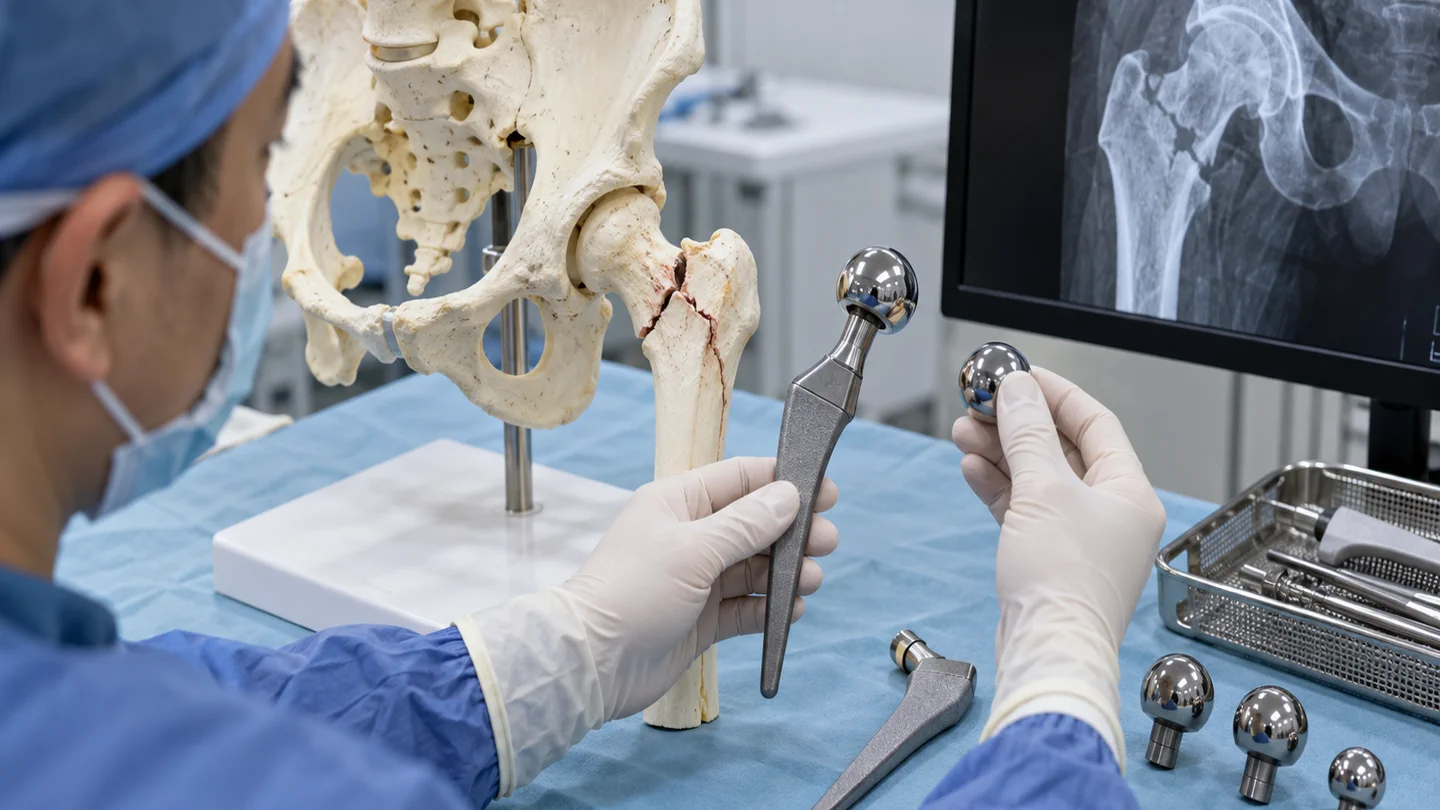
Hemiarthroplasty implant, femoral neck fracture model and X-ray used during surgical planning
Only the femoral side is replacedThe natural socket remains. Fracture pattern, bone quality and the patient’s previous function help determine whether hemiarthroplasty or total replacement fits better.

How the operation works

Under spinal or general anaesthesia, the surgeon removes the fractured femoral head and prepares the upper femur for a stem. A metal or ceramic ball is attached to the stem and moves against the natural socket. For older adults with a displaced femoral-neck fracture, AAOS guidance supports cemented femoral fixation because it is associated with better patient-reported outcomes and a lower risk of a further fracture around the implant.

The operation may use an anterior, lateral or posterior route. Approach, head design and fixation must be selected by the treating team; the label “partial” does not mean risk-free or minor surgery.

When the plan can change

Unexpected socket damage, fracture anatomy, implant stability or other findings can alter the plan. The consent discussion should explain whether conversion to total replacement or additional fixation could be required.

Recovery after fracture surgery

The aim is usually to allow early weight bearing and mobilisation, but the surgeon’s instructions take priority. A multidisciplinary team may include orthopaedics, geriatric medicine, anaesthesia, nursing, physiotherapy, occupational therapy, dietetics and fracture-liaison services.

International patient walking with a wheeled frame under physiotherapist supervision after partial hip replacement
Recovery starts with safe mobilisationWalking practice, transfers and daily activities are progressed while the team also addresses pain, confusion, nutrition, bone health and future fall risk.
First daysPain control, medical review and supported standing
Before dischargeSafe transfers, walking aid and home plan
Following weeksStrength, balance and daily function training
Longer termBone health and fall-prevention follow-up

Recovery reflects both the operation and the original fracture. Some people do not regain their previous strength or independence. International transfer after an acute fracture requires medical clearance, reliable assistance and an agreed handover plan.

Risks and warning signs

Risks include infection, blood clots, bleeding, delirium, chest or urinary infection, pressure injury, dislocation, fracture around the implant, nerve or blood-vessel injury, leg-length difference, socket wear and later loosening. Frailty and existing disease can add substantial medical risk.

Urgent assessment is essential

Breathlessness, chest pain, fever, wound drainage, increasing calf swelling, a sudden painful change in hip position, a fall or new inability to stand needs urgent medical review.

Before hospital review

Records for partial hip replacement assessment

For an acute fracture, speed and accuracy matter. Send the essentials without delaying emergency treatment.

Emergency X-rays and CT, if performed
Time, cause and side of the injury
Pre-fracture walking and independence level
Medication list, especially blood thinners
Major medical and anaesthetic history
Cognition, living arrangements and available support
Recent laboratory and cardiac results
Hospital notes if transfer is being considered
Send original imaging when possible

Radiology reports are helpful, but DICOM files or clear original image exports let the orthopedic team review alignment, bone quality and implants directly.

Tell us what you need

Ask about your care,
your hospital and your budget.

You can ask about suitability, an expert opinion, an appointment or the likely medical cost. If you are unsure, choose “Not sure — please advise”.

This enquiry is aboutPartial Hip ReplacementNot sure — please advise

How a personal estimate is prepared

  1. Tell us about your case.Describe your diagnosis, main question and preferred city, if any.
  2. Share the relevant records.We explain what is needed and how to send it by WhatsApp or email.
  3. Request a hospital estimate.Where appropriate, we help request hospital review and a cost estimate. Any paid review is agreed first.

This is an enquiry, not an order or payment. Proxy consultation is not mandatory. Any service scope is agreed separately before you proceed.

Ask about Partial Hip Replacement

A first enquiry is free. Email and permission to respond are required; the other details are optional. Any paid clinical review or coordination is discussed separately.

Included automatically so we know which procedure you are asking about.
A preference, not a confirmed appointment.
Please do not send passport numbers, card details or full medical files in this first enquiry. We will explain which records are needed next.

Send a short summary first. This is an enquiry, not an order, payment or confirmed appointment.

No booking or payment is made by sending this enquiry.
Editorial transparency

Medical sources

Patient information is based on established orthopedic guidance. Content updated 5 October 2026. This is patient information, not an individual clinical assessment.