Why a treatment name is not enough
When you write "I had ablation" or "I had a biopsy" or "I took medication for a kidney tumour", the receiving urologist cannot tell whether the lesion is still present, whether it has grown, whether it sits near the collecting system or major vessels, or how much healthy kidney remains. Partial nephrectomy removes part of a kidney, and the proposed approach depends on the lesion and on how the kidney is assessed. Those two things are exactly what a bare treatment name hides.
A useful description answers four questions: what was done, when, why, and what happened next. "Why" matters because a treatment chosen for a small peripheral lesion is a different situation from one chosen for a lesion touching the renal hilum. "What happened next" matters because a stable scar after ablation and a growing residual mass after incomplete treatment lead to very different surgical conversations.
You do not need to interpret the results yourself. You need to hand over the documents that contain them, and describe in plain language what your treating team told you at the time. If you were told "it looked treated" or "we will watch it", say that, and say who said it.
The imaging story: what changed between scans
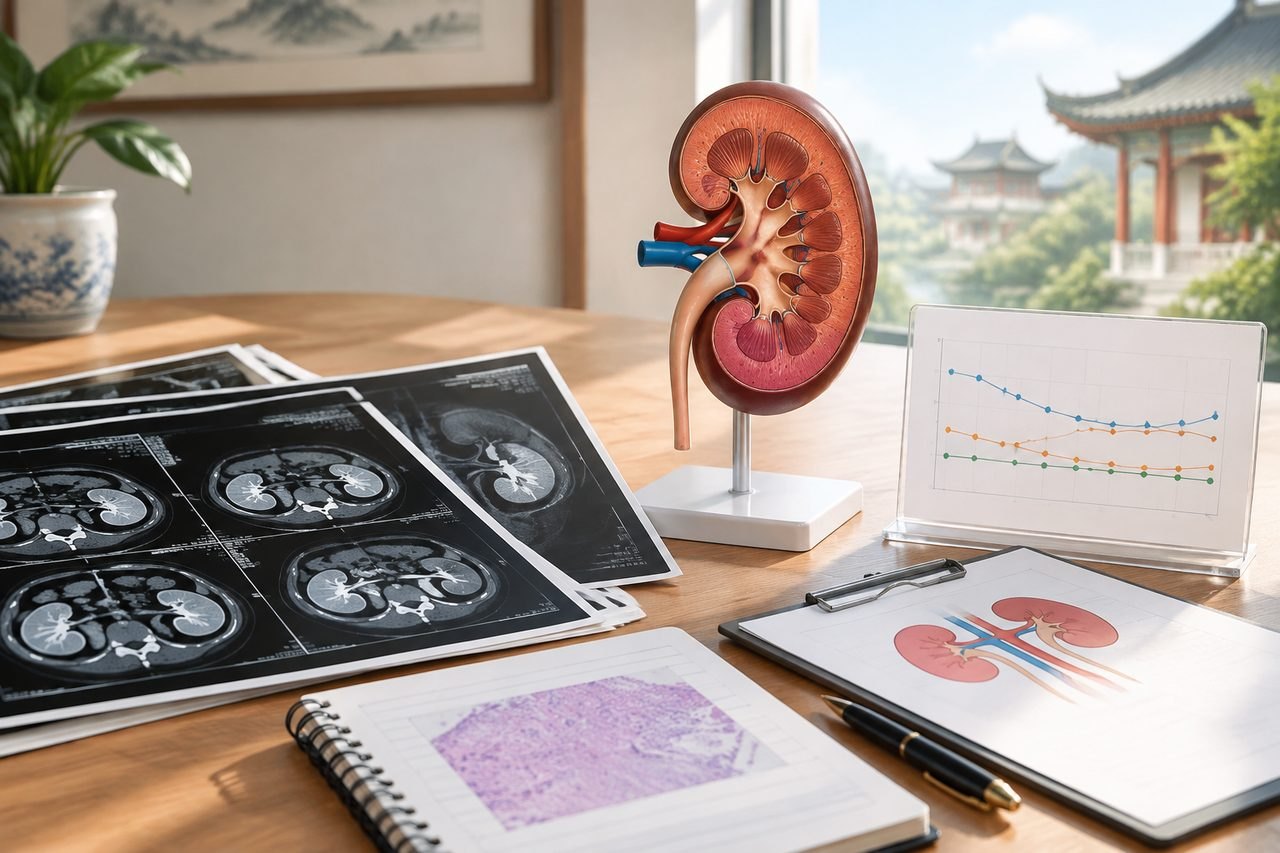
Kidney imaging is the backbone of partial nephrectomy planning. A single report is less useful than a sequence. The receiving team wants to see the lesion before treatment, immediately after treatment, and at the most recent follow-up, so they can judge enhancement, size change, distance from the collecting system, and relationship to the renal sinus and vessels.
Describe the timeline in dates, not in vague intervals. "CT in March 2023 showed a 3.2 cm enhancing mass in the left interpolar region. Cryoablation in May 2023. Follow-up MRI in November 2023 showed a non-enhancing treated zone. CT in August 2024 showed a new 1.1 cm enhancing focus at the margin." That single paragraph tells a surgeon more than a page of treatment names.
If you have the actual images on disc or via a cloud link, say so. Reports alone may be enough for an initial conversation, but the treating team will decide what imaging it needs. Ask whether they want the original DICOM files or whether reports are sufficient for a first review. Do not assume either answer.
Kidney function: numbers, trend and context
Partial nephrectomy is a kidney-preserving operation, so the assessment of how much kidney function you have, and how it is distributed between the two kidneys, is central. Serum creatinine alone is a weak description. Give the dates and values of creatinine and eGFR over time, and mention whether a nuclear medicine scan or other split-function study was done.
Context changes the meaning of a number. If you have one kidney, or the other kidney has reduced function, or you have diabetes or longstanding hypertension, say so. If a previous treatment was on the same kidney now being considered for surgery, say that clearly. These facts affect how much kidney a surgeon can safely leave behind.
Do not try to calculate or predict your own kidney function after surgery. Ask the treating team how they assess the balance between removing the lesion and preserving function in your specific case, and what tests they would want before deciding.
Pathology and the conclusions your team recorded
If a biopsy or a previous operation produced a pathology report, that report is one of the most important documents you can send. Describe the diagnosis in the report's own words, the grade if stated, and whether margins were reported as clear, positive or uncertain. If no pathology was obtained, say that plainly rather than leaving it ambiguous.
Also describe the conclusions your treating team recorded. Discharge summaries, clinic letters and multidisciplinary meeting notes can contain the reasoning that a raw report does not. Phrases such as "residual disease cannot be excluded", "recommend surveillance" or "consider nephrectomy if progression" are exactly the kind of information a new team needs.
If your records are incomplete, say which parts are missing rather than guessing. A clear statement of what you do not have is more useful than a confident summary that turns out to be wrong.
One distinction is worth making explicit: a pathology report describes tissue that was removed or sampled, while a follow-up scan describes what is visible now. A clear margin on an earlier specimen does not by itself describe the current lesion, and a stable scan does not replace a tissue diagnosis. Keep the two kinds of evidence separate in your summary so the reviewer can see which question each document answers.
If the pathology was reported at another laboratory, say where and when. The receiving team may want to review the slides or blocks itself, or it may accept the written report for an initial conversation. Ask which of those it prefers rather than sending material abroad on your own initiative.
Finally, note any discrepancy between what the pathology showed and what the imaging suggested. If a biopsy was non-diagnostic, or if the imaging impression changed after the pathology came back, state that sequence. Reviewers use those mismatches to decide what further assessment, if any, is needed before a surgical plan can be discussed.
How to write the summary a Chinese team can act on
A short structured summary works better than a long narrative. One page, in English, with dated entries, is usually enough for a first review. Keep it factual and avoid adjectives such as "successful" or "failed" unless your treating team used them.
A practical structure: diagnosis and date; each treatment with date and intent; imaging findings with dates and lesion size; kidney-function values with dates; pathology result if any; current symptoms; current medications; and your main question. That last line matters, because it tells the reviewer what decision you are trying to make.
For example, an administrative planning note might read: "Seeking review for possible partial nephrectomy of a left renal mass after previous ablation. Main question: is kidney-preserving surgery still feasible, and what further imaging or tests would the team require?" That is a question, not a request for a guarantee, and it is the right level of detail for an initial enquiry.
- Diagnosis and date of first detection.
- Each previous treatment, its date and its stated aim.
- Imaging reports in date order, with lesion size and enhancement described.
- Creatinine and eGFR values with dates, plus any split-function study.
- Pathology report wording, including margin status if stated.
- Current symptoms, medications and your single main question.
What the treating team must confirm, and your next step
No article can tell you whether partial nephrectomy is feasible in your case. The lesion's location, its relationship to vessels and the collecting system, the condition of the remaining kidney, your overall health and your own priorities all feed into that decision. The hospital decides suitability, and a records-based opinion does not establish final eligibility or hospital acceptance.
Ask the team how they assess kidney-preserving surgery in your situation, what approach they would propose and why, how they would follow up pathology and kidney function afterwards, and what alternatives they would consider if partial removal is not advisable. Ask about evidence-based risk estimates and uncertainty for your case rather than expecting a fixed number.
For an initial enquiry, a brief summary is enough. You can share fuller records after first contact, and an initial enquiry does not require buying a proxy consultation. If you have current or worsening symptoms, seek local medical care first rather than delaying for an overseas enquiry. When you are ready, start with the free initial case review and describe your previous treatment results as above.
Sources & scope of this guide
References and official service information relevant to this guide.
This is general planning information and has not been individually reviewed by a doctor. Medical decisions and personal treatment advice come from your treating clinicians.