Why tumour scope is the first question, not the last
When you ask about partial nephrectomy in China, you are really asking a set of linked questions. Is the lesion confined enough that removing part of the kidney is a reasonable option? Which part of the kidney is involved? How close is it to the collecting system, the main vessels or the healthy tissue the surgeon wants to preserve? The answers decide whether a kidney-preserving operation is proposed, and they also shape how the team will monitor you afterwards.
This is why a records-based discussion should start with scope rather than with a procedure name. A report that says a kidney mass was found does not tell the treating urologist whether partial removal is feasible, what margin is realistic or whether the remaining kidney can carry enough function. Those are clinical judgements made by the hospital team after reviewing imaging, kidney function and the whole clinical picture. Your job before travelling is to understand what information the team still needs and what it will decide.
Partial nephrectomy removes part of a kidney, and the proposed approach depends on the lesion and kidney assessment. Those general facts describe the procedure, not your diagnosis or eligibility. No article, and no overseas coordinator, can declare from images alone that a cancer is present, that kidney preservation is assured, that cure is achieved or that partial removal is always feasible. Treat any statement that goes beyond this with caution.
What the imaging and kidney-function records actually need to show
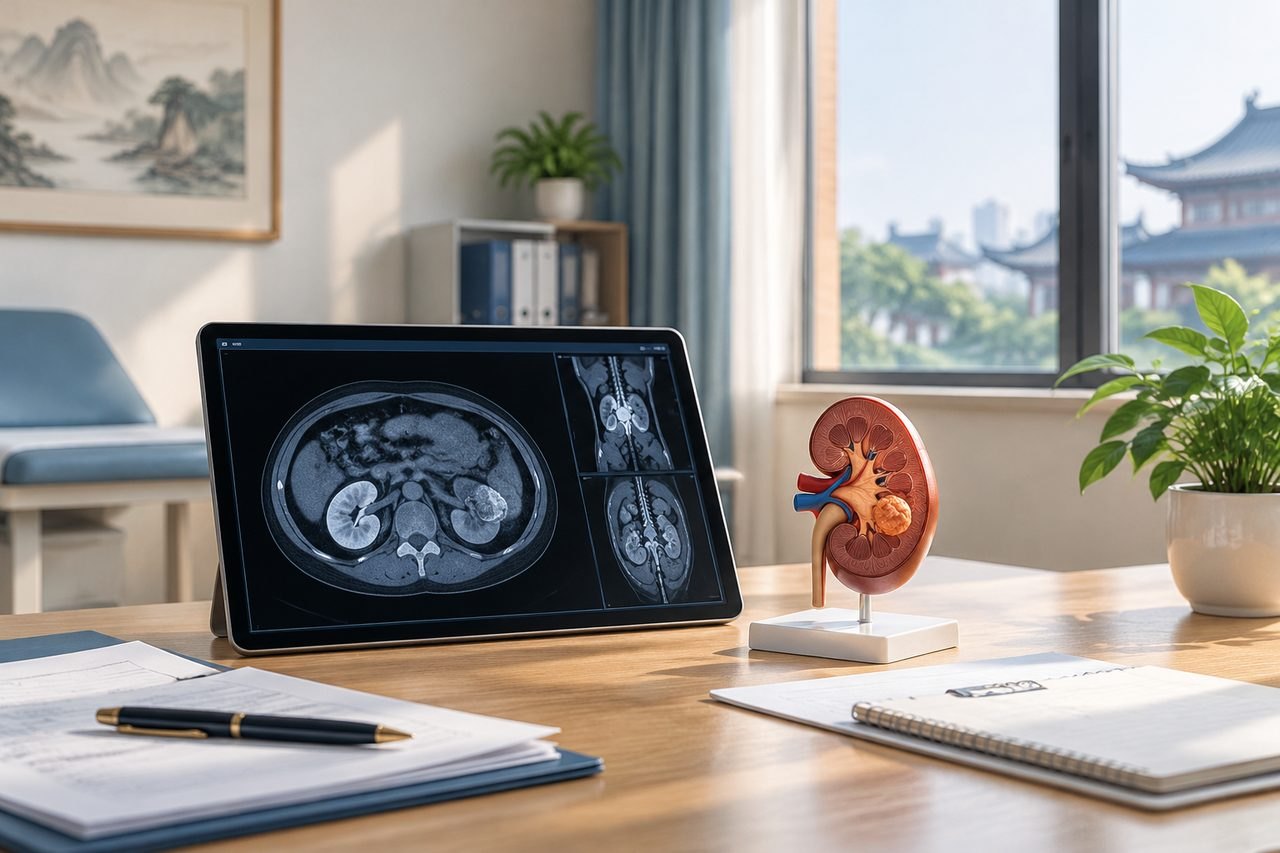
Chinese urology teams assessing a kidney lesion will want the original imaging, not only a translated summary. That normally means the actual CT or MRI series, including the phases that show the kidney, the lesion and the surrounding anatomy. A written report helps, but the images themselves are what allow a surgeon to judge size, position, depth and relationship to structures. If you only send a one-line conclusion, the team cannot answer your scope question.
Kidney function matters just as much. The team needs to know how well each kidney is working, because preserving function is the reason partial nephrectomy is considered at all. Relevant records may include blood tests such as creatinine and estimated glomerular filtration rate, urine tests, and any nuclear medicine study that measures split function. Which of these the team requires for your case is a clinical decision, so ask rather than assume.
Pathology records matter if a biopsy has already been done. The original pathology report, including the type and grade if available, helps the team understand what is being treated. If no biopsy has been taken, that is also important information. Do not send a complete medical archive at first contact; a short summary with the main question is enough to begin, and the team can then tell you which specific documents it wants.
- Original imaging files, not only translated reports.
- Recent kidney-function blood and urine results.
- Any biopsy or pathology report already issued.
- A short list of your current medicines and allergies.
- A clear statement of your main question about tumour scope.
Questions that separate a scope decision from a surgical plan
Scope and surgical approach are related but not identical. Scope is about the lesion and the kidney: how much is involved, how much can be preserved and what the team expects from the remaining tissue. The surgical plan is about how the operation is performed, which may include laparoscopic, robotic or open techniques depending on the case. A team may be able to preserve the kidney but choose a different route than you expected, or it may conclude that partial removal is not the right option for your anatomy.
Ask the team to explain its reasoning in plain terms. Which imaging features support a kidney-preserving approach? What would make the team change its recommendation? How will it decide the margin of healthy tissue around the lesion? What is the plan if the lesion turns out to be more extensive than the imaging suggested? These are not challenges to the surgeon's judgement; they are the questions that let you understand the decision you are being asked to make.
It also helps to ask who will make the final call. In many hospitals, complex kidney cases are discussed by a multidisciplinary team before a plan is confirmed. Ask whether your case will be reviewed that way, and what the review needs from you. If the answer is that a single specialist will decide, that is also useful to know. Either way, the hospital decides suitability, not the coordinator and not the patient.
Pathology and kidney function after surgery: what follow-up should cover
The operation is not the end of the scope question. After partial nephrectomy, the removed tissue is examined by a pathologist, and that report tells the team what was actually present, whether the margins are clear and what surveillance is appropriate. Ask how and when you will receive that pathology result, and who will explain it to you. If you are travelling home soon after surgery, ask how the report will reach you and your local doctor.
Kidney function also needs follow-up. Removing part of a kidney can affect how well the remaining tissue filters blood, and the team will want to monitor this over time. Ask what tests will be used, how often they will be done and what results would prompt a change in plan. The answers depend on your individual kidney function, the amount of tissue removed and other health factors, so they belong in a conversation with the treating clinician rather than in a general article.
Follow-up is also where the limits of an overseas trip become practical. If your surgeon recommends monitoring at specific intervals, you need to know whether those visits can happen locally, what records your local doctor will need and how the Chinese team will stay involved if you want that. Ask these questions before surgery, not after, because the answers may affect how long you plan to stay and what arrangements you make.
How to prepare records and questions before contacting a Chinese hospital
Start with a short, clear summary rather than a full archive. State the main finding, the date of the most recent imaging, the current kidney-function results and your specific question about tumour scope. Mention any previous kidney surgery, biopsy or relevant condition. This lets the team decide quickly whether it can offer a useful opinion and what else it needs. You do not need to buy a proxy consultation to make an initial enquiry; a brief summary is enough to begin.
When you send records, keep them organised. Label each file with its date and type. If documents are in another language, a translation of the key reports helps, but the original imaging should still be included. Ask the hospital or your coordinator what format it prefers for imaging files, because large studies may need to be transferred in a specific way. Confirm what has been received before assuming the team has everything.
Prepare your questions in writing. Focus on the decision you are facing: how the team assesses kidney-preserving surgery for your lesion, what approach it proposes and why, what it expects from pathology and kidney-function follow-up, and what would change the plan. Ask for the answers in writing if you need them for your own doctor or for your family. A written reply also reduces the risk of misunderstanding across languages.
Coordinating a partial nephrectomy enquiry in China
ChinaSpecialistCare provides information and non-clinical coordination for international patients considering care in China. For a partial nephrectomy enquiry, that can include helping you organise your records, matching you with a suitable urology team and coordinating an appointment or hospital admission after the hospital accepts your case. We can also arrange interpretation and practical support during your visit. These are coordination services, and their fees are separate from hospital charges.
We cannot decide whether partial nephrectomy is right for you, whether your tumour is suitable for kidney-preserving surgery or what your pathology and kidney-function follow-up should be. Those decisions belong to the treating hospital and its licensed clinicians. We also cannot promise a particular surgeon, a specific hospital's acceptance or any clinical outcome. Any estimate of hospital fees depends on the hospital's own assessment and written quote, which we can help you request.
If you would like to start, send a brief summary of the diagnosis, the most recent imaging date and your main question about tumour scope. Our team will review what you have, identify what is missing and suggest the relevant next step. This initial review is free and does not commit you to treatment or travel. You can also read more about partial nephrectomy and urology care in China before you decide.
Sources & scope of this guide
References and official service information relevant to this guide.
This is general planning information and has not been individually reviewed by a doctor. Medical decisions and personal treatment advice come from your treating clinicians.