Why a written follow-up plan matters after partial nephrectomy
Partial nephrectomy removes part of a kidney. The proposed approach depends on the lesion and the assessment of the remaining kidney. Because the operation preserves kidney tissue, follow-up usually has to address two separate questions: whether the lesion is being monitored appropriately, and how the remaining kidney is functioning. Those are different clinical questions, and they may be handled by different people.
For an overseas patient, the practical risk is not only clinical. It is also informational. If you fly home with a discharge summary but no clear written plan, your local doctor may not know which scans were done, what the pathology showed, what the baseline kidney function is, or whom to contact in China with a question. A written plan reduces that gap. It does not replace your local clinician's judgement, and it does not guarantee a particular outcome. It simply records what the treating team intends and who is responsible.
The plan should be specific to you. A general leaflet about kidney surgery is not enough. Ask for a document that names your situation, the planned reviews, and the contact route.
What the written plan should cover: imaging, pathology and kidney function
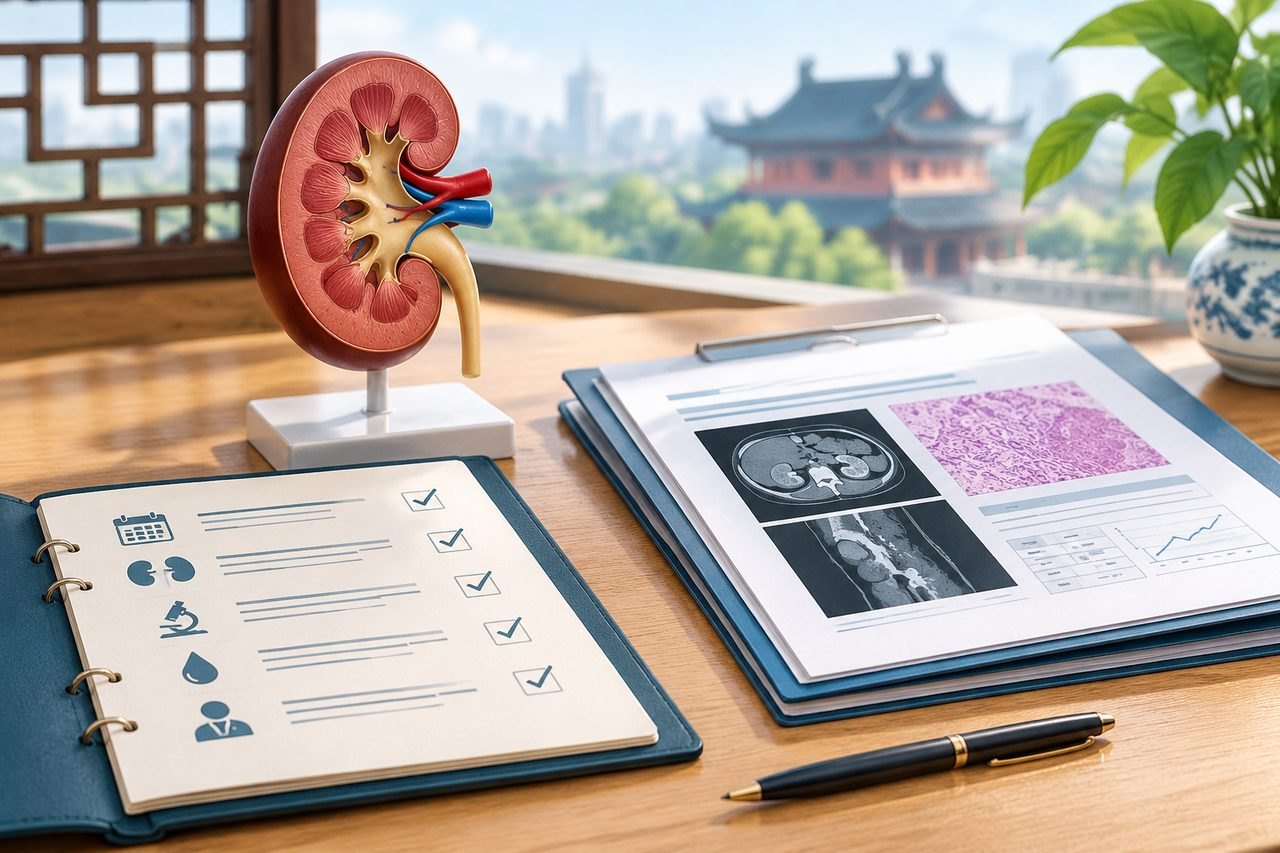
Three clinical threads need to be visible in the written plan. The first is kidney imaging. Ask how the team plans to monitor the operated kidney and the remaining kidney, what type of imaging is proposed, and what question that imaging is meant to answer. The second is pathology. If a lesion was removed, the pathology report describes what was found. Ask when and how that report will be explained to you, and whether a translated summary will be provided. The third is kidney function. Ask what baseline tests were done, what the results were, and how kidney function will be checked over time.
These threads matter because a missing answer changes what you can do next. If you do not know which imaging is planned, you cannot arrange it or discuss it with your local doctor. If you do not have the pathology explained, you may not understand what surveillance is for. If you do not know your kidney-function baseline, a later change is harder to interpret.
Write down the specific questions before your discharge conversation. For example: What imaging is planned, and what will it look for? Who will explain the pathology report, and when? What was my kidney function before surgery, and how will it be monitored? What symptoms should prompt me to seek care sooner? The treating team must answer these; a coordinator cannot.
Do not assume that a follow-up schedule used in another country applies in China. Ask this hospital what it recommends for your case and why.
Records to request before you leave the hospital
A written plan is only useful if it travels with the records that support it. Before discharge, ask what documents you will receive and in what language. The exact list depends on the hospital, so confirm it rather than assuming.
Useful items to ask about include the discharge summary, the operative note, the pathology report, the imaging reports and images, and the kidney-function results. Ask whether these can be provided in English or with an English summary, and whether there is a charge or a waiting period for copies. Ask how you will receive them: printed, on a disc, through a patient portal, or by email. If you need them sent to a doctor at home, ask what the hospital's process is and who authorises it.
Keep your own copy. Do not rely on a single set travelling by one route. If a document is missing, ask now rather than after you have left. If the hospital cannot provide a particular item immediately, ask when it will be available and how it will reach you.
This is administrative preparation, not a clinical instruction. Your local doctor will decide what to do with the records once they arrive.
Contacts, language and who answers what
A follow-up plan without a working contact route is incomplete. Ask the hospital to write down the contact details for follow-up questions, including who monitors that inbox or phone line and in what language. If you do not speak Chinese, ask whether English-language communication is available for follow-up, and through which channel. Confirm this rather than assuming it.
Clarify who is responsible for what. The surgical team may handle questions about the operation and pathology. A nephrology or urology follow-up clinic may handle kidney-function monitoring. A local doctor at home may handle day-to-day care. The written plan should say who to contact for which type of question, and what to do if you cannot reach them.
Ask how urgent questions are handled. If you develop a fever, pain, blood in the urine, or reduced urine output after you leave, who should you contact first? The answer may be your local emergency service rather than the Chinese hospital. Ask the treating team what they advise for your situation, and follow that advice. Do not delay urgent local care to wait for an overseas reply.
If a coordinator is involved in your arrangements, clarify the boundary. Coordination can help with appointments, interpretation and document transfer. It does not make clinical decisions, and it does not replace the treating hospital's responsibility for your care.
How to ask for the plan in writing without creating conflict
Some patients worry that asking for a written plan will seem distrustful. In practice, it is a normal request. You can frame it plainly: you are travelling home, you want your local doctor to understand the plan, and you want to know whom to contact. Ask whether the hospital can provide the plan as a document you can keep.
If the hospital prefers to explain verbally, ask if you can take notes and then confirm them back. Ask whether a nurse, resident or follow-up clinic can review your written summary for accuracy. If something is unclear, ask again before you leave. It is easier to correct a misunderstanding in person than by email across time zones.
If the plan changes after discharge, ask how you will be informed. Confirm whether the hospital contacts you, or whether you are expected to contact them. Ask what happens if a test result needs review and you are no longer in China.
Keep the tone practical. You are not asking the team to guarantee an outcome. You are asking them to record the plan and the responsibilities around it.
What to confirm with the hospital and your next step
Before you leave, confirm the written plan covers the follow-up schedule, the imaging and kidney-function monitoring, the pathology explanation, the contact route, and who is responsible for each part. Confirm how records will be shared with your doctor at home. Confirm what to do in an urgent situation. If any of these is missing, ask for it to be added.
Remember that a plan is not a promise of a particular result. The treating hospital decides suitability for surgery and follow-up. Your local clinician remains responsible for care after you return home, and may recommend a different schedule based on their own assessment.
If you are considering partial nephrectomy in China and want help preparing the questions and records for a hospital review, you can start with a free initial enquiry. Share a brief summary of your diagnosis and main question; the team will explain what information is missing and what the relevant next step is. You do not need to buy a proxy consultation to make an initial enquiry.
Sources & scope of this guide
References and official service information relevant to this guide.
This is general planning information and has not been individually reviewed by a doctor. Medical decisions and personal treatment advice come from your treating clinicians.