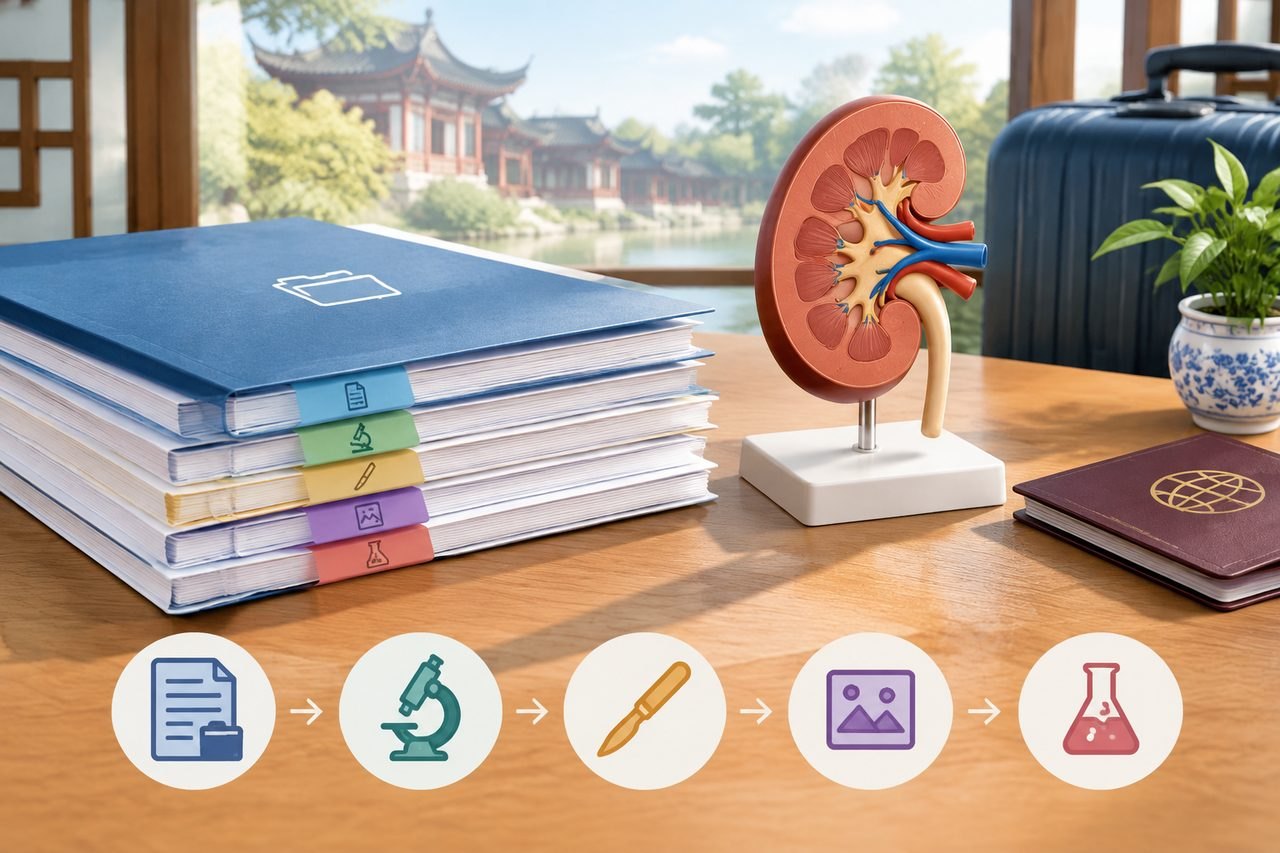
What the receiving clinician actually needs from a partial nephrectomy
A partial nephrectomy removes part of a kidney rather than the whole organ. The proposed approach depends on the lesion and on how the kidney is assessed, so the records that matter after surgery are the ones that describe that specific operation and its findings. A generic hospital letter is not enough. Your home urologist or nephrologist needs to see the operative note, the pathology report on the removed tissue, the discharge summary and the kidney function results from around the time of surgery.
The operative note should state what was removed, how the kidney was closed and whether any additional steps were taken during the operation. The pathology report should describe the tissue, the margins and any features the pathologist recorded. The discharge summary should list the medicines you were given, any complications and the follow-up plan the Chinese team proposed. Recent blood tests, including kidney function, let your clinician see the baseline you are returning with.
Ask the hospital for these as complete documents, not a one-page summary. If the pathology report is only in Chinese, ask whether an English translation can be arranged before discharge. If not, a certified translation at home may be needed, and your receiving clinician can tell you what they require.
Unresolved results and pending tests before you leave
Some results may not be final when you are discharged. Pathology sometimes needs extra stains or a second opinion, and imaging may be reported after you have left the ward. Ask the treating team which results are final, which are pending and how they will reach you. Get a named contact and a realistic route for receiving them, whether by email, patient portal or a printed copy collected later.
If a result is pending, ask what the working interpretation is and what the plan would be under each possible outcome. This is not the same as asking for a diagnosis from images. It means knowing whether the team expects routine follow-up or whether a change in plan is possible. Your home clinician can then decide how urgently to review you once the final report arrives.
Do not leave China without a written record of any pending test, the date it was taken and the expected reporting route. If the hospital cannot provide this before departure, ask what alternative arrangement it can offer and confirm it in writing.
Will your home clinician accept the Chinese pathology and imaging?
Acceptance is not automatic. Your receiving clinician may accept the Chinese pathology report as it stands, ask for the slides or blocks to be sent for review, or request a repeat of selected tests. This is a clinical judgement, not a comment on the quality of the original work. Different laboratories use different reporting formats and reference ranges, and a clinician who will be responsible for your follow-up needs to be satisfied with the material.
Before you travel, ask your home clinician what they will need. Some will want the original slides or a digital pathology file; others will accept a translated report. If they want the slides, ask the Chinese hospital whether it can release them and what the process involves. This is a question to confirm with both sides, not an assumption.
The same applies to imaging. Ask for the images on disc or a secure download link, not just the written report. Your clinician may want to review the actual scans rather than rely on a summary. Confirm the format and whether the hospital can provide it before discharge.
Communication between the two clinical teams
Direct communication between your Chinese surgeon and your home clinician can reduce ambiguity, but it is not always possible or necessary. Ask both sides whether they are willing to correspond. If they are, a short written summary from the Chinese team, translated if needed, is often more useful than a phone call. Your home clinician can then ask specific questions.
If direct contact is not arranged, you become the carrier of the records. Keep a single folder, physical or digital, with the operative note, pathology report, discharge summary, imaging and blood results. Give your home clinician the complete set rather than selected pages. If something is missing, say so rather than presenting an incomplete file as complete.
Do not ask the Chinese team to predict what your home clinician will decide. The receiving clinician assesses your situation independently, and their plan may differ from the one proposed in China. That is normal and does not mean either team is wrong.
Responsibilities after you return home
Once you are home, the responsibility for your ongoing kidney monitoring sits with your local clinical team. They will decide what surveillance is appropriate, when to repeat imaging or blood tests, and whether any further treatment is needed. The Chinese records inform that decision but do not replace it. This division of responsibility is worth stating plainly to both sides before you leave, so that nobody assumes the other team is arranging the next scan or blood test.
Ask your home clinician what they want you to do in the first weeks after return. This may include a repeat kidney function test, a wound check or a review of your medicines. Follow their instructions rather than a plan written in China if the two differ. If you are unsure, ask. A written plan from your home clinician, even a short one, is easier to follow than a verbal instruction you are trying to remember while recovering.
Keep your records accessible. If you need care from a different clinician later, the same folder should be available. Do not rely on a hospital app or portal that may not be accessible from your home country. A printed set plus a scanned copy on a device you control is the simplest arrangement.
If your home clinician wants to speak with the Chinese team, ask both sides whether that is possible and how they prefer to make contact. Some clinicians will correspond by email; others will not. If direct contact is not arranged, your records carry the information instead.
Ask your home clinician what they will do with the Chinese pathology report. They may accept it, request the slides for review, or ask for a repeat of selected tests. This is their decision, and it is reasonable for them to make it after seeing the material rather than in advance.
Keep a short written summary of your own: the date of surgery, what was removed, the pathology result if final, your current medicines and the name of the clinician who is following you up. This is not a substitute for the full records, but it helps any clinician who sees you before the folder is available.
If you are later referred to another specialist, give them the complete set rather than selected pages. If something is missing, say so rather than presenting an incomplete file as complete. A clinician who knows what is absent can ask for it; one who assumes the file is complete may not.
Finally, ask your home clinician before you travel what they will need and how they prefer to receive it. A short email from you with the list of available records lets them tell you what is missing. This step is free and does not commit you to any service.
Practical preparation before discharge
Before you leave the hospital, ask for a printed and digital copy of every document. Check that names, dates and test results are correct. Ask whether the pathology report is final or preliminary. Ask who to contact if a result is amended after you leave.
If you need a medical certificate for travel or insurance, request it before discharge. If you need a translated discharge summary, ask whether the hospital provides one or whether you should arrange it yourself. Confirm the cost and timing of any translation or courier service.
Sources & scope of this guide
References and official service information relevant to this guide.
This is general planning information and has not been individually reviewed by a doctor. Medical decisions and personal treatment advice come from your treating clinicians.