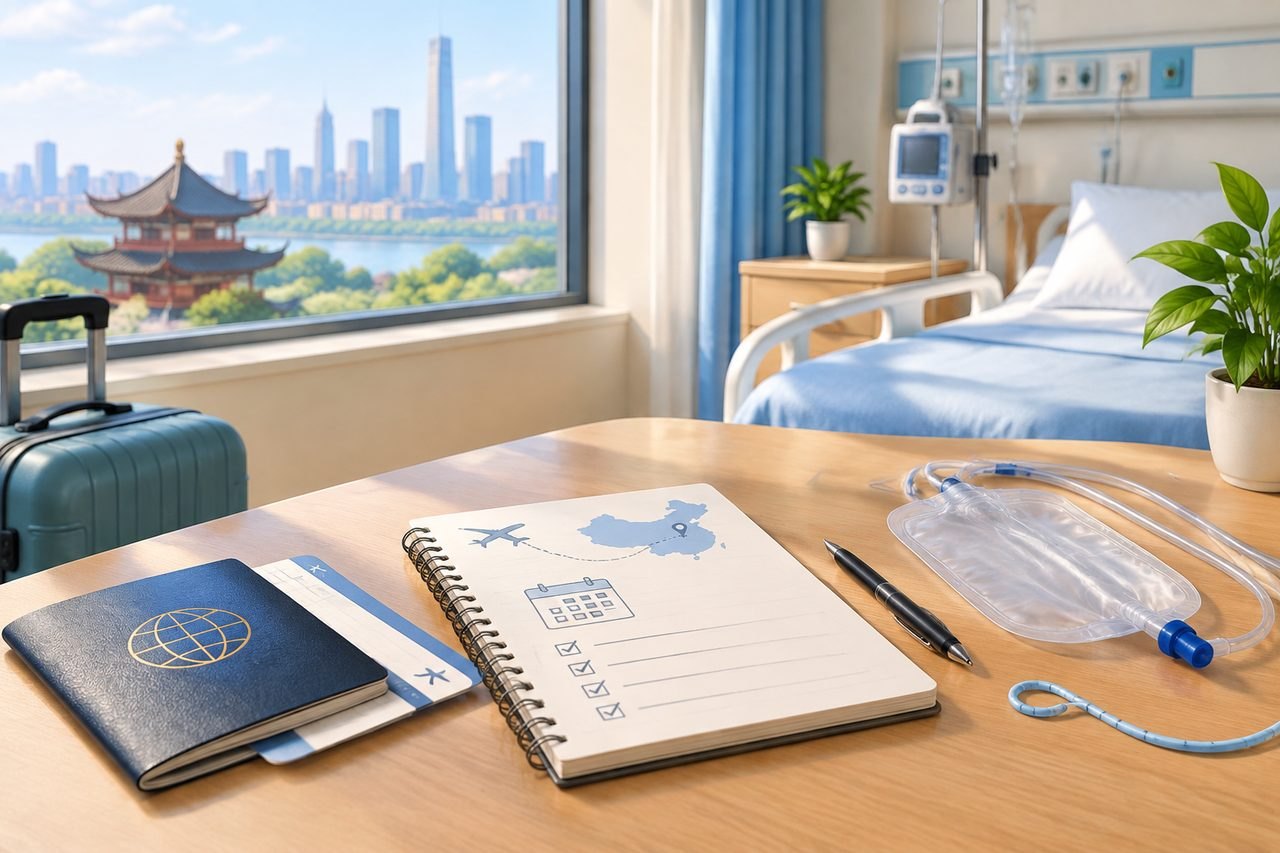
Why the drain or stent question decides your trip
Percutaneous nephrolithotomy (PCNL) is a kidney stone operation that reaches the stone through a small tract created from the skin into the kidney. The British Association of Urological Surgeons patient information describes this access route and notes that further treatment or drainage may be needed. That single sentence is the reason this article exists: the presence or absence of a tube after surgery is not a side detail of your trip. It is one of the main variables that determines how long you stay in China, where you stay, who travels with you, and when you can reasonably book a return flight.
Many patients planning surgery abroad focus on the operation date and the hospital. The post-operative drainage plan is equally practical. A nephrostomy tube exits through the skin on your back or flank. A ureteric stent is a thin tube placed inside the ureter between the kidney and bladder, with no external component. These are different devices with different care needs, and either may be used, or neither, depending on what the surgeon finds and does during your procedure.
Because the decision is made during or after surgery, you cannot always know the answer before you travel. What you can do is ask the treating team how they plan for each possibility, and build a trip that does not collapse if the plan changes. That is the planning task this guide addresses.
Questions that change your booking decisions
Before you commit to flights and accommodation, get written answers to a short set of questions. These are not clinical questions you should answer yourself; they are questions whose answers the treating team must provide for your individual case.
First, ask whether the planned procedure is expected to leave a nephrostomy tube, a ureteric stent, or no drainage device, and how that decision will be made. Second, ask what the follow-up plan is for each possibility: if a tube or stent is placed, who checks it, when, and where. Third, ask whether any part of that follow-up could be done in your home country, and what the treating team would need from a local clinician to hand over safely. Fourth, ask what symptoms or changes should prompt you to seek care urgently rather than wait for a scheduled review.
The answers determine whether you book a short stay with a clear discharge plan, or a longer stay with a scheduled follow-up appointment already in the calendar. They also determine whether you need a companion who can help with practical tasks if you leave hospital with an external tube.
Do not treat any of these answers as fixed until the treating team confirms them for your case. A plan discussed before surgery can change if the operation takes a different course.
What an external nephrostomy tube means for daily logistics
If you leave hospital with a nephrostomy tube, you have a visible external device that needs to be protected and managed. This affects clothing, sleeping position, bathing, and how much you can carry. It also affects how comfortable you are in a hotel room versus a serviced apartment, and whether you can manage stairs or long walks.
Ask the treating team what care the tube needs, who will change or check it, and what the plan is if you are still abroad when it needs attention. Ask whether the tube is expected to be removed before you fly, or whether you would travel home with it in place. If you would travel with it, ask what written instructions and supplies you should carry, and what your home clinician would need to take over.
These are practical questions, not medical decisions you should make alone. The treating team's answers should be specific to your tube, your kidney, and your recovery so far.
What an internal ureteric stent means for planning
A ureteric stent sits inside the body, so it does not change your clothing or bathing routine in the same way. It can still cause symptoms such as urinary urgency, discomfort, or blood in the urine, and it normally needs to be removed or exchanged at a planned time. That planned time is the key planning fact: if the stent is to be removed in China, your trip must cover that appointment. If it can be removed at home, you need a clear handover to a local urologist.
Ask the treating team when the stent would be reviewed or removed, whether that can happen before you fly, and what would need to be arranged if it cannot. Ask what symptoms would mean you should seek care sooner. Do not assume a stent can simply be left in place indefinitely, and do not assume it must be removed in China; ask which applies to you.
If the answer is that removal happens in China, that appointment becomes a fixed point in your travel plan. Build your flights and accommodation around it rather than around the surgery date alone.
Building a trip that survives a changed plan
The most useful planning principle for PCNL abroad is to avoid non-refundable commitments that depend on a single expected outcome. If you book a return flight for a fixed number of days after surgery, and the treating team then decides you need a tube or stent managed in China, you may face a costly change.
Consider flexible or changeable flights, accommodation that can be extended, and travel insurance that covers medical changes. Ask the treating team for a realistic range of how long you may need to stay, understanding that this is an estimate for planning, not a guarantee. Ask what would need to happen for you to be cleared to fly, and who provides that clearance in writing.
If you are travelling with a companion, agree in advance who handles logistics if you are less mobile than expected. If you are travelling alone, ask the hospital or your coordination service what practical support is available for tasks such as pharmacy visits or transport to follow-up appointments.
Keep your home clinician informed. A short summary of what was done and what device, if any, is in place will help if you need local care after you return.
When to seek care urgently instead of continuing your trip
A drainage tube or stent can be associated with infection or other complications. Fever, severe pain, confusion, or feeling generally very unwell are reasons to seek urgent local medical care rather than wait for a scheduled appointment or a flight. This applies wherever you are. Do not delay assessment because you are abroad or because you have a follow-up booked later.
Ask the treating team before discharge what warning signs they want you to act on, and where to go if they appear. If you are still in China, ask which hospital or clinic you should attend. If you have returned home, your local emergency or urgent care service is the right route.
This is not a reason to avoid PCNL abroad. It is a reason to have a clear escalation plan before you need it.
Practical support before you book
ChinaSpecialistCare provides non-clinical coordination for international patients considering care in China. We can help you prepare a short summary of your case, identify the questions to put to the treating hospital, and coordinate practical arrangements such as appointments, interpretation, and local support. We do not decide whether PCNL is suitable for you, whether a drain or stent will be used, or when you can fly. Those decisions belong to the treating hospital and licensed clinicians.
If you would like to start, send a brief summary of your diagnosis, your main question, and any relevant imaging or procedure reports you already have. An initial enquiry is free and does not commit you to any paid service. You can read more about the procedure itself on our PCNL reference page.
For patients who want a records-based opinion before travelling, an optional proxy consultation is available, but it is not a prerequisite for an appointment or operation. The hospital decides suitability after reviewing your records.
Sources & scope of this guide
References and official service information relevant to this guide.
This is general planning information and has not been individually reviewed by a doctor. Medical decisions and personal treatment advice come from your treating clinicians.