Why a contact reply is not an appointment confirmation
When you send an enquiry about percutaneous nephrolithotomy (PCNL) to a hospital or coordination service, the first message back is usually an acknowledgement. It may say your information has been received, that a specialist will review it, or that someone will contact you. None of that tells you whether a urology team has looked at your imaging, whether the hospital can take your case, or whether a date exists.
This matters because PCNL is not a single universal operation. It is a procedure that reaches kidney stones through a small tract from the skin, and the treating team decides whether it fits your stone burden, where the stones sit, and what your kidney and overall health allow. That clinical judgement belongs to the hospital. A coordination service can pass records and request an appointment, but it cannot decide suitability or promise that PCNL will be offered.
So the practical question is not 'did someone reply?' It is 'has a named department at a named campus accepted my records for assessment, and what kind of appointment is this?' Until you can answer that, you do not yet have a confirmed plan.
The three confirmations that turn a reply into an appointment
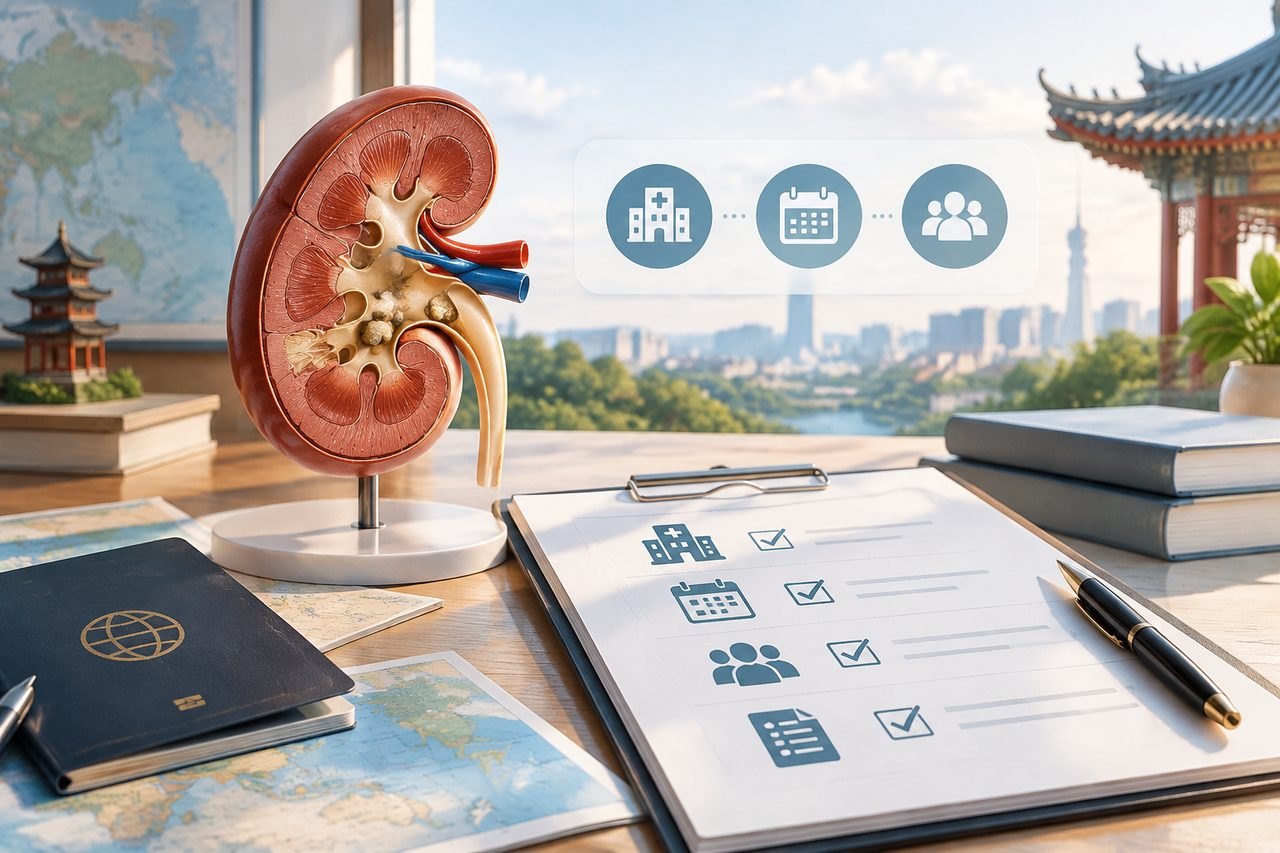
Ask for confirmation of the department, the campus and the appointment type, in writing, before you book flights or accommodation.
Department. For PCNL, the relevant specialty is urology. Ask whether your records have been routed to a urology department, not simply to an international office or a general reception. If the hospital has a stone or endourology service within urology, ask whether that is where your case sits. A general reply from a hospital does not tell you which clinical team has your file.
Campus. Many large hospitals run more than one site, and departments are not always at the address you first found. Ask for the exact campus, building and department name where you would be seen. If the hospital has both a standard and an international patient route, ask which one your appointment is under and whether the clinical team is the same. Do not assume the two are interchangeable.
Appointment type. Distinguish between a records-based review, an outpatient consultation, a pre-admission assessment and a scheduled procedure. These are different stages. A consultation does not mean surgery is booked. A pre-admission assessment does not mean a bed is held. Ask which stage your appointment represents and what has to happen before the next one.
If any of these three is unclear, treat the reply as preliminary. It is reasonable to ask again, politely and specifically, rather than travel on an assumption.
What the urology team needs to judge stone burden and procedure scope
PCNL suitability depends heavily on stone burden, stone location and the anatomy of your kidney and collecting system. The team also needs to know whether you have had previous stone surgery, whether there is current infection, and what other conditions affect your fitness for the procedure.
Useful records to ask about include your most recent CT imaging of the urinary tract, any ultrasound or X-ray reports, previous operative notes if you have had stone treatment before, recent kidney function blood tests, urine tests, and a list of your current medicines with doses. If you have had a stent or a drainage tube placed, include that information.
The source material for this article notes that PCNL accesses kidney stones through a small tract from the skin, and that further treatment or drainage may be needed. That is a reminder that the plan can involve more than one step. Ask the team directly: how are you evaluating my stone size and location, and is a staged or multi-step approach being considered? If a second look or later stone review is possible, ask how that would be arranged and where.
Do not send passport numbers, card details or a complete medical archive in a first message. A short summary with the key reports is enough to start. The hospital will tell you what else it wants.
Questions that clarify who owns the next step
A confirmed appointment should come with a clear owner for the next action. Ask who is responsible for reviewing your imaging, who will contact you with the outcome, and through which channel. If a coordination service is involved, ask what it will do and what the hospital will do, so the two are not confused.
Ask whether the appointment you have been given is provisional or fixed. A provisional clinical stage may still change after the team sees your imaging or examines you. That is normal, but you should know which stage you are in before committing to travel.
Ask what would make the plan change. For example, if infection is found, or if your kidney function needs review, the team may adjust the approach. Understanding this in advance helps you avoid treating a preliminary reply as a guarantee.
If you are comparing more than one hospital, ask each one the same questions so the answers are comparable. A reply that names a department, a campus and an appointment type is more useful than one that only says your case is under review.
Practical preparation before you travel
Once you have written confirmation of the department, campus and appointment type, you can plan around it. Ask the hospital what it expects you to bring, how records should be shared, and whether an interpreter will be needed for the consultation. If you do not speak Chinese, ask whether the appointment includes interpretation or whether you should arrange it.
Ask about the practical sequence: where you register on arrival, which building you go to, and who to contact if your plans change. If you are travelling with a companion, confirm whether they can attend the consultation.
Do not treat a confirmed appointment as confirmation that PCNL will be performed. The hospital decides suitability after assessment. If your symptoms worsen, or if you develop fever, severe pain or difficulty passing urine, seek local urgent care rather than waiting for an overseas appointment.
Keep your questions and the hospital's answers in one place. If a coordination service is helping, ask it to confirm in writing what has been arranged and what remains open.
Next step
Start with a short summary of your case and your main question. An initial enquiry is free and does not require buying a proxy consultation. If you would like help requesting a urology appointment and confirming the department, campus and appointment type, ChinaSpecialistCare can pass your records to a suitable hospital and clarify what has actually been arranged. The hospital still decides whether PCNL is appropriate for you.
Before you write, decide what you are actually asking for. If you already have imaging and a clear question about whether PCNL is a reasonable option, say so and attach the key reports. If you are still gathering records, say that too, so the reply can tell you what is missing rather than simply acknowledging your message. A short, specific enquiry is easier for a hospital to route to the right team than a long narrative without a question.
When a reply arrives, read it against the three confirmations. If it names a urology department, a campus and an appointment type, you have something you can plan around. If it only says your case is under review, ask which of the three is still open. That single follow-up question is often enough to move a preliminary reply toward a concrete arrangement, or to show that the hospital needs more information before it can offer one.
Keep a simple record of what you sent, when you sent it, and what came back. If more than one hospital is involved, note which department and campus each reply refers to, because names can look similar across sites. If you are working with a coordination service, ask it to confirm in writing what it has requested and what the hospital has confirmed, so the two are not blurred together.
If your symptoms change while you are waiting, do not wait for the overseas appointment. Fever, worsening pain or difficulty passing urine need local assessment. A confirmed appointment is a plan for elective assessment, not a substitute for urgent care.
Finally, treat the appointment as the start of the clinical process, not the end of it. The urology team will assess your stone burden, your imaging and your general health before deciding whether PCNL fits, and the plan may change after that assessment. Your job before travel is to know which department, which campus and which stage you are dealing with, and who to contact if any of those answers change.
Sources & scope of this guide
References and official service information relevant to this guide.
This is general planning information and has not been individually reviewed by a doctor. Medical decisions and personal treatment advice come from your treating clinicians.