Why a focused question list matters more than a long history
A first in-person discussion about percutaneous nephrolithotomy, or PCNL, is a clinical assessment, not a general information session. The urologist needs to understand your stone situation, your previous treatments and your current symptoms, but the conversation works best when you also arrive with a small number of clear questions. A long, unstructured narrative can leave the most important decisions unresolved.
PCNL accesses kidney stones through a small tract from the skin. That single sentence already tells you why the discussion must be specific: the team is planning a route into the kidney, and the details depend on where the stone sits, how large it is and whether more than one session may be needed. Your questions should help you understand how the team reaches those decisions, not just what the procedure is called.
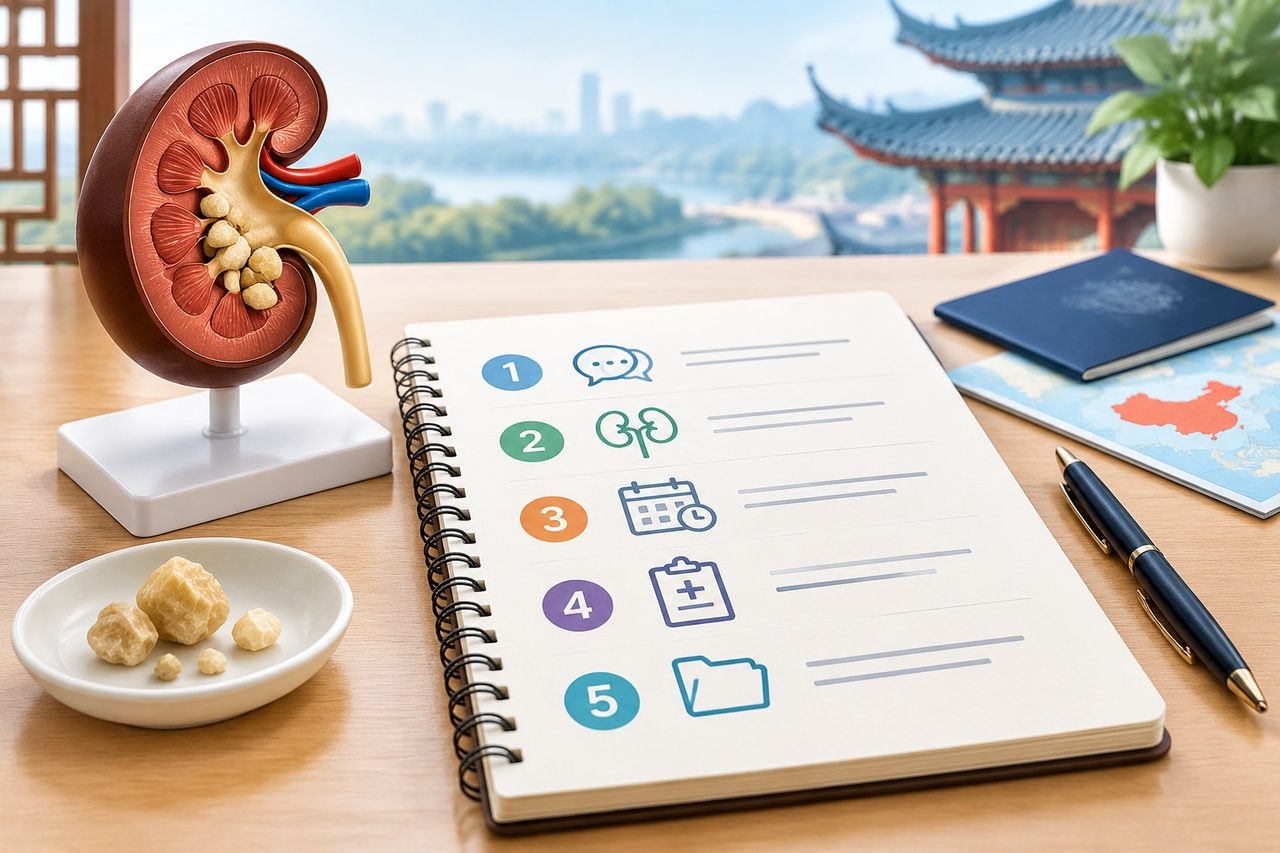
Write your questions down before the appointment. Keep the list to three to five items so you can actually discuss each one. If you use an interpreter, give them the list in advance so the clinical conversation is not slowed by translation of background details that the team can read in your records.
Ask how the team evaluates stone size and location
Stone burden is a practical term for how much stone is present and where it sits. The treating team will assess this using your imaging and clinical history. Ask directly: which images are being used, and what do they show about the size and position of the stone or stones? This matters because the same procedure name can describe very different operations depending on whether the stone is in the kidney pelvis, a calyx or another location.
You can also ask whether the team expects a single tract or more than one access point. The answer depends on the stone distribution and the kidney anatomy, and the team may not finalise this until they review the imaging in person. That is normal. What you need from the first discussion is the team's working assessment and the reasons behind it, not a guaranteed plan that cannot change.
If you have previous imaging from your home country, bring the actual images or a secure digital copy, not only the written report. Reports summarise; images let the urologist see the stone burden directly. Ask whether the team wants any additional imaging before deciding on the approach, and who will arrange it.
Clarify whether staged treatment is proposed and why
PCNL may be planned as a single session or as part of a staged approach. Further treatment or drainage may be needed. Ask the team whether they are proposing one procedure or a staged plan, and what would trigger a second stage. The answer might depend on stone clearance, bleeding, infection risk or the need for a temporary drainage tube.
This is not a question about whether the team is being cautious. It is a question about what you are agreeing to. If a staged plan is possible, ask what the intervals would be, what assessments would happen between stages, and whether the later stage would be at the same hospital. Do not accept a vague answer if the plan affects your travel and accommodation.
You should also ask what happens if the first stage does not clear all the stone. The team may recommend a second look, a different procedure or observation. Ask how that decision would be made and who would be involved. A clear answer here helps you plan realistically rather than assuming a single trip will resolve everything.
Ask how later stone reviews would be handled
Follow-up after PCNL is not a formality. Stones can recur, and the team will want to review your imaging and kidney function after treatment. Ask how the hospital handles follow-up for international patients: would reviews happen in person in China, or could some be done remotely with your local doctor?
If remote review is possible, ask what records the team would need and how images would be shared. If in-person review is required, ask how soon after the procedure it would be scheduled and whether it can be combined with your discharge planning. These are practical questions, and the answers vary by hospital and by your clinical situation.
You should also ask what symptoms would require urgent local care rather than waiting for a scheduled review. Urgent infection needs local care. Ask the team to explain the warning signs in plain language and to give you a written summary you can share with a local clinician if needed.
Prepare the records and practical details the team will need
Before the appointment, gather your recent imaging, blood tests, urine tests and any previous stone treatment records. If you have had a stent, a drainage tube or a previous stone procedure, include those details. The team needs to know what has already been done and what the outcome was.
The reason this matters is that the first discussion is where the team builds its working picture of your stone burden. If a previous procedure cleared part of the stone, or if a stent was placed and later removed, that history changes how the team reads the current imaging. A gap in the record does not stop the assessment, but it does mean the team may need to ask more questions or request a specific document before it can give you a clear view of the proposed approach.
Ask the hospital what format they prefer for imaging and reports, and whether translations are needed. Do not assume that a report from your home country will be accepted without the images. If you are unsure what to bring, send a brief summary to the hospital or your coordination contact and ask what is missing.
When you send that summary, be specific about what you are asking. A message that says only "I have a kidney stone" gives the team little to work with. A message that states the stone size and location from your most recent imaging, the date of that imaging, any previous stone treatment and your main question is far more useful. It also lets the hospital tell you which records are still missing before you travel.
On the practical side, confirm the appointment time, the department, the interpreter arrangement and the payment route for the consultation. Hospital consultation fees are separate from any coordination service. Ask the hospital directly what its consultation fee is and how it should be paid.
If you are using an interpreter, decide in advance how the conversation will run. A three-way conversation is slower, and clinical terms can lose precision. Give the interpreter your written question list before the appointment so they can prepare the vocabulary. Ask them to translate your questions exactly rather than summarise them, and to tell you when a term has no direct equivalent.
You should also confirm who will be in the room. A first PCNL discussion may involve a urologist, a resident or a nurse, and the person who explains the plan may not be the person who performs the procedure. Ask who will make the final decision on the approach and whether you will have a chance to speak with them before the procedure date.
Finally, ask what the hospital needs from you before the appointment is confirmed. Some hospitals want imaging and reports in advance; others review them on the day. The answer affects how soon you can be seen and whether your trip needs to be split into two visits. Confirm this in writing if you can, so there is no confusion about what has been agreed.
What to confirm before you leave the first discussion
By the end of the appointment, you should be able to state the team's working assessment of your stone burden, whether a single or staged procedure is being considered, and what the next step is. If any of those points is unclear, ask for clarification before you leave. It is better to spend an extra few minutes than to travel home with an uncertain plan.
Ask the team to write down the key points: the proposed procedure, the reason for it, the possible need for further treatment or drainage, and the follow-up plan. A written summary helps you discuss the plan with your family and your local doctor.
If you are considering PCNL in China, you can start with a free initial enquiry. Our team checks the available diagnosis, records and your main question, identifies missing information and suggests the relevant next step. This is not a diagnosis or a promise of acceptance. You do not need to purchase a proxy consultation to make an initial enquiry. The hospital decides whether PCNL is suitable for you.
For more detail on the procedure itself, see the PCNL reference page.
Sources & scope of this guide
References and official service information relevant to this guide.
This is general planning information and has not been individually reviewed by a doctor. Medical decisions and personal treatment advice come from your treating clinicians.