
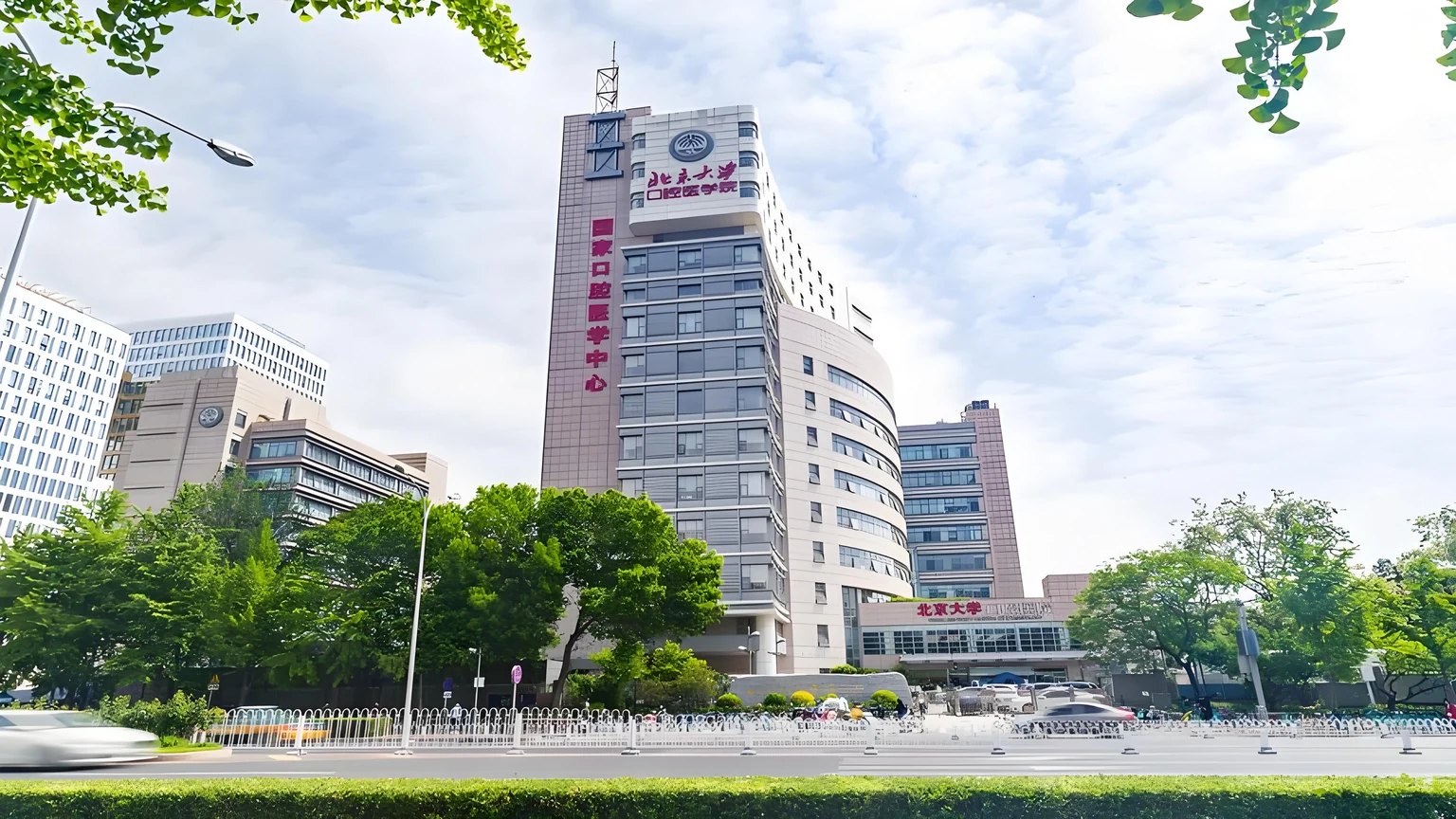
A university dental hospital with distinct clinical directions
Peking University School of Stomatology brings hospital-based specialists together with academic research. Its official university profiles document oral and maxillofacial surgery, salivary-gland disease and prosthodontics. These are selected strengths of the teams discussed here, not an exhaustive list of everything the hospital treats. The practical starting point is the diagnosis and the decision for which an assessment is needed.
The hospital was first in the 2023 Fudan national stomatology specialty reputation list. That is a dated departmental reference, not a ranking of individual dentists or of the hospital's subspecialties.
An enquiry about a jaw tumor should make clear whether the unresolved question concerns diagnosis, the proposed resection, reconstruction or rehabilitation afterwards. An enquiry about a prosthesis should explain the existing defect and the difficulty with the current restoration. Naming the same hospital does not make those two requests equivalent or establish that the same team should review both.
Oral tumors, salivary function and prosthetic rehabilitation
The verified profiles point to several distinct areas rather than a full service list. Oral and maxillofacial surgery is the most prominent, covering tumours of the oral cavity and skull base, reconstruction of the jaw and face, and salivary gland disease. Salivary work includes function-preserving surgery and contributions to salivary gland guidelines, and one research direction concerns submandibular gland transplantation in severe dry eye. That transplantation research is a specialist research interest; it does not establish that the procedure is appropriate for, or available to, any individual patient.
Reconstruction is a second documented direction. Work described in the profiles includes individualized functional reconstruction after oral tumours and navigation-guided fibula-flap mandibular reconstruction. These are major surgical procedures with their own risks, and the treating team must judge whether reconstruction is feasible, which technique fits the defect and what function can realistically be restored.
Prosthodontics is the third area, including digital complete dentures, individualized impression trays, jaw-relation workflows and maxillofacial prostheses designed from virtual patient models and combined CT and oral-scan data. Digital dentistry here describes how planning, design and fabrication are organised; it is not a separate guarantee of a faster or better result. A fourth, more laboratory-oriented strand covers bone regeneration, scaffold biomaterials and biomarkers for tumour spread, which are research questions rather than treatments a patient can request.
Yu Guangyan, Guo Chuanbin and the clinical-research teams
Yu Guangyan is an oral and maxillofacial surgery professor and honorary president of the Chinese Stomatological Association in his official university profile. He was dean from 1996 to 2009. His senior academic role should not be confused with the current administration or with a promise of a personal appointment.
Guo Chuanbin's profile identifies him as an oral and maxillofacial surgery professor and president of the Chinese Stomatological Association. His head-and-neck cancer research addresses nodal spread and reconstruction. A 2024 Journal of Oral Rehabilitation paper uses modeling to investigate jaw-opening function after mandibular reconstruction, providing a concrete example of research into postoperative function rather than simply tumor removal.
Cai Zhigang is identified as hospital vice president, national medical center deputy director and oral and maxillofacial specialist. His documented directions also include facial-nerve injury assessment and repair. He led the national key research project on standardized and personalized oral-disease treatment with a stated 2022–2025 project period. That project period is not a current enrollment window for patients.
Liu Yunsong is a hospital vice president, professor, chief physician and prosthodontics specialist according to his profile. Chen Hu is an associate professor, deputy chief physician and deputy director of the hospital's digital dentistry research center. Their different roles connect clinical restoration with the design and development of dental workflows; neither title by itself confirms who would treat a new patient.
How does the research connect to a real patient decision?
For an oral or jaw tumor assessment, the team’s published work can help frame a more precise enquiry. Ask what the existing diagnosis establishes, whether regional lymph nodes need further review and what functional goals would guide a reconstruction discussion. If bone removal is being considered, ask which reconstructive and prosthetic teams would contribute and how the proposed stages relate to each other. The hospital must decide what review is needed.
If your problem is salivary, the relevant thread is function-preserving surgery and guideline contributions. The practical question is whether your gland can be treated while preserving function, and what the alternatives are if it cannot. If your problem is missing teeth or a facial prosthesis, the digital workflow work is relevant to how impressions, jaw relations and design are captured. Ask how your records will be used, who designs the prosthesis, and what try-in stages are planned.
Two cautions follow. First, laboratory work on magnesium alloys, scaffolds or organoids does not mean those approaches are approved treatments available to you. Second, a publication by a clinician does not make that clinician your treating doctor, and it does not predict your outcome. The value is in the questions the work makes possible, not in a promise.
What honours are documented, and how should they be read?
Yu Guangyan's profile lists a National Science and Technology Progress Second Prize as first contributor, the National May 1 Labor Medal, and honorary fellowships from the Royal Colleges of Surgeons of Edinburgh and of England. The profile does not give award years, so none should be assumed. These are recognitions of a career and of specific work; they are not a statement that a given operation will succeed for you.
Liu Yunsong's listed honours include a National Teaching Achievement Second Prize, a Chinese Stomatological Association Science and Technology First Prize and an AADR Hatton Award, again without supplied award years. Chen Hu's profile lists participation in a Beijing technological-invention first prize, which is participation rather than sole ownership. Read honours as signals of peer recognition in teaching, research or invention. They do not replace a clinical assessment, and they do not tell you which clinician is appropriate for your case.
What should an overseas patient actually prepare and ask?
Begin with a concise account of the diagnosis, previous treatment and the decision you want reviewed. Ask which existing imaging, pathology and dental or surgical records would help the receiving clinician, and whether original material or a translated summary is needed. For an existing denture or facial prosthesis, ask how to describe the fit, function and adjustments already attempted. Do not commission a new set of investigations simply to assemble an enquiry.
Then ask the hospital specific questions. Which department is the right entry point for your problem? Which records does the treating clinician need before an opinion can be given? Will the assessment be records-based first, or is an in-person examination required? If surgery is proposed, what reconstruction and prosthetic stages are planned, and who leads each? For digital workflows, ask what data are captured, how the design is checked, and what the try-in and adjustment process involves.
Also confirm the administrative points that vary by provider and cannot be assumed: how appointments are arranged for international patients, what language support exists, how imaging and reports are shared, and what the written treatment plan and fee scope will contain. Ask whether any proposed procedure is established clinical care or part of a research study, and what the alternatives and risks are. Worsening symptoms, bleeding, swelling or pain need local urgent assessment rather than a waiting period for overseas travel.
How can ChinaSpecialistCare help with this specific assessment?
ChinaSpecialistCare can help organise a focused dental or maxillofacial assessment request and prepare existing records. We are independent of the hospital, not its official representative. The hospital confirms acceptance and the reviewing team; coordination does not promise a named clinician, experimental treatment or a particular clinical result.
Sources & scope of this guide
References and official service information relevant to this guide.
- procedures
- Dental care in China for international patients
- Fudan 2023 historical national specialty reputation list
- Peking University official profile: Yu Guangyan
- Peking University official profile: Guo Chuanbin
- Peking University official profile: Cai Zhigang
- Peking University official profile: Liu Yunsong
- Peking University official profile: Chen Hu
This is general planning information and has not been individually reviewed by a doctor. Medical decisions and personal treatment advice come from your treating clinicians.