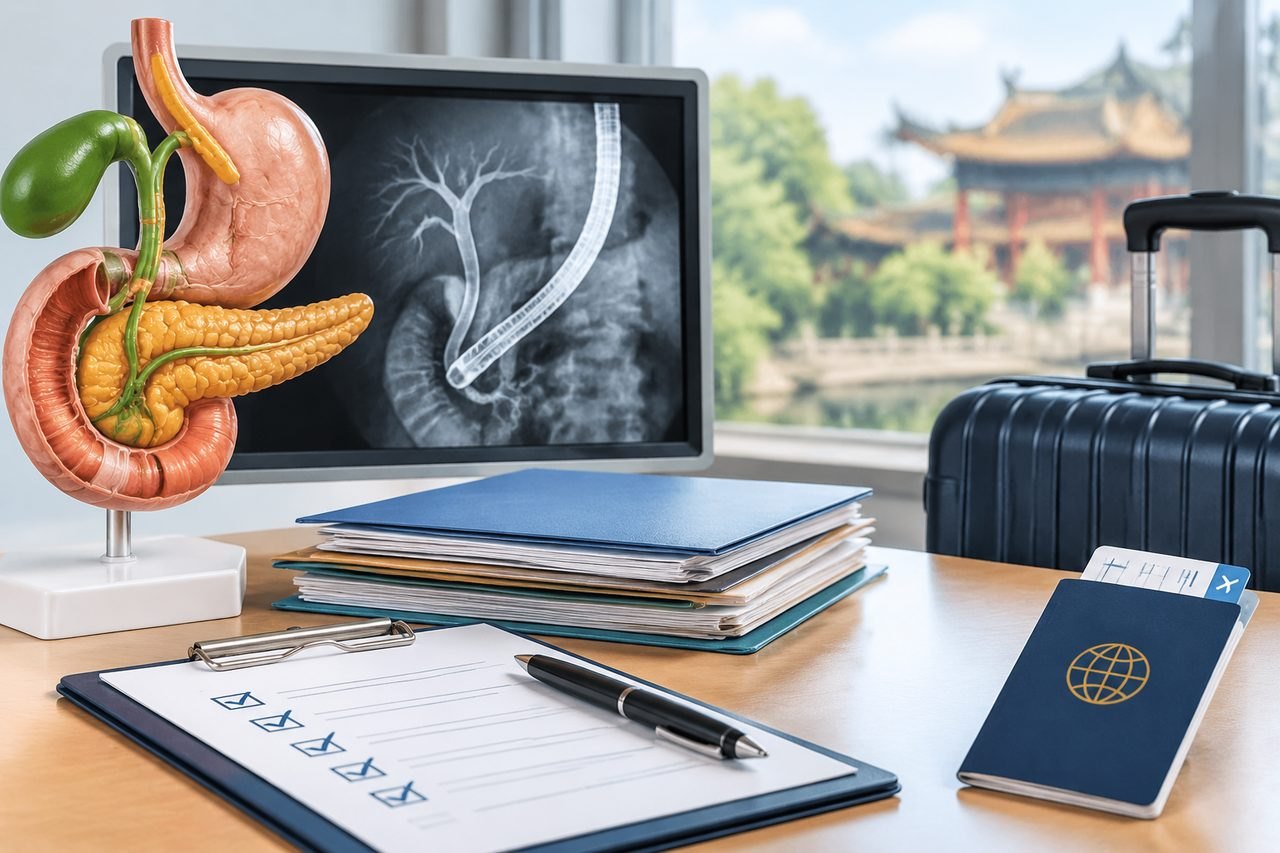
What ERCP is and why the decision belongs to the treating team
ERCP, or endoscopic retrograde cholangiopancreatography, combines endoscopy and X-rays to examine and treat problems in the bile or pancreatic ducts. It is not a routine screening test. It is usually performed when a clinician suspects or has already identified a duct problem that may need treatment, such as a blockage, stone, narrowing or leak. The procedure can both diagnose and treat, but it also carries risks including pancreatitis, bleeding, infection and sedation-related complications. Because of those risks, the decision to perform ERCP is a clinical one. A hospital will review your records and decide whether ERCP is appropriate for your situation, whether another test or procedure would be safer, and what preparation you need.
For an overseas patient, the practical question is not simply whether ERCP is available in China. It is whether a specific hospital, after reviewing your actual records, will accept you for ERCP and give you a clear plan. That plan should state the reason for the procedure, the intended approach, what will be done if the findings differ from expectations, and what follow-up or additional treatment may be needed. Without that, a flight booking is premature.
Records to prepare before asking a hospital to review your case
The records that matter most are the ones that show why ERCP is being considered. These typically include recent imaging of the bile or pancreatic ducts, such as MRCP, CT or ultrasound reports; blood test results, especially liver and pancreatic enzymes; and any previous endoscopy or ERCP reports. If you have had a stent placed or removed, the details of that procedure and the current stent status are important. A discharge summary from a recent hospital admission can also help.
You do not need to send a complete lifetime medical archive at the first contact. A brief summary with the key reports is enough for an initial review. After that, the hospital or coordination team can tell you what else they need. Ask specifically: which imaging files do you need, in what format, and do you need the original images or are reports sufficient? Also ask whether the hospital wants any tests repeated in China before ERCP, and whether those can be done during the same visit or require a separate trip. The answers will affect your travel dates and budget.
If your records are in a language other than Chinese or English, ask whether a certified translation is needed and who can provide it. Do not assume that a report from your home country will be accepted without review. The receiving clinician needs to see the actual findings, not just a diagnosis label.
Questions that determine whether you can book travel
Before buying tickets, you need written confirmation on several points. First, has the hospital accepted your case for ERCP? Acceptance means a clinician has reviewed your records and agreed that ERCP is a reasonable next step, not just that the hospital offers the procedure. Second, what is the planned date or window for the procedure? This may depend on operating room schedules, the availability of the endoscopist, and any pre-procedure tests or consultations. Third, what pre-procedure preparation is required? This can include fasting instructions, medication adjustments, or additional imaging. Do not follow any fasting or medication instruction from a website; wait for the treating team's specific directions.
Fourth, what is the expected length of stay? ERCP may be done as an outpatient procedure or may require admission, depending on the complexity and your overall health. The hospital should tell you whether you will be admitted, for how many nights, and what the discharge plan is. Fifth, what follow-up is needed? Some patients need a repeat procedure, stent removal, or monitoring for complications. Ask how that will be arranged and whether it can be done locally or requires another trip to China.
Finally, ask what could change the plan. If the ERCP findings are different from expected, what are the alternatives? Will the team proceed with treatment during the same procedure, or stop and discuss options? Having a contingency plan helps you decide how much flexibility to build into your travel.
Practical support during an ERCP visit
ERCP is usually performed under sedation or anesthesia. After sedation, you should not drive or travel alone. The treating team will give you specific instructions about escort, transport and supervision. For an overseas patient, this means arranging a companion or a professional support service in advance. A bilingual hospital companion can help with admission paperwork, interpretation during consent discussions, and communication with the clinical team. This is a non-clinical coordination service, not medical care, and it should be agreed separately from hospital fees.
You will also need to plan for communication. Consent for ERCP involves discussing risks, benefits and alternatives. If you do not speak Chinese, ask whether an interpreter will be available for the consent discussion and for any conversations after the procedure. Do not rely on a family member to interpret complex medical information unless the hospital agrees. Ask the hospital what language support it provides and whether you need to arrange your own interpreter.
Practical arrangements such as accommodation near the hospital, local transport and payment methods should be confirmed before travel. Hospital fees for consultation, tests, the procedure itself, medicines and any inpatient stay are paid to the hospital or relevant provider. Coordination fees for services such as appointment booking, interpretation or companion support are separate. Ask for a written outline of what is included in any quote and what remains undecided until after the procedure.
What to ask about costs and what an estimate can and cannot tell you
ERCP costs in China vary by hospital, by the complexity of the procedure, and by what is found and treated during the procedure. A simple diagnostic ERCP may cost less than one that involves stone removal, stent placement or treatment of a stricture. Additional factors include the type of sedation or anesthesia, the length of stay, and any complications that require further care. Because of this variation, a general price range is not a reliable basis for planning. Instead, ask the specific hospital for a records-based estimate after they have reviewed your case.
When you receive an estimate, ask what it includes and what it excludes. Does it cover the procedure, the endoscopist's fee, anesthesia, medications, consumables, and any inpatient bed? Does it include pre-procedure tests and post-procedure monitoring? What happens if the procedure takes longer than expected or if additional treatment is needed? Ask whether the estimate is a fixed quote or an approximation, and what the process is for additional charges. Also ask about payment timing: what is paid before the procedure, during admission, and at discharge. Keep in mind that hospital fees and coordination fees are separate, and that travel costs such as flights, accommodation and local transport are your own responsibility.
Do not treat a foreign price or a website figure as evidence of what a Chinese hospital will charge. The only reliable estimate comes from the hospital that will perform your procedure, based on your actual records.
Contingencies: what if the plan changes or you need to stay longer
Even with a confirmed plan, ERCP can reveal unexpected findings or require additional treatment. Ask the hospital in advance what the options are if a stent is needed, if a stone cannot be removed in one session, or if a complication occurs. Will you need to stay in China longer? Can follow-up be done locally, or will you need to return? What is the process for extending a hospital stay or changing a flight? Having answers to these questions helps you decide how much buffer to build into your itinerary and whether you need travel insurance that covers medical changes.
Also ask what happens if you become unwell before the procedure. If you develop fever, worsening pain, jaundice or other symptoms, you should seek local medical care rather than travel. The treating hospital can advise on whether to postpone. Do not board a flight if you have acute symptoms without speaking to a clinician first.
Finally, clarify the follow-up plan. If a stent is placed, when does it need to be removed or exchanged? Can that be done at home, or does it require a return visit to China? The answer affects both your travel planning and your long-term care. Ask for the plan in writing so you can share it with your local doctor.
Next step: a free initial enquiry
You can start with a free initial enquiry by sharing a brief summary of your diagnosis, key reports and your main question. ChinaSpecialistCare's team checks the available information, identifies what is missing and suggests the relevant next step. This is not a diagnosis or a promise of hospital acceptance. If you want a records-based opinion before travelling, ask whether a proxy consultation is appropriate for your case; it is optional, not a prerequisite. The hospital decides whether ERCP is suitable for you. Once you have written confirmation of acceptance and a procedure plan, you can book travel with more confidence.
Sources & scope of this guide
References and official service information relevant to this guide.
This is general planning information and has not been individually reviewed by a doctor. Medical decisions and personal treatment advice come from your treating clinicians.