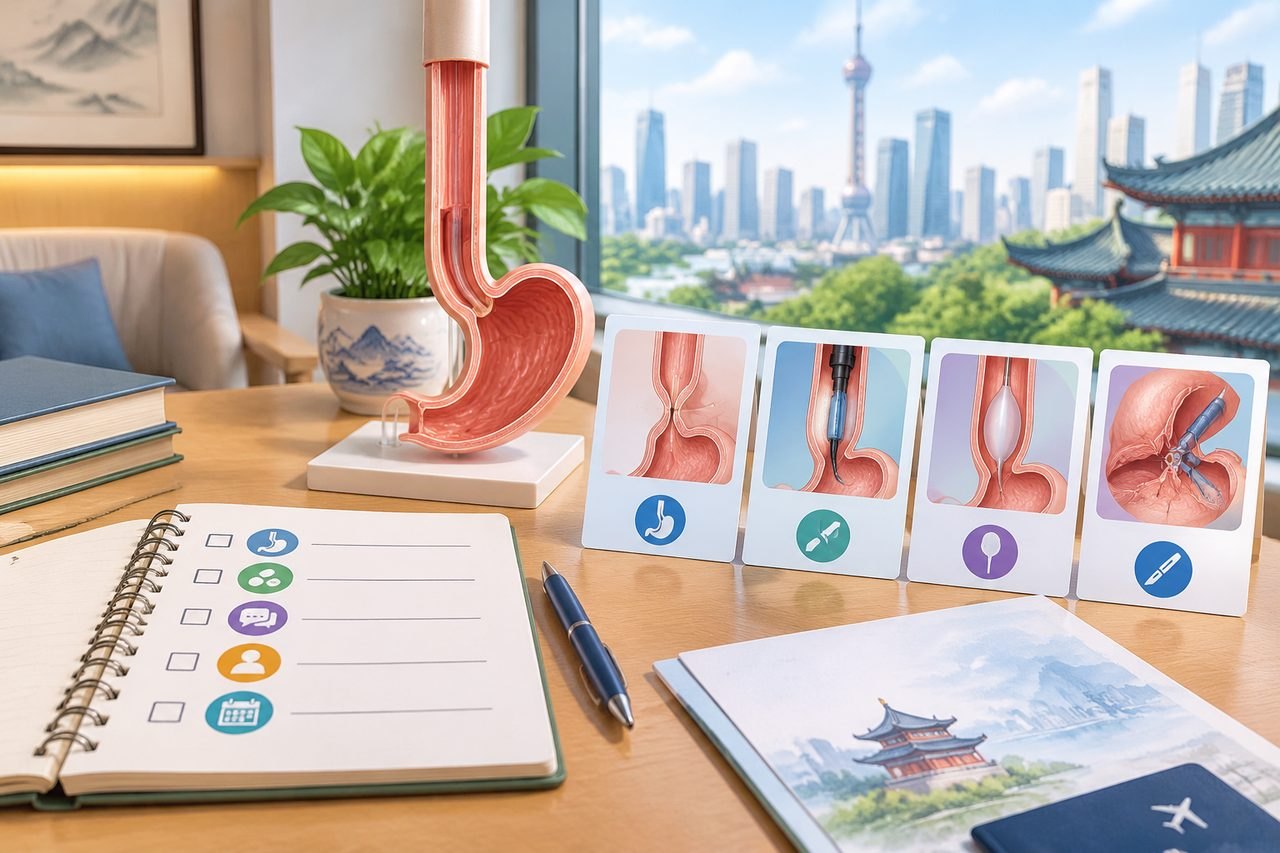
What each swallowing test actually tells the POEM team
Achalasia is a disorder of the muscle function of the oesophagus, and POEM is an endoscopic treatment that cuts the muscle. The treating specialist needs to know which muscle is affected, how the oesophagus behaves between swallows, and whether the appearance fits achalasia rather than a condition that mimics it. Different tests answer different parts of that picture, so sending a folder of results without knowing which question each one addresses makes the review slower.
Oesophageal manometry is the test that measures pressure and coordination in the oesophagus. It is the study most often used to classify achalasia into types, and the type can influence which treatment a specialist considers. If your manometry report includes the Chicago classification or a named subtype, that is directly useful. If it only says 'abnormal motility' without tracings or a conclusion, the specialist may not be able to rely on it.
Upper endoscopy shows the inside lining of the oesophagus and the gastro-oesophageal junction. It helps exclude narrowing, tumours or other causes of swallowing difficulty, and it documents whether the oesophagus is dilated or retains food. The endoscopy report and any biopsy result belong in the review.
A barium swallow, also called a timed barium oesophagogram, shows the shape of the oesophagus and how much contrast remains after swallowing. It can support the diagnosis and give a baseline for comparison after treatment. If you have had one, include the images or the radiologist's report, not just a one-line summary.
High-resolution manometry, endoscopy and barium studies are complementary. A specialist reviewing records remotely can often form a working impression from them, but the final decision about whether POEM is suitable for you depends on an in-person assessment and on the treating team's own judgement.
Why prior achalasia treatment changes the review
Previous treatment is one of the most important parts of the history, because it can change the anatomy and the options. If you have had pneumatic balloon dilatation, Heller myotomy, previous POEM, botulinum toxin injection or a stent, the specialist needs to know when it was done, at which hospital, and what the immediate result was.
Each of these treatments leaves a different mark. Botulinum toxin can cause scarring around the gastro-oesophageal junction that makes later muscle-cutting more difficult. A previous Heller myotomy or POEM means the muscle layer has already been partly divided, and the specialist has to consider whether a repeat procedure is appropriate and where the remaining muscle is. Pneumatic dilatation can cause scarring or perforation history that affects planning.
The useful records are the procedure report, the discharge summary and any follow-up notes describing symptom response. If you do not have the procedure report, ask the hospital that performed it for a copy. If that is not possible, write down what you know: the procedure name, the approximate date, the hospital and city, and whether swallowing improved afterwards.
Do not stop or change any medication before the review. If you take nitrates, calcium channel blockers, proton pump inhibitors or any other medicine for swallowing or reflux, list them with doses and bring the list to the appointment. The treating clinician decides whether any adjustment is needed.
What remote review can and cannot settle
A records-based opinion can answer several practical questions. It can clarify whether your diagnosis is supported by the documents you have, whether the achalasia subtype is documented, whether prior treatment is described clearly enough, and which additional information the treating team would want before an in-person assessment. It can also help you understand whether POEM is a treatment that is generally considered for your situation, without promising that it will be offered.
Remote review cannot confirm final suitability. It cannot replace the in-person assessment of your swallowing function, your nutritional state, your anaesthetic fitness or the endoscopic view of your oesophagus. It cannot establish that a particular hospital will accept you, that a particular specialist will perform the procedure, or that the procedure will produce a particular outcome.
It also cannot resolve missing records by guessing. If your manometry was done years ago and the tracings are unavailable, the specialist may ask whether it should be repeated. That is a clinical decision for the treating team, not something to arrange on your own before the review.
The practical value of remote review is to make the first in-person visit more focused. You arrive with the questions that matter already identified, rather than spending the first appointment assembling the history.
Organising the gaps without ordering tests yourself
Start by listing what you have and what you do not have. A simple table with columns for test name, date, hospital, and whether you hold the report or images is enough. Then note which items are missing and why: never performed, performed but report lost, or performed abroad and not translated.
For each gap, the useful next step is to ask the treating team whether the missing item matters for their assessment. Do not book a new manometry, endoscopy or barium study on your own before that conversation. The specialist may consider an older study adequate, may want it repeated at their own hospital under their own protocol, or may prefer a different test entirely. Ordering tests in advance can add cost and delay without answering the question the team actually has.
If you have reports in another language, ask the hospital whether they need a certified translation or whether an English summary is acceptable. Do not assume a particular format is required; confirm it with the receiving team.
Keep a one-page summary at the front of the folder: your diagnosis, when it was made, your main swallowing symptoms, your prior treatments with dates, your current medicines, and your main question. This is the page the specialist is most likely to read first.
Questions that change the next step
The answers to a small number of questions determine whether the next step is an in-person assessment, a request for more records, or a different treatment discussion. Ask the treating team these directly rather than assuming the answer.
First, does my manometry report include a recognised achalasia subtype, and is the tracing available if the report alone is not enough? Second, does my prior treatment history change which procedure you would consider, and would you want the original procedure report before deciding? Third, which of my existing tests would you accept as current, and which would you want repeated at your hospital? Fourth, what does the in-person assessment involve, and what should I bring that is not already in the records? Fifth, if POEM is not suitable for me, what alternatives would you consider?
These questions are not a checklist to complete before travelling. They are the points where the specialist's answer changes what you do next. If the team says your records are sufficient for a first assessment, you can plan around that. If they say a key study is missing or too old, you know what to discuss before booking anything.
Write down the answers. A short written summary of what the team said is more reliable than memory, especially if you are communicating across languages.
Practical preparation and one next step
Gather your records in a single folder, ordered by date, with the most relevant items first: manometry, endoscopy, barium study, prior procedure reports, current medication list and a one-page summary. Keep a copy for yourself and send a brief summary first rather than a complete archive.
If you are considering care in China, the initial enquiry is free and asks only for a short summary of your diagnosis, your main question and what records you hold. The team can then explain what is missing and suggest the relevant next step. A proxy consultation is optional and is not a prerequisite for an appointment or for the hospital's own assessment.
The hospital and its clinicians decide whether POEM is suitable for you. Your preparation makes that decision easier to reach, but it does not replace the specialist's assessment.
Sources & scope of this guide
References and official service information relevant to this guide.
This is general planning information and has not been individually reviewed by a doctor. Medical decisions and personal treatment advice come from your treating clinicians.