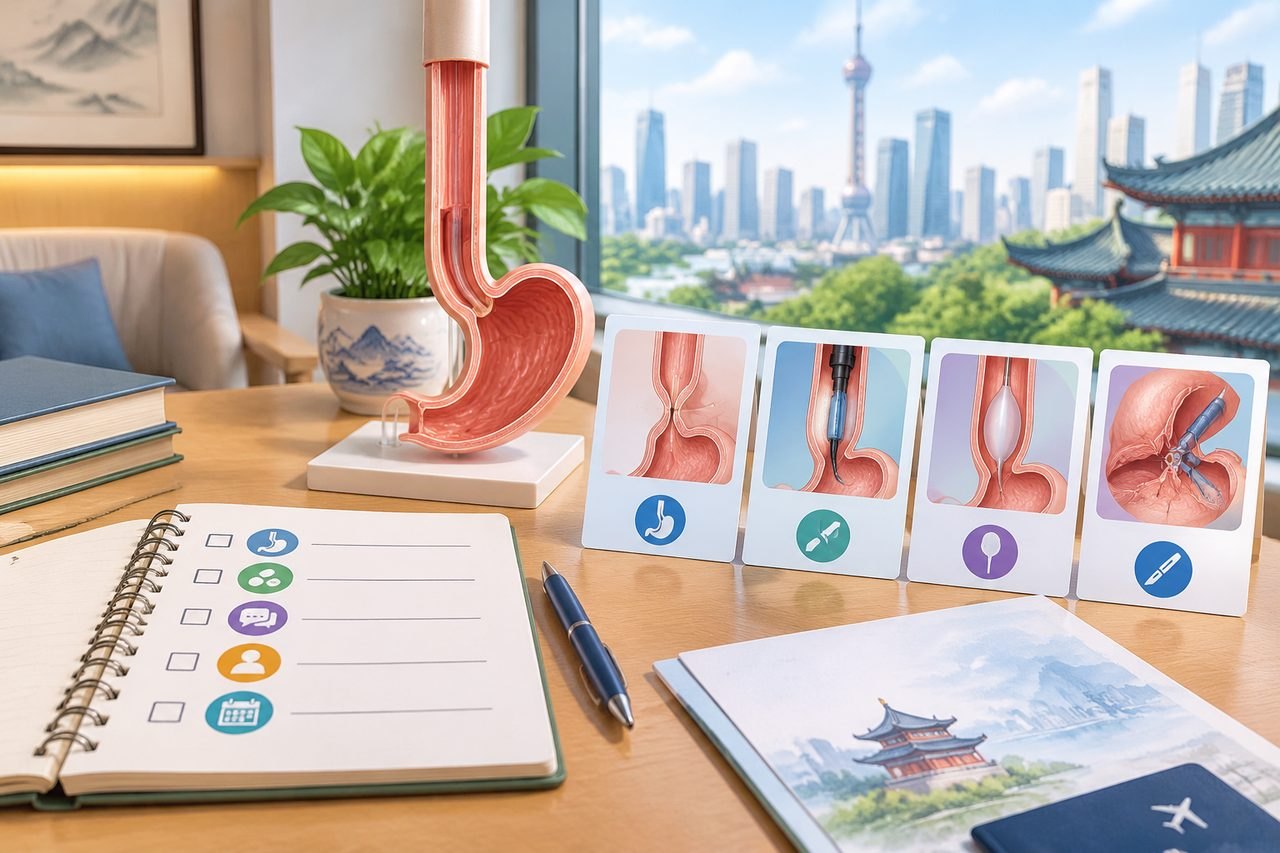
What POEM actually is, and what it is not
Peroral endoscopic myotomy, or POEM, is a treatment for achalasia in which the operator works through the mouth with an endoscope rather than making incisions on the outside of the body. The aim is to reduce the obstruction caused by a tight lower esophageal sphincter and an unrelaxing esophagus. The supplied clinical source describes POEM as an endoscopic muscle-cutting treatment used for achalasia, and suitability requires specialist assessment.
That description matters because patients often arrive with two competing expectations. One is that POEM is a permanent cure. The other is that it is a minor procedure with no meaningful trade-offs. Neither is a safe assumption. POEM can improve swallowing for appropriately selected patients, but it does not restore a normal esophagus in every respect, and it does not remove the need for follow-up. It also carries its own risks, including reflux and procedure-related complications, which the treating team must discuss with you.
The practical question is not whether POEM is a good procedure in general. It is whether it is the right choice for your specific esophagus, your previous treatments and your priorities. That is a clinical judgement, not a booking decision.
The alternatives you should ask about by name
A useful consultation does not stop at 'POEM or nothing.' Achalasia has several established treatment routes, and the conversation should cover them explicitly so you understand why one is being recommended over another.
Pneumatic dilation uses a balloon to stretch the lower esophageal sphincter. It is less invasive than surgery but often requires repeat sessions, and the durability varies between patients. Heller myotomy is a surgical muscle-cutting operation, historically performed laparoscopically, and it is often combined with a partial fundoplication to reduce reflux. Botulinum toxin injection can relax the sphincter temporarily and is sometimes used when a patient is not a candidate for more definitive treatment, but its effect is not permanent. Medications are generally considered a limited option rather than a definitive treatment.
Each option has a different risk profile, a different likelihood of needing further treatment, and a different recovery experience. Ask the specialist to explain, for your case, why POEM is or is not preferred over Heller myotomy and over pneumatic dilation. If the answer is only that POEM is newer or less invasive, that is not a complete answer. The relevant comparison is between the expected benefit and the expected burden of each route for your anatomy and history.
What 'expectations' should mean in your consultation
Patients often ask what percentage of people get better. That question is understandable, but a single number rarely answers the decision in front of you. A more useful set of questions is about your situation: What is the goal of treatment in my case? Is it to make swallowing easier, to reduce regurgitation, to allow me to eat more normally, or to avoid a more invasive operation? Which of those goals is realistic, and over what time frame?
You should also ask what happens if POEM does not produce the improvement you hope for. What are the options then? Would a repeat procedure be considered, and under what circumstances? What follow-up is planned, and what symptoms would prompt earlier review? These questions are not pessimistic. They are part of informed consent, and a specialist who welcomes them is giving you better care than one who avoids them.
Finally, ask about reflux. POEM deliberately weakens the barrier at the lower esophagus, and reflux after the procedure is a recognised consideration. Ask how your team plans to monitor and manage it, and whether that changes your choice between POEM and an operation that includes an anti-reflux component.
Why the choice is not the same for every patient
Achalasia is not one uniform condition. Subtypes differ in how the esophagus behaves, and prior treatments change the tissue the operator will work with. A patient who has already had pneumatic dilation or a Heller myotomy may present a different technical situation from someone who has had no prior intervention. Age, general health, medication use and personal priorities also matter.
This is why a records-based opinion can be useful before you commit to travel. A specialist reviewing your manometry, endoscopy, barium swallow and operative history can tell you whether POEM is technically feasible, what alternatives remain, and what information is still missing. That review is not the same as a final decision, and it does not guarantee that the hospital will accept you for the procedure. It is a way to avoid arriving in China for a treatment that a clinician would not have recommended if they had seen your full file first.
It also helps to separate two questions that patients often merge. The first is whether POEM is medically suitable for you. The second is whether you want to have it in China. The first is clinical. The second involves language, continuity of follow-up, travel, cost and your own comfort with the plan. Both deserve a clear answer.
A labelled planning example: how the decision can change
Consider a hypothetical patient, not a real case, who has confirmed achalasia and has never had treatment. Their main symptom is difficulty swallowing solids, with occasional regurgitation at night. They are otherwise healthy and want to avoid a surgical operation if possible. In this situation, a specialist might discuss POEM and pneumatic dilation as reasonable options, explain the trade-offs, and recommend one based on the manometry findings and the patient's tolerance for repeat procedures.
Now change one detail: the same patient has already had a Heller myotomy five years ago, and symptoms have returned. The anatomy and scar tissue are different. The specialist may still consider POEM, but the technical difficulty and the expected benefit are not the same as in the first scenario. The conversation should include whether a repeat surgical approach, further dilation or another option is more appropriate.
Change another detail: the patient has significant reflux disease already. That may shift the balance toward an operation that includes a fundoplication, or it may change how the team plans to manage reflux after POEM. The point of the example is not to recommend a treatment. It is to show that the same diagnosis can lead to different recommendations depending on history, anatomy and priorities. Your consultation should reflect your details, not a generic pathway.
What to prepare and what to confirm before committing
If you are considering POEM in China, the first practical step is to gather the records that let a specialist assess you properly. These typically include your manometry study, endoscopy reports, barium swallow images and reports, pathology if any, and a clear summary of previous treatments and current medications. Ask the receiving clinician which specific items they need, because requirements can differ between providers and between patients.
Before you travel, confirm the clinical plan in writing where possible. Ask what the proposed procedure is, what alternatives were considered, what the follow-up plan looks like, and who will be responsible for your care after discharge. Ask what language support will be available for consent discussions and follow-up. Ask what the hospital's written estimate includes and excludes, and what would change that estimate. These are not bureaucratic details. They are the difference between a plan you understand and a plan you are guessing at.
You do not need to buy a proxy consultation to make an initial enquiry. A short summary of your diagnosis and main question is enough to start. The hospital decides suitability, and no coordination service can promise acceptance or a clinical outcome. If you want to begin, you can send a brief enquiry through the ChinaSpecialistCare care-review route and ask what records would be most useful for a POEM assessment.
Sources & scope of this guide
References and official service information relevant to this guide.
This is general planning information and has not been individually reviewed by a doctor. Medical decisions and personal treatment advice come from your treating clinicians.