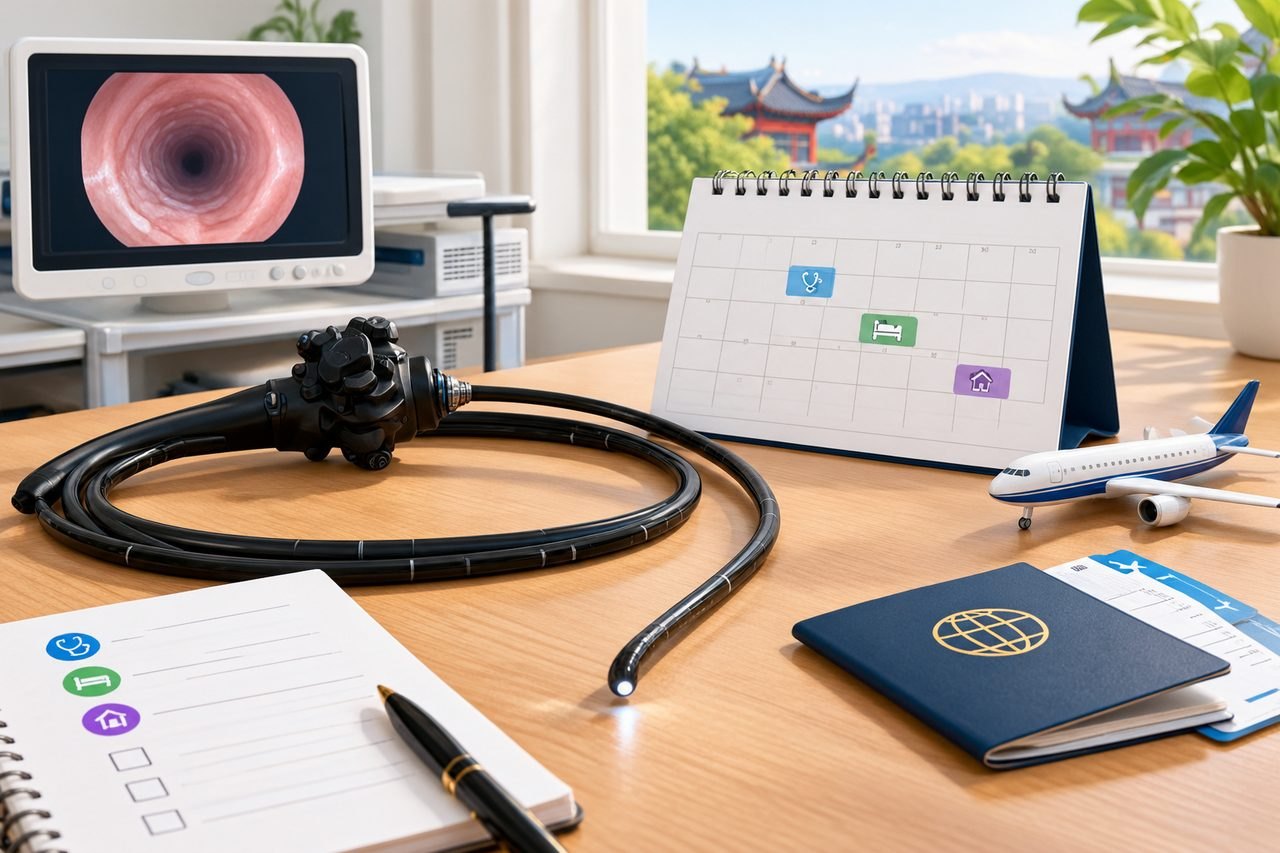
Separate the decisions that can be made remotely from those that cannot
POEM is an endoscopic treatment that cuts the muscle at the lower end of the esophagus; it is used for achalasia, and suitability requires specialist assessment. That single sentence matters for travel planning because it tells you the treatment is not something you can book like a hotel room. The hospital has to decide whether POEM fits your case, and that decision depends on records and, in most pathways, an in-person assessment.
The practical split is this: a records-based opinion can happen while you are still at home. A treating team can look at your manometry, endoscopy, barium swallow and symptom history and tell you whether POEM is worth considering. What it cannot do is confirm that you will be accepted for the procedure, that a specific date is available, or that no further tests are needed. Those are clinical and scheduling decisions that belong to the hospital.
So the first travel-affecting appointment is not the procedure. It is the point at which the hospital moves from 'we have reviewed your records' to 'we have assessed you and listed you for POEM.' Until that happens, any flight you book is a bet, not a plan.
The pre-procedure assessment is the appointment that usually sets your arrival date
For an overseas patient, the pre-procedure assessment is often the first in-person clinical step. It may include a repeat of some tests, a review of your swallowing function, anesthesia assessment, and a conversation about alternatives such as pneumatic dilation or Heller myotomy. The hospital may also want to confirm that your diagnosis is achalasia and not a condition that mimics it.
This appointment affects travel because it determines whether you proceed. If the team decides POEM is not suitable, you may need a different treatment or no procedure at all. If they decide it is suitable, they may still need additional tests before scheduling. Ask the hospital directly: which tests must be done in China, which can be done at home, and how long the gap is between assessment and procedure for their service. Do not assume a standard gap; it varies by hospital, clinician and case.
You should also ask whether the assessment and the procedure can be planned in one trip or whether the hospital requires a separate visit. Some centers combine them; others do not. This is a hospital-specific administrative and clinical question, not a China-wide rule.
- Ask: does the hospital require an in-person assessment before confirming a POEM date?
- Ask: which tests must be repeated in China, and which records are accepted from your home hospital?
- Ask: if POEM is not suitable, what alternatives would the team consider?
- Ask: can assessment and procedure be scheduled in one trip for your case?
The procedure itself and the discharge check both affect when you can fly home
POEM is performed under sedation or anesthesia, and the hospital will have its own rules about observation after the procedure. You should not plan your return flight until the treating team confirms you are fit to travel. That confirmation is a clinical decision, not a logistics one, and it depends on how you recover, what you are eating or drinking, and whether any complication is suspected.
The discharge check is the appointment that most directly affects your departure date. Before you book a return flight, ask the hospital what their discharge process involves, whether a follow-up visit is required before you leave China, and what instructions you will receive about diet, medication and activity. Do not rely on a general recovery timeline from another country or another patient.
If you are travelling with a companion, ask whether the hospital requires an escort for transport after sedation. This is a safety instruction from the treating team, not a travel preference. Plan for the possibility that your discharge date may shift.
What to prepare before you ask for appointment dates
The quality of the hospital's response depends on the records you send. For achalasia and POEM assessment, useful records typically include your manometry report, endoscopy report and images, barium swallow study, pathology if any, and a clear summary of your symptoms and previous treatments. If you have had prior dilation or surgery, include those records too.
You do not need to send a complete medical archive at first contact. A short summary with the key reports is enough for the hospital to tell you what else they need. Ask how they prefer to receive records, whether they need translated copies, and whether they accept imaging on disc or via a secure link.
One practical point: do not book flights or accommodation until the hospital has confirmed that your records are sufficient for an assessment and has given you a provisional appointment window. A provisional window is not a confirmed procedure date. Keep your bookings flexible until the clinical steps are clear.
- Manometry report and tracing
- Endoscopy report and images
- Barium swallow study
- Symptom summary and prior treatments
- Pathology reports if available
Questions that change your next step
The answers to a few specific questions determine whether you can plan a single trip or need to prepare for more than one. Ask the hospital's international office or treating team directly, and get the answers in writing where possible.
If the hospital says a records-based opinion is enough to proceed to scheduling, your next step is to confirm the assessment date and the procedure date together. If they say an in-person assessment is required first, your next step is to plan for that visit and keep the procedure date open. If they say more records are needed, your next step is to obtain those records before making any travel commitment.
For POEM specifically, also ask what follow-up is recommended after you return home, and whether the hospital can communicate with your local gastroenterologist. This affects how you plan the weeks after travel, not just the trip itself.
- Does the hospital require an in-person assessment before confirming POEM?
- Can assessment and procedure be done in one trip?
- What tests must be repeated in China?
- What discharge and follow-up appointments are required before I can fly home?
- Will the hospital provide a written summary for my doctor at home?
Practical contingencies for an overseas POEM trip
Even with good planning, clinical schedules can change. A test may need repeating, a procedure slot may move, or the team may decide that more assessment is needed. Build flexibility into your travel: choose changeable tickets where possible, keep accommodation cancellable, and avoid tight connections or fixed commitments immediately after your planned discharge.
If you are travelling from a different time zone, ask the hospital whether any appointments require you to be fasting or to adjust medications, and follow their instructions rather than a general rule. Do not stop or change any prescribed medication without the treating clinician's direction.
Finally, keep the purpose of the trip clear. POEM is a treatment for achalasia, not a treatment for every cause of swallowing difficulty, and it does not replace the need for a proper diagnosis. The hospital decides suitability. Your job in planning is to give them the records they need, ask the questions that affect dates, and keep your travel arrangements adjustable until the clinical steps are confirmed.
Sources & scope of this guide
References and official service information relevant to this guide.
This is general planning information and has not been individually reviewed by a doctor. Medical decisions and personal treatment advice come from your treating clinicians.