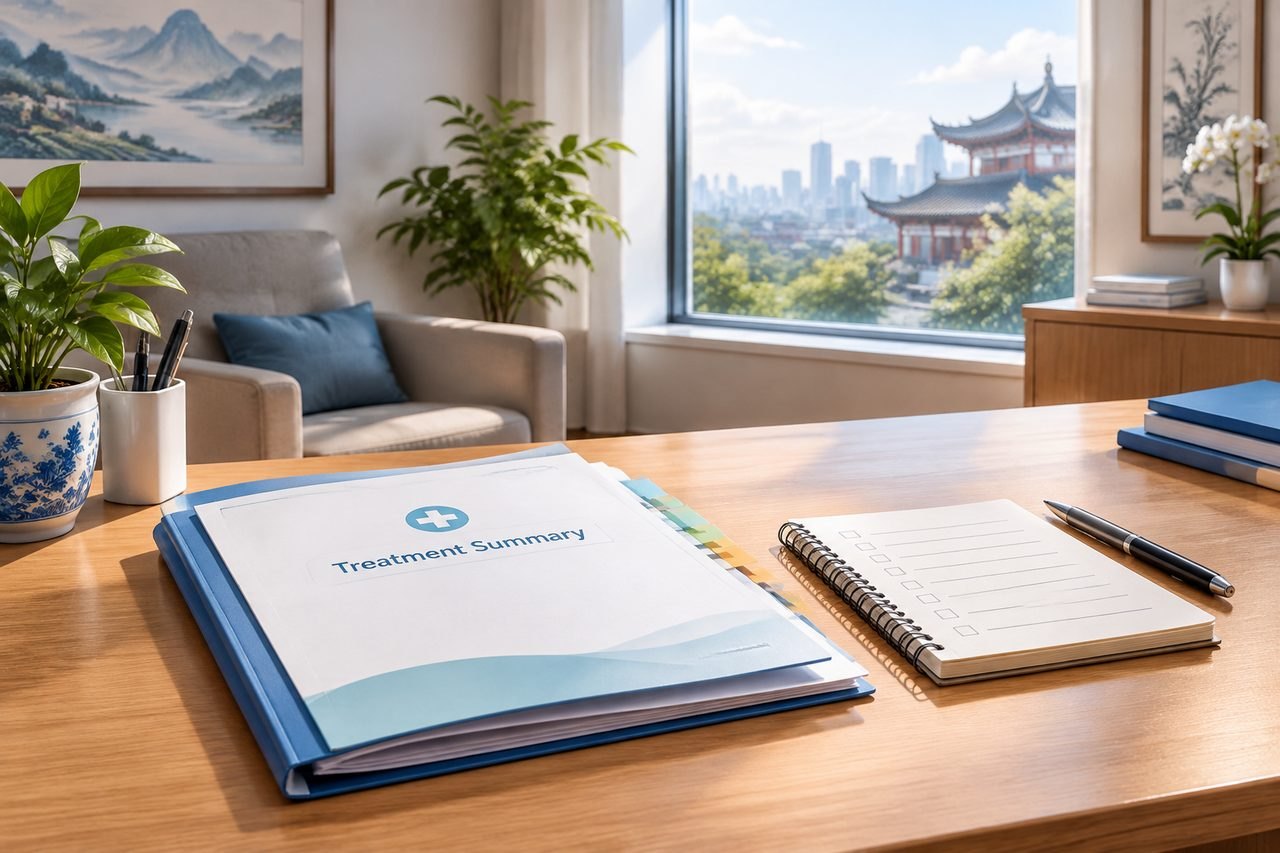
What a treatment summary is, and what it is not
A treatment summary is a short clinical document prepared by the team that delivered your care. It records the diagnosis or reason for treatment, the main procedures or therapies received, the dates, the treating clinician or department, medicines at the point of discharge or completion, and any outstanding tests, referrals or follow-up instructions. It is written for another clinician to read, not as a patient diary or a discharge letter you write yourself.
It is not a new diagnosis, a second opinion, or a substitute for your original records. A post-treatment health review in China uses the summary as an index: it tells the reviewing team where to look and what to ask. The receiving clinician still needs the underlying reports, imaging, pathology and laboratory results to form a view. If those are missing, the summary alone may not be enough to plan a review.
It is also not a fixed format. Hospitals and clinics organise summaries differently. One may be a one-page letter; another may be a structured discharge document with sections for procedures, medicines and follow-up. What matters is that the content is legible, dated, attributed to a named clinician or department, and written in a language the receiving team can use. If the original summary is in a language other than English or Chinese, ask whether a certified translation is needed before you send it.
Why the summary changes what a review can answer
Without a treatment summary, a post-treatment review becomes a general checkup. The reviewing clinician sees a patient with a history but no clear timeline, no confirmed list of what was done, and no indication of what the original team was monitoring. That makes it difficult to decide which tests are relevant, which results need comparison, and which questions belong to the original treating team rather than the reviewer.
With a summary, the review can be scoped. The clinician can see whether the question is about recovery from a specific procedure, surveillance after a treated condition, management of a long-term medicine, or simply a routine health check after treatment has finished. Each of those leads to a different conversation. A summary also helps the receiving team identify what they cannot assess remotely and what they would need to see in person.
The summary also protects you from repeating tests unnecessarily. If the original team already documented a recent result, the reviewer can ask whether it is still current or whether a repeat is needed. That decision belongs to the treating clinician, not to a coordinator or a website. Your job is to make the summary available and to state your main question clearly.
What to ask the original treating team to include
When you request a treatment summary, ask for the elements that a reviewing clinician would look for. The exact list depends on your condition and treatment, so treat the following as a prompt for your request, not a universal checklist. Confirm with the issuing team what they can provide.
Ask for the diagnosis or reason for treatment, the dates of admission and discharge or the dates treatment started and finished, the names of the main procedures or therapies, and the treating department or clinician. Ask for the medicines you were on at the end of treatment, including doses and any planned stop dates. Ask for outstanding results, pending referrals, and any follow-up instructions the original team gave you.
Ask for the summary to be signed or attributed to a named clinician or department, and for a contact point if the receiving team needs clarification. If the summary refers to other documents, ask for those to be listed by name and date so the receiving team can request them. A summary that says 'see imaging' without identifying which scan and when is harder to use.
If the original team cannot issue a full summary, ask what they can provide instead: a discharge letter, a clinic note, a procedure report, or a medication list. A partial document is still useful if it is dated and attributed. The receiving team can then tell you what else they need.
How to send the summary and what to say
Send the summary with a short covering message that states your main question. For example: 'I completed treatment for [condition] in [month, year]. I would like a post-treatment health review to discuss [specific concern]. I have attached the treatment summary and can provide the underlying reports on request.' This gives the receiving team a clear reason to look at the document.
Do not send a complete medical archive in the first message. A brief summary and your main question are enough for an initial enquiry. If the provider needs more, they will ask. This keeps the first contact manageable and avoids sending sensitive documents before you know who will receive them.
If you are working with a coordination service, ask how records are shared after first contact. A responsible service will explain what it needs, how it stores documents, and who will see them. It should not ask for passport numbers, card details or a full archive at the enquiry stage. If you are contacting a hospital directly, ask for the international office or the relevant department and confirm the preferred format for records.
Keep a copy of everything you send. Note the date you sent it and to whom. If the review is arranged, bring the original summary and the underlying reports with you, even if you have already sent them electronically.
What the summary does not decide
A treatment summary does not determine whether a review is appropriate, which tests are needed, or whether a particular hospital will accept you. Those decisions belong to the treating clinician and the hospital. The summary is an input, not an instruction. A clinician may read it and decide that a different document is more relevant, or that an in-person assessment is needed before any plan can be made.
It also does not transfer responsibility. The original treating team remains responsible for the accuracy of the summary and for clarifying anything that is unclear. The reviewing team is responsible for deciding what, if anything, they can assess from the records and what requires a visit. If the two teams need to speak, that is a clinical conversation, not something a patient or coordinator should arrange without the clinicians' agreement.
Finally, a summary does not guarantee that a review will find something new or that it will change your care. A post-treatment review may confirm that you are on track, or it may identify a question that needs further assessment. Both outcomes are useful. The point of sending the summary is to make the review specific rather than generic.
Practical next step
Start by requesting a treatment summary from the team that delivered your care. Ask for it to be dated, attributed and written in a language the receiving team can use. Then decide what you want the review to address. If you are considering a post-treatment health review in China, you can send a brief summary and your main question through the enquiry form, email or WhatsApp. An initial enquiry is free and does not require buying a proxy consultation. The hospital decides whether a review is suitable and what records it needs.
If you want to understand how routine health checkups are organised in China, including how base packages and add-ons are confirmed, the health checkup packages page explains the general approach. Use it alongside your treatment summary, not instead of it.
Sources & scope of this guide
References and official service information relevant to this guide.
This is general planning information and has not been individually reviewed by a doctor. Medical decisions and personal treatment advice come from your treating clinicians.